


Wheat is getting cheaper, while bread is getting more expensive: what is happening to prices in Ukraine
Kyiv • UNN
In the Danube ports, wheat costs $145–150 per tonne, while global prices are falling due to negotiations and forecasts of larger harvests. Ukraine’s exports have declined, but bread could become 6–10% more expensive by the end of the year.

Global wheat prices are declining amid expectations of agreements on shipping security in the Black Sea and improved forecasts for the global harvest. At the same time, Ukrainian farmers are facing export restrictions, expensive transportation, and low purchase prices.
How much does a tonne of wheat currently cost, how does international politics affect the grain market, and should Ukrainians expect bread prices to fall? UNN explains.
Details
The global wheat market has come under pressure from several factors at once: diplomatic talks on the Russian-Ukrainian war, an expected increase in grain production, and growing global stocks. One of the main factors determining traders' behavior remains the security situation in the Black Sea, through which a significant share of Ukrainian and Russian wheat exports has traditionally been shipped.
According to analysts at GrainTrade, as of November 18, purchase prices for Ukrainian food-grade wheat at Danube ports fell by $5 per tonne. Global exchanges are showing divergent trends: U.S. quotations are falling, while European prices are receiving support from export demand. The situation is complicated by the fact that declining global prices are not necessarily accompanied by similar changes in Ukraine's domestic market. For farmers, the decisive factors remain logistics costs, the ability to ship grain, and demand from exporters.
How much wheat costs in Ukraine in November 2026
As of November 18, purchase prices for food-grade wheat at Ukrainian Danube ports stood at $145–150 per tonne, or approximately 7,400–7,800 hryvnias. Feed wheat, used mainly for animal feed, was purchased at $130–140, or 7,000–7,200 hryvnias per tonne. At the same time, in the Romanian port of Constanța, demand for Ukrainian food-grade wheat remained at $245–250 per tonne, while demand for feed wheat was around $230.
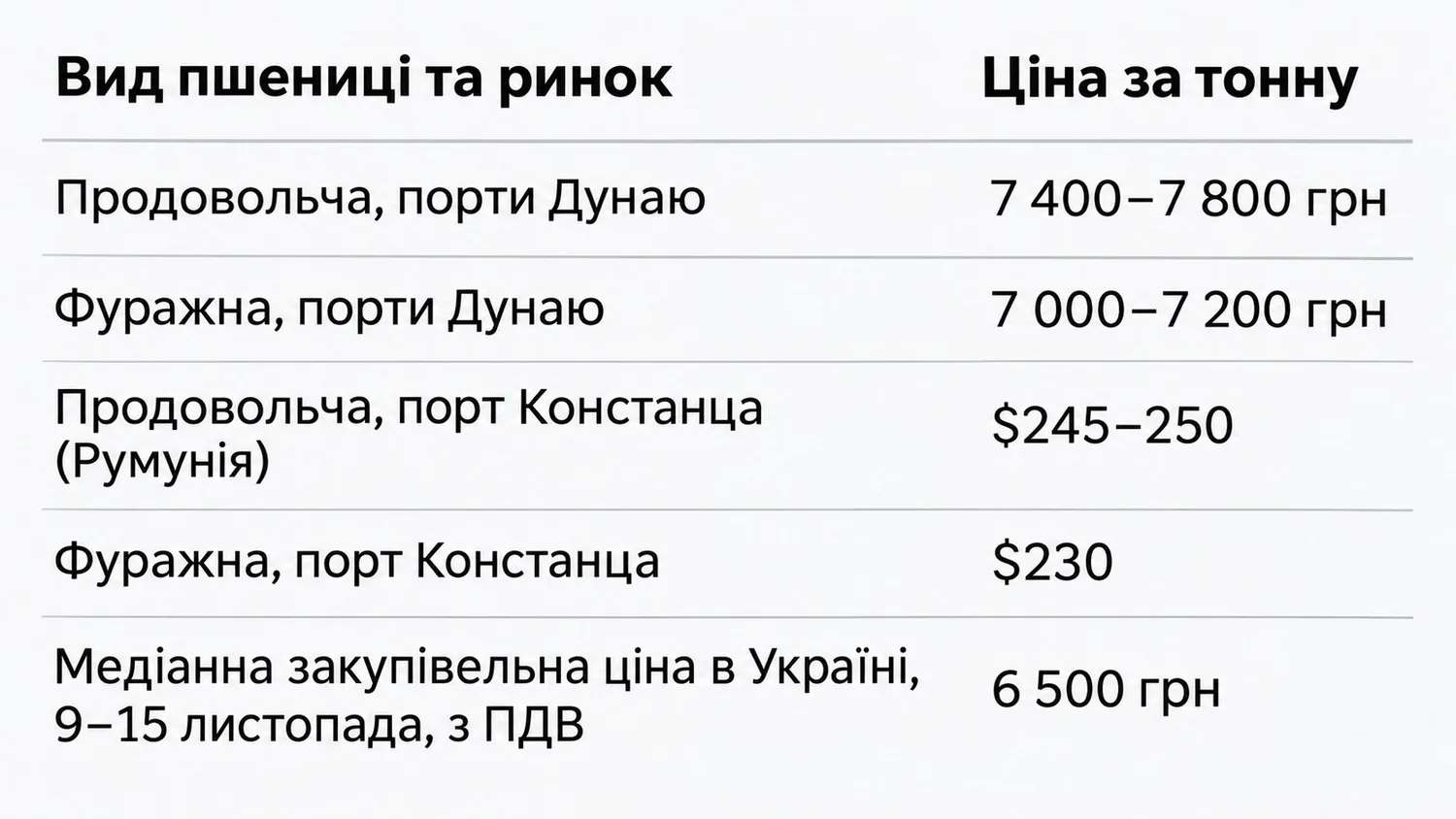
Analysts explain such a significant difference between prices at the ports, in particular, by rising sea-transport costs, shipping risks, and vessel delays.
The situation in the domestic market is somewhat different. According to the Ukrainian Universal Exchange, average indicative wheat prices even showed moderate growth from November 9 to 15. In particular, the average price of second-class wheat was 5,767.46 hryvnias per tonne, 3.92% higher than the previous week. Third-class wheat rose by 2.37% to 5,219.93 hryvnias, while fourth-class wheat increased by 2.71% to 5,113.10 hryvnias.
In addition, according to the Harvest Agro Purchase Index, the median demand price for wheat, calculated including VAT, amounted to 6,500 hryvnias per tonne from November 9 to 15. At the same time, domestic purchase prices and the cost of grain at the ports should not be equated, as they are formed under different delivery terms and take different logistics costs into account.
Despite the local price increase, Ukrainian producers are in no hurry to sell their harvest. Analysts note low trading activity and a limited pool of buyers. Therefore, some farmers continue to store their grain, hoping for an improvement in the price situation.
How negotiations between the U.S., Ukraine, and Russia are affecting the grain market
One of the main factors behind the decline in global quotations was the expectation of diplomatic progress on shipping security in the Black Sea. As Bloomberg reported, on November 16, wheat futures on the Chicago Mercantile Exchange fell by approximately 1% amid hopes for possible agreements between Ukraine, the U.S., and Russia.
Last week, delegations from the three countries held talks in Abu Dhabi, during which the issue of Black Sea regional security was raised. However, no significant progress was made toward restoring stable shipping. Meanwhile, participants in the grain market are taking into account the possibility of new international agreements that could reduce risks for commercial vessels and facilitate grain exports.
The mechanism by which diplomacy affects prices is fairly simple. If the security situation in the Black Sea improves, Ukraine and Russia could potentially increase grain supply volumes. The resulting increase in supply on the global market would, in turn, create additional pressure on prices. At the same time, traders respond not only to decisions that have been made but also to expectations of future agreements. Therefore, even reports of possible progress in the negotiations can affect exchange quotations.
At the same time, the absence of real security guarantees, continued attacks on port infrastructure and merchant vessels could quickly change the situation and trigger a reverse increase in prices.
What is happening to grain prices on global exchanges
According to information from UkrAgroConsult, following trading on November 16, December wheat futures on the Chicago Board of Trade (CBOT) fell by 1.05% to $215.68 per tonne. In Kansas City, hard red winter wheat fell to $227.44 per tonne. An additional factor was the strengthening of the US dollar, which reached its highest level since April 2025. A stronger US currency makes US grain more expensive for foreign buyers and weakens the competitiveness of American exporters.
By contrast, on the Euronext exchange in Paris, December wheat contracts rose by 3.7% over the week, to €235.25 per tonne. European quotations were supported by stronger export demand and the weakening of the euro against the dollar.
As we can see, despite the overall pressure on the grain market, prices in different regions are changing unevenly. Currency fluctuations, competition among exporters, importer demand and geopolitical risks are of decisive importance.
Why Ukrainian wheat exports have declined significantly
One of the biggest problems for Ukraine's grain market remains the decline in exports.
According to GrainTrade, during the first 16 days of November, Ukraine exported 383,000 tonnes of wheat. For comparison, during the same period in 2025, the figure was 857,000 tonnes. In other words, shipment volumes fell by approximately 55%.
Since the beginning of the 2026/2027 marketing year, total Ukrainian wheat exports have amounted to 4.157 million tonnes, compared with 7.09 million tonnes a year earlier. This means a decline of approximately 41%. The main buyers of Ukrainian wheat in November were Algeria, which imported 98,400 tonnes, Spain — 47,800 tonnes, and Egypt — 46,600 tonnes.
Limited export opportunities lead to the accumulation of grain inside the country. Accordingly, producers are forced to compete for limited demand, while buyers gain the opportunity to offer lower purchase prices. Logistics costs create additional pressure. Attacks on ports and vessels, transport delays and increased insurance risks raise exporters' expenses. Under such conditions, even relatively high global prices do not guarantee Ukrainian producers corresponding revenues, since a significant portion of potential profits may be absorbed by the cost of delivering grain to foreign buyers.
Russian attacks remain a threat to global food security
Despite diplomatic expectations, the security situation for shipping in the Black Sea remains tense. On November 16, the cargo vessel BETUL 8 sank off the coast of Bulgaria while carrying approximately 3,000 tonnes of wheat from Romania to Egypt. Reuters reported, citing sources in the maritime security sector, that the vessel may have been hit by a maritime drone. The crew of 12 Turkish nationals was rescued. The incident demonstrated that risks to grain transportation persist even near the coast of NATO countries.
For his part, Ukrainian Foreign Minister Andrii Sybiha emphasized on November 16 the threats to global food security resulting from Russian attacks. According to him, more than 1,600 Ukrainian port infrastructure facilities have been damaged as a result of Russian aggression, while more than 260 civilian vessels have been hit.
The Ukrainian side emphasizes that ensuring the security of the Black Sea is important not only for the Ukrainian economy but also for countries that depend on food imports. Further instability in shipping could intensify fluctuations in global grain prices and create additional risks for countries in Africa and the Middle East.
The global harvest is growing: why this matters for grain prices
Another powerful factor influencing the market was the updated forecasts from the United States Department of Agriculture (USDA). In its November report, the agency raised its estimate of global wheat production in the 2026/2027 marketing year from 822.39 million tonnes to 827.51 million tonnes. The forecast for global ending stocks also increased, from 276.04 million tonnes to 280.82 million tonnes.
The improvement in the figures is related, in particular, to the increased expected harvests in Argentina, Australia, and Ukraine. For Ukraine, the USDA raised its wheat production forecast from 26 million tonnes to 26.5 million tonnes. At the same time, the export estimate was lowered from 12.5 million tonnes to 11.5 million tonnes. The forecast for Ukraine's ending wheat stocks increased from 6.1 million tonnes to 7.3 million tonnes.
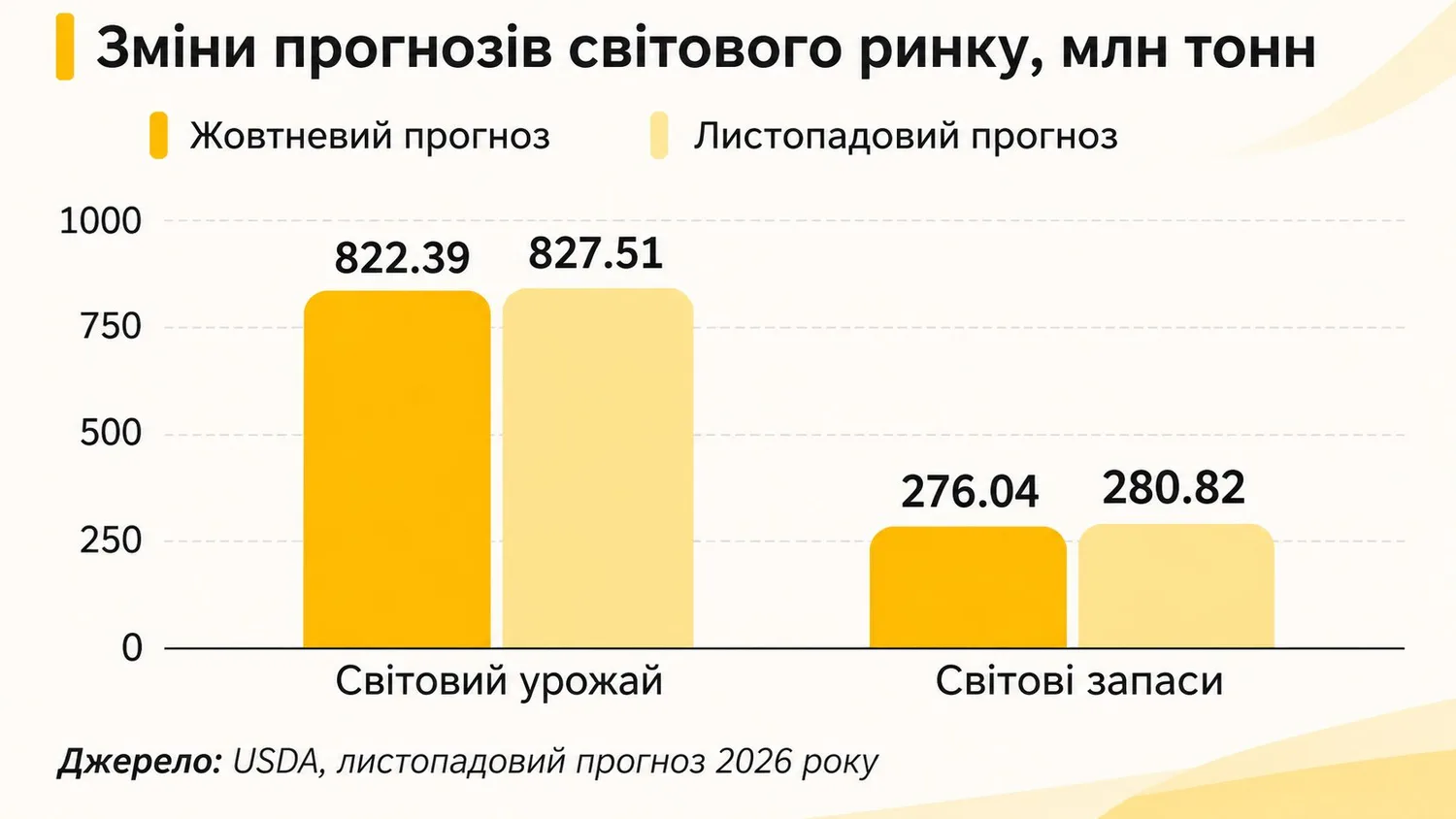
This indicates that Ukraine may produce more grain than previously expected, but selling it on foreign markets will be more difficult.
Meanwhile, globally, increased production and stocks are creating more favorable conditions for importers. Buyers can choose among a larger number of suppliers and also postpone purchases in anticipation of further price declines.
Will bread become cheaper in Ukraine in the near future
Despite the decline in some wheat purchase prices, Ukrainians should not yet expect a corresponding reduction in bread prices. The reason is that the cost of grain is only part of the expenses involved in producing finished goods. Bakeries have to pay for electricity, gas, fuel, transportation, employee salaries, and other production needs. Due to Russian attacks on energy infrastructure, the use of generators and alternative sources of electricity supply has become an additional financial burden.
Deputy Chairman of the All-Ukrainian Agrarian Council Denys Marchuk previously predicted that by the end of 2026, bread in Ukraine could become another 6–10% more expensive. In his assessment, even with an adequate supply of wheat, the rising cost of other components will continue to put pressure on final prices for consumers.
What will happen to wheat prices by the end of the year
The further situation on the grain market will depend on several key factors: the results of international negotiations, the safety of shipping in the Black Sea, logistics costs, and the size of the global harvest. If diplomatic agreements help reduce risks for commercial vessels and ensure more stable grain supplies, global quotations may come under additional pressure due to the expected increase in supply.
For Ukrainian farmers, such a scenario would have mixed consequences. On the one hand, lower global prices could limit revenues from product sales. On the other hand, the restoration of safe logistics would allow grain exports to increase, reduce transportation costs, and decrease excess supply on the domestic market. If attacks on port infrastructure and vessels continue, exports will remain limited, and Ukrainian producers will continue to depend on expensive alternative routes.
Projected high harvests in Australia, Argentina, and other exporting countries will create additional pressure on global prices.
In addition, global traders are already factoring in a possible improvement in the situation in the Black Sea, while Ukrainian farmers continue to work amid real wartime risks. And how much Ukrainian wheat will cost at the end of 2026 and at the beginning of the next season will depend largely on whether diplomatic negotiations turn into concrete security guarantees.
Reminder
Earlier, UNN reported that wheat fell in price to an 11-week low amid negotiations concerning the war in Ukraine.