










A blow to Putin’s digital empire: what the loss of Yandex data centers will mean
Kyiv • UNN
Following the FP-1 attacks, three of Yandex’s supercomputers stopped working, causing disruptions to services and risks for thousands of companies. Experts predict mounting pressure on Russia’s economy and digital infrastructure.

Ukrainian strikes on the data centers of Russia’s "Yandex" may have consequences far more serious than temporary disruptions to the search engine, taxi, or other popular services. The stability of companies using cloud infrastructure, as well as certain digital tools used by the Russian war machine, has been jeopardized. UNN, together with experts, examined how significant the consequences of the strikes on "Yandex" will be for russia.
Three of "Yandex’s" supercomputers have stopped working: what is known about the strikes
Ukrainian long-range FP-1 drones attacked the data centers of the Russian company "Yandex", which housed powerful computing systems used, in particular, to develop artificial intelligence technologies.
On the night of October 8, the Defense Forces of Ukraine struck a data center in Sasovo (Ryazan region), where two of the company’s three supercomputers, "Chervonenkis" and "Lyapunov," were located; on October 9, a large data center in the Kaluga region was attacked; and on the night of October 11, the third "Yandex" supercomputer, "Galushkin," in the city of Vladimir was hit.
According to investigations by Russian opposition media, dictator vladimir putin may own a stake in "Yandex" through his proxies. Thus, the company is under the control of the kremlin.
President Volodymyr Zelenskyy explained that the strikes on Russia’s digital infrastructure were a response to similar Russian attacks on Ukrainian data centers.
What consequences are already being felt by Russians
Launched in 2000, "Yandex" has long since evolved into an entire ecosystem combining taxi, delivery, mapping, online commerce, data storage, cloud computing, and artificial intelligence services, and even has its own payment system. For example, Yandex Cloud is a platform for hosting information systems, processing data, and managing business processes.
After the Ukrainian strikes, all three of the company "Yandex’s" major supercomputers stopped working. Russians are reporting disruptions to "Yandex.Go," "Yandex.Pay," "Yandex.Music," "Kinopoisk," "Yandex.Eats," "Yandex.Lavka," and "Home with Alice" on social media.
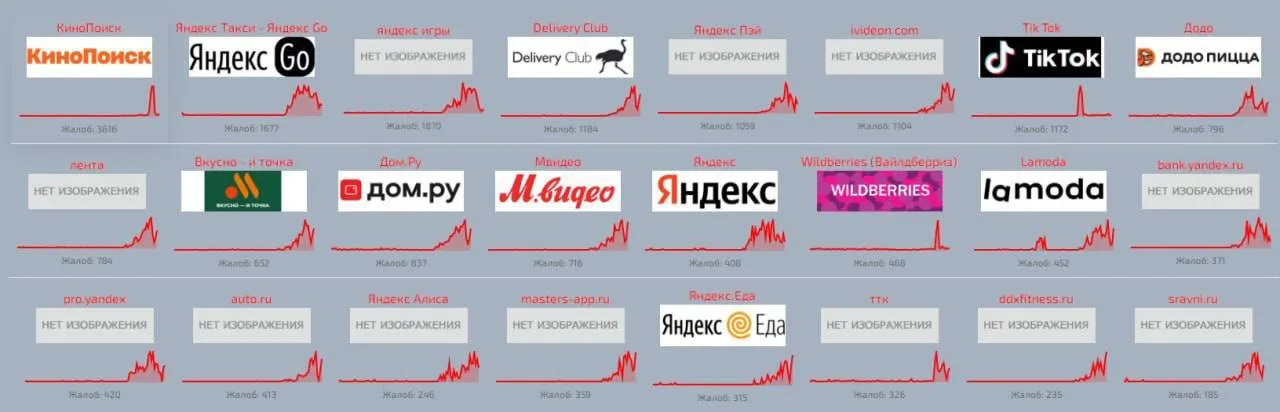
Users are reporting problems ordering taxis, having food delivered, paying for purchases, using electronic maps, and watching films. The real-time movement of public transport has stopped being displayed on "Yandex.Maps," and the electric scooter rental service is not working.
Moreover, platforms such as those operated by "Yandex" may host companies and systems involved in transmitting television content. Therefore, disruptions to the operation of this infrastructure could potentially affect not only internet services but also the delivery of signals to some television channels.
According to IT expert Oleksandr Hlushchenko, the destruction or serious damage of a data center causes a certain segment of digital infrastructure to go offline, and specific services operating on that site begin to degrade. At the same time, Hlushchenko notes that Russian infrastructure was not prepared for a full-scale war and systematic strikes on such facilities. At the same time, he says, the kremlin has long been conditioning Russians to accept that the internet may disappear.
They shut down mobile internet, test so-called white lists, and constantly increase the number of banned resources and services. Therefore, if an average Russian’s "Yandex.Food" is not working, they may not even be surprised: their mobile internet is not working either. In this sense, the kremlin is effectively preparing the population for digital restrictions
A welcome bonus following the strikes on data centers in russia was a decline in the activity of Russian bots on social media, recorded not only in Ukraine but also in Europe, particularly in Poland. According to social media users, the number of posts inciting hostility between Ukrainians and Poles decreased significantly there.
Thousands of Russian companies under threat
Large data centers power many digital systems, and disruption to their operations would have a chain reaction for businesses, Russian state institutions, and even the military machine. According to local media reports, the outage affecting Yandex has already been felt by companies in Russia, Kazakhstan, Kyrgyzstan, Uzbekistan, Belarus, and Armenia.
If the operation of such infrastructure is disrupted, the consequences can extend far beyond the technology company itself. These are major economic losses
Oleksandr Hlushchenko draws attention to one of the main vulnerabilities of Russia’s digital system. Unlike Ukraine’s, Russia’s IT infrastructure is centralized.
First, two can play this game. Second, Russia’s telecommunications infrastructure is physically much larger than Ukraine’s, because Russia is a large country with enormous distances. Therefore, its data centers and communications channels are located in different regions. At the same time, the Russian internet segment, particularly in terms of data hosting and the provision of digital services, is largely centralized and monopolized. And finally, Russian companies do not always have somewhere to quickly move their data and computing capacity
According to experts, even the availability of backup capacity does not guarantee uninterrupted operation after strikes on major data centers. Transferring the load to other locations can cause delays, overloads, and degraded service performance. There is also a risk of information loss if clients have not created backups.
If Yandex has backups of its own data at other sites, it can restore them. But if a client stored its data in only one location and did not make backups, the consequences could be much more serious. In that case, some of the information could be lost forever
It is important that even the temporary unavailability of digital resources can cost businesses money due to halted operations, disrupted logistics, and the need to restore infrastructure.
The economic impact of the strikes on Yandex
Economic expert Ihor Harbaruk suggests viewing attacks on data centers in the context of a strategy to weaken the Russian economy.
I would describe this strategy as a strategy of a thousand jabs. You cannot kill a person with one jab, but when there are a thousand of them, their cumulative effect can be entirely different. The same applies to war: a single strike on an oil refinery, logistics facility, or data center will not necessarily lead to a strategic turning point. But when such strikes accumulate, they create systemic pressure on the enemy’s economy and infrastructure
According to him, it is currently difficult to assess the specific losses from any particular strike on facilities in Russia.
However, the general logic is clear: when the operation of major digital platforms is disrupted, this potentially affects trade, logistics, and the services sector. Similar dependencies exist for other major companies, including Wildberries and Ozon. And that means taxes—and, accordingly, money for the war
The actual financial losses will depend on the cost of the damaged equipment, the duration of the downtime, restoration expenses, and possible customer attrition. Modern data centers require servers, graphics accelerators, cooling systems, power supply systems, and high-speed network components. In the case of supercomputers, the requirements are even higher. According to experts, alternative import channels, such as China, may only partially compensate for the shortage and do not guarantee the rapid acquisition of equipment.
If companies using Yandex services have to spend additionally on backups, data migration, and the purchase of servers, this will increase operating costs and may affect tax revenues to the Russian budget.
Cybersecurity specialist Kostiantyn Korsun does not rule out problems in the banking system in the event of large-scale and prolonged disruptions to Yandex’s operation.
In a certain scenario, such disruptions could also affect economically important systems, including banking services. If people began to face widespread inability to use financial services, this could heighten public anxiety and negatively affect economic activity. However, speaking of an inevitable banking or economy-wide collapse solely on the basis of strikes on data centers would be premature
Will the Russian army be affected by the loss of Yandex supercomputers?
Military expert Oleksandr Kovalenko notes that for the military, the ability to navigate terrain, obtain information about topography and landscape, determine the elevations of various objects, and analyze the characteristics of an area is particularly important. Russians use all this data when planning and carrying out military tasks.
The Russian army is largely dependent on civilian digital infrastructure, and in this context, Yandex plays an important role. The company is one of the key providers of digital services and software tools in Russia, which can be used by both government agencies and the military. This involves a wide range of tasks – from record-keeping and data processing to cartography, navigation, geolocation, and computing resources. Above all, these are geodata, cloud computing, and navigation technologies
For example, the Russian military uses Yandex Maps to obtain cartographic information. Kovalenko recalled that some Russian units had even publicly demonstrated their use of the service, and in 2025 the Russian military prosecutor’s office went to court seeking restrictions on servicemen’s publication of materials revealing the use of Yandex Maps.

The Russians use Yandex Cloud to work with large volumes of information, conduct analysis, and develop software solutions. According to Kovalenko, if such tools are involved in military projects, they could potentially support various processes – from processing intelligence data to operating artificial intelligence systems.
Let us imagine a situation: a servicemember has information about the terrain, topographical features, the location of certain objects, and the movement of the enemy. They need to process this data, compare it, and make a decision. Various digital tools, mapping services, and computing systems may be used for this. If artificial intelligence is involved in such a process, it also requires appropriate computing capacity. That is why I view strikes on data centers not only as economic or social pressure on Russia, but also as an issue that could potentially have military significance
Cybersecurity specialist Kostiantyn Korsun adds that a significant part of the Russian war machine’s activities related to data processing, the operation of websites and servers, and other digital processes depends on ordinary internet infrastructure. At the same time, encryption, traffic anonymization, and other protective measures are used.
As for the direct impact of strikes on data centers on the situation at the front, it will most likely be significantly smaller than we would like. I would even say that this impact could be minimal. Certain consequences are possible for rear headquarters located far from the line of contact and actively using the regular internet for their work. But the situation directly on the front line is different
This is because the Russians have virtually no internet connection on the front line, so the use of services such as Yandex Maps is limited.
But this does not mean that such strikes are entirely pointless. Their potential effect should be considered more broadly – in the context of the economy, digital infrastructure, and the dependence of Russian businesses on major technology platforms
Can the strikes increase pressure on the Kremlin?
Experts interviewed by UNN agree that Ukrainian strikes on Russian facilities have a cumulative effect and will gradually weaken Russia’s economy and its technological capabilities.
This does not mean that a single strike will automatically cause a logistical collapse. But if such losses become systematic, their cumulative effect may be much more tangible. This is precisely the point of gradually weakening the key nodes of the Russian economy
Clearly, the more of Russia’s critically important technological facilities are put out of operation and the more difficult they are to restore, the more costly the war against Ukraine becomes for the Russian economy.