









A reduction in reserving could hit critical enterprises: businesses and lawmakers warn of risks and call for dialogue
Kyiv • UNN
Lawmakers warn of corruption risks and micromanagement due to the new reserving rules.

A possible tightening of the rules for reserving conscription-eligible employees could create additional risks for Ukrainian businesses, the defense industry, and critical infrastructure. Business community representatives and members of parliament warn that reducing quotas and revising the criticality criteria could lead to the loss of qualified personnel, delays in the operation of enterprises, and additional bureaucracy, UNN writes.
Earlier, Member of Parliament Yaroslav Zhelezniak reported that the Cabinet of Ministers was preparing changes to the procedure for reserving conscription-eligible employees. The draft provides for a new approach to calculating the number of reserved employees and a revision of the criteria for the critical importance of businesses. In particular, it proposes setting the maximum reservation limit for defense-industrial complex and energy enterprises at 85% instead of 100%, while for heat-supply companies, water utilities, and household waste management enterprises, it would be reduced from 75% to 60%. The draft also provides for the establishment of a Coordination Center under the Cabinet of Ministers, which would have the authority to issue recommendations on granting and revoking the status of critically important enterprises.
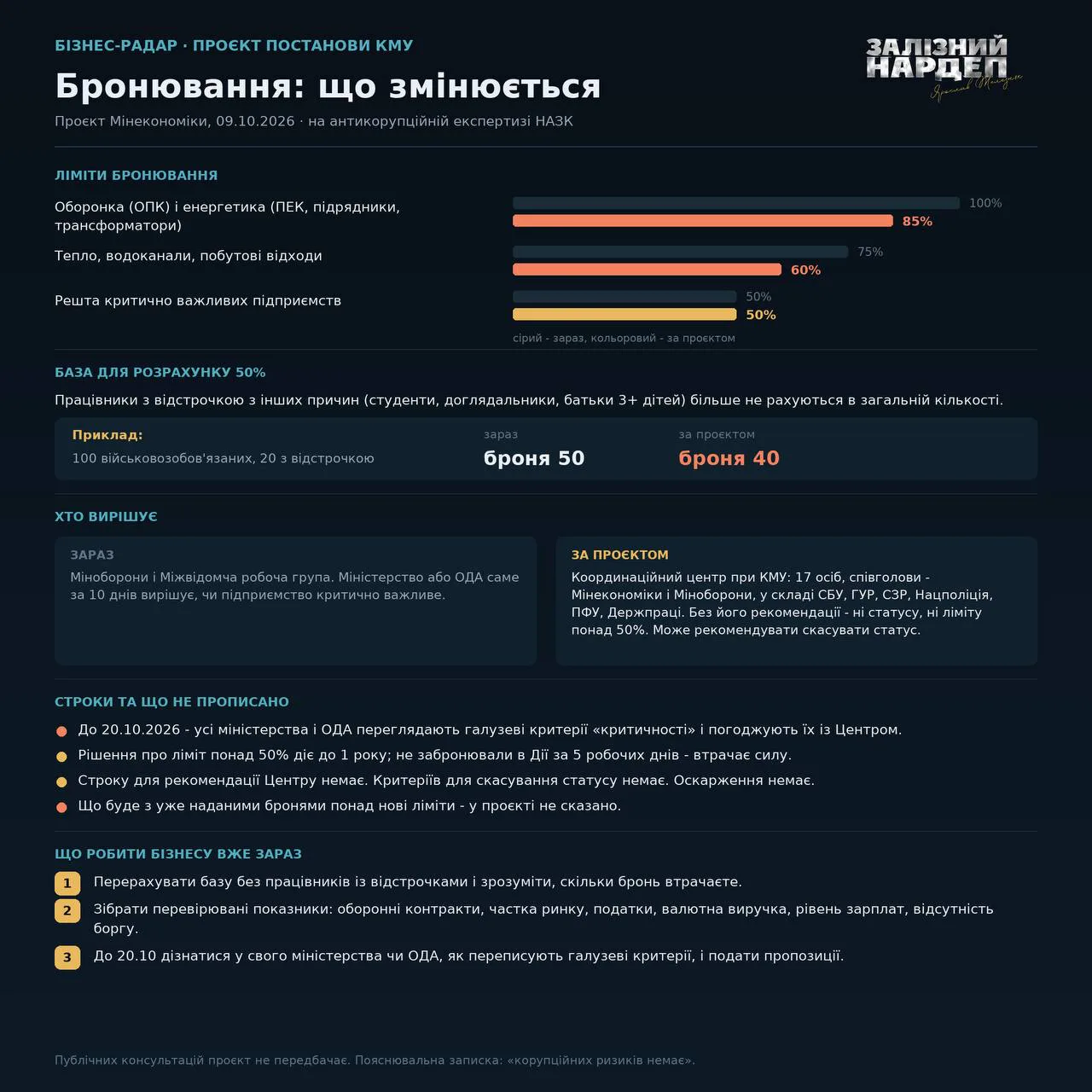
Source: Yaroslav Zhelezniak’s Telegram channel.
Businesses warn of the risk of losing key employees
The European Business Association expressed concern over information about a possible tightening of restrictions on reservations. The business community emphasizes that Ukrainian enterprises are already operating amid constant security threats, damage to energy infrastructure, disruptions in electricity and water supplies, a shortage of qualified personnel, and rising operating costs.
Under such circumstances, any risk of losing key personnel will negatively affect the continuity of production processes and, ultimately, the fulfillment of contractual obligations, the generation of tax revenues, and the overall resilience of the national economy. Businesses fully understand the needs of Ukraine’s defense forces and the absolute priority of protecting the state. At the same time, it is also important to strike a balance between the needs of the economy and ensuring defense capabilities
The association recalled that, by September 1, critically important enterprises were already required to extend the validity of their status or obtain it again in accordance with the government’s updated requirements. Therefore, another revision of the rules without proper discussions with businesses could increase uncertainty for companies that have already adapted to the new criteria.
In this regard, the European Business Association calls on the government to ensure an open dialogue with the business community before adopting any possible changes, publish the relevant proposals for discussion, and assess their potential impact on the activities of enterprises and the economy as a whole. The European Business Association is ready to join such a dialogue and submit consolidated proposals from its member companies to develop balanced solutions
Members of parliament warned against additional bureaucracy and corruption risks
Member of Parliament and member of the Verkhovna Rada Committee on National Security, Defense and Intelligence Iryna Friz believes that establishing a Coordination Center for organizing the reservation of conscription-eligible employees under the Cabinet of Ministers could lead to additional bureaucracy and corruption risks.
According to her, critical infrastructure enterprises, defense-industrial complex manufacturers, and utility services are already suffering significant losses due to Russian shelling and often face staff shortages. Under such conditions, the possibility of comprehensive reservations helps ensure the stability of their operations.
No one is explaining to either society or the relevant committee how the Cabinet of Ministers plans to produce the necessary quantity of weapons, restore the energy system and heat supply after shelling. All other enterprises are being placed in a situation where the existing digital system will be dismantled, and they will have to obtain critical status through the so-called Coordination Center—a group of individuals, government representatives and security officials—which creates opportunities for corruption and backroom dealing
She called on the Cabinet of Ministers to hold a professional discussion on the advisability of changing the criticality criteria and creating additional bureaucracy before adopting the relevant resolution.
Another member of the Verkhovna Rada Committee on National Security, Defense and Intelligence, Oleksandr Fedienko, warned of the negative consequences of the new reservation rules.
According to him, the draft provides that employees who already have deferments on other lawful grounds will not be included in the total number of persons liable for military service, from which an enterprise’s reservation quota is determined. These include, in particular, students, parents of three or more children, and people who have a deferment because they care for other persons.
A situation may now arise in which employers could dismiss employees if they stop providing quotas for other employees. This is called the cascading effect. A potentially dangerous logic emerges: an employee with their own deferment does not increase an enterprise’s quota; their presence on the staff does not help reserve other employees; an employer seeking to retain the maximum number of reserved employees may begin to view such people as disadvantageous for its staffing structure
Member of Parliament Dmytro Solomchuk also criticized the draft Cabinet resolution. In his opinion, the proposed restrictions could seriously harm enterprises that ensure the functioning of the economy and the livelihoods of communities.
What does the government propose? To reduce the reservation quota for municipal utility workers from 75% to 60%. On the eve of winter, when the enemy attacks our infrastructure every day! Who will repair heating networks and water pipelines and restore heat and water after shelling?
The lawmaker separately emphasized the possible consequences for small farms, producers and enterprises located near the front line. According to him, for a small farm, the loss of one or two machine operators could mean the disruption of sowing or harvesting, while for an enterprise operating under shelling, it could mean a complete halt to its activities.
In his opinion, the creation of a coordination center will give officials additional influence over whom to grant critical status to, how many people to allow to be reserved, and whose status to cancel, which could lead to manual control, delays in decision-making and corruption.
My position is that this draft resolution must be stopped and radically revised! The army needs people. But the army also needs weapons, fuel, equipment, supplies and a functioning economy. It is impossible to defend Ukraine while simultaneously weakening those who ensure its livelihood and defense!
Ombudsman emphasizes the need for clear rules
Dmytro Lubinets, the Verkhovna Rada Commissioner for Human Rights, also emphasizes that the review of the reservation mechanism must take into account defense needs, the uninterrupted operation of critical infrastructure and the protection of citizens’ labor rights.
According to him, the criteria for determining enterprises as critically important and the reservation quotas must be clear, justified and predictable so that state decisions do not create legal uncertainty for employees and employers.
At the same time, he reported that the draft amendments had not yet been submitted to the Office of the Ukrainian Ombudsman, and therefore it was too early to comment on it as an officially received document or draw conclusions. After receiving the relevant documents, the Office will review them and provide a legal assessment.
Ensuring the state's defense capability and protecting human rights are not mutually exclusive tasks. Measures aimed at strengthening defense must be implemented with strict adherence to the Constitution of Ukraine, international human rights standards, and the principle of proportionality
The Defense Ministry calls for maximum exemption from mobilization for the defense industry
Against the backdrop of discussions about a possible reduction in exemptions from mobilization, Defense Minister Yevhenii Khmara stated that the ministry supports granting maximum exemptions from mobilization to the human capital of the defense-industrial complex.
The position of the Ministry of Defense is to grant maximum exemptions from mobilization to the human capital of the defense industry. If enterprises are tasked with scaling up production of systems critical to the front and the state awards them contracts, it must create the conditions for fulfilling those contracts
At the same time, the minister noted that the exemption system should take into account an enterprise's actual contribution to supporting the Defense Forces and be fair.
What happens next
By October 20, 2026, ministries and regional state administrations must review the criteria under which enterprises receive critical-importance status. It is worth noting that the draft does not specify whether the new limits will affect exemptions from mobilization that enterprises have already arranged. Therefore, it is currently unknown whether companies will have to review existing exemptions after the possible adoption of the changes.
Reminder
As of September 1, 2026, Ukraine increased the salary requirement for employees exempted from mobilization to three minimum wages. In addition, employees working multiple jobs and persons with another deferment began to be counted at only one place of employment.