


Toyota lost 20% of its value, while Tesla plunged 38%: how the ranking of the most valuable automotive brands changed
Kyiv • UNN
Toyota retained its lead among automakers, but its value fell by 19.9%. Tesla lost 37.8%, while Ferrari, BYD and the Korean brands grew.

Despite Toyota retaining its lead in the annual Best Global Brands 2026 ranking, most leading automotive brands declined in value in 2026. Tesla suffered the biggest loss among automakers in the Interbrand ranking, while Ferrari, BYD and the Korean brands managed to increase their value. UNN explains who topped the ranking and why it is becoming increasingly difficult for the automotive industry to maintain its position.
Toyota remains the world's most valuable automotive brand
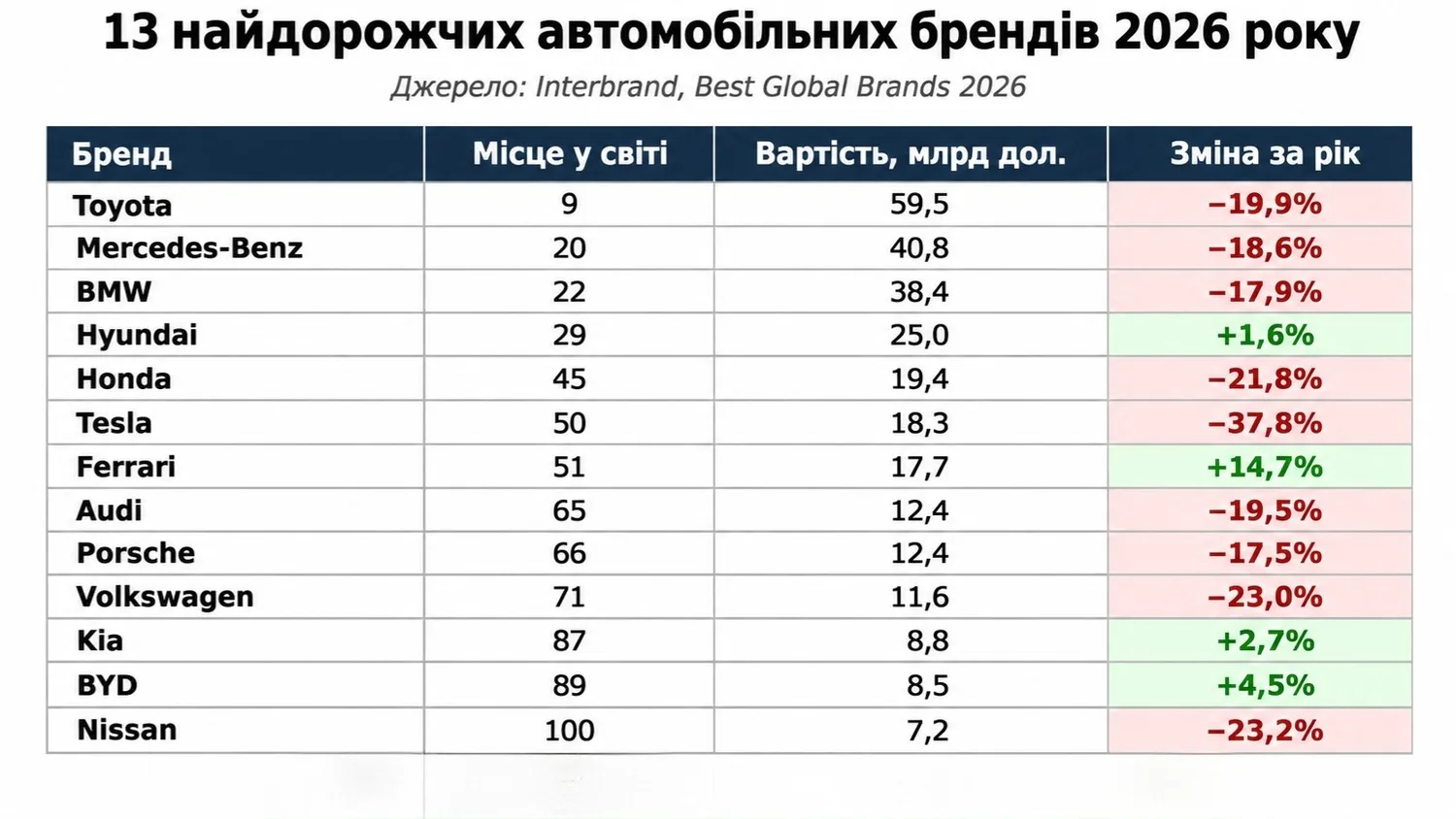
The annual Best Global Brands 2026 ranking, compiled by the international consulting company Interbrand, includes 13 automotive brands. Compared with 2025, nine of them declined in value, while only four showed growth. Overall, the automotive industry recorded the sharpest decline of all sectors.
Japan's Toyota retained first place among automakers with a valuation of $59.5 billion. In the global ranking, it is ninth, although it was sixth a year earlier. The brand's value fell by 19.9%, or $14.7 billion, from $74.2 billion in 2025.
Mercedes-Benz took second place in the automotive category. The German brand was valued at $40.8 billion, down 18.6% from last year. In the global ranking, it is in 20th place. BMW ranked third among automotive brands, with a valuation of $38.4 billion and a decline of 17.9%.
Toyota leads Mercedes-Benz by $18.7 billion in valuation and BMW by $21.1 billion. However, all three leaders lost around one-fifth of their value over the year.
Tesla lost 38% of its value: who else ended up among the laggards
The hardest hit was American Tesla: its brand was valued at $18.3 billion, compared with $29.5 billion in 2025. The decline amounted to 37.8%, or approximately $11.2 billion. Tesla fell 25 positions in the overall ranking, from 25th to 50th place, and now only slightly surpasses Ferrari. This is the second consecutive year in which its brand value has declined sharply: in 2025, the drop amounted to 35.2%.
Traditional brands also declined in value. Nissan lost 23.2% of its value, to $7.2 billion; Volkswagen fell 23%, to $11.6 billion; and Honda declined 21.8%, to $19.4 billion. Audi lost 19.5% of its value, while Porsche fell 17.5%. Both brands are now valued at the same $12.4 billion.
Ferrari, BYD and Hyundai: who managed to increase their value
Against the backdrop of the overall decline, Ferrari recorded the biggest increase. The Italian sports car manufacturer added 14.7%, reaching $17.7 billion. This places it 51st in the world, just one position below Tesla. The gap between the valuations of the two brands has narrowed to $600 million.
China's BYD added 4.5%, reaching $8.5 billion, and ranked 89th. South Korea's Kia grew 2.7%, to $8.8 billion, while Hyundai increased 1.6%, to $25 billion. Hyundai retained fourth place among automotive brands and 29th place worldwide.
Interbrand explains the relative success of Ferrari, BYD, Hyundai and Kia by their clearer positioning: consumers better understand how these brands differ from their competitors and why they should choose them. Ferrari's result shows that brand valuation is not reducible to the number of cars produced.
How much the 13 most valuable automotive brands are worth
It should be noted that Interbrand's methodology is based on three components: the financial performance of products and services sold under the brand, the role of the brand in the buyer's decision, and its competitive strength.
Why automotive brands are losing billions of dollars
Interbrand notes that it is becoming increasingly difficult for automakers to turn technological innovations into a compelling distinction from competitors. Electric vehicles, digital systems and new features are spreading rapidly across the market. Therefore, simply having advanced technologies does not guarantee that a buyer will prefer a particular brand.
Industry experts also identified the following risk factors: competition, changes in demand, pricing pressure and consumer trust. The competition is particularly intense in the electric vehicle market.
Who topped the overall ranking of the world's most valuable brands
Apple retained the top spot among all industries with a valuation of $514.6 billion. That is approximately 8.6 times more than Toyota’s brand value. Microsoft took second place with $443.7 billion, while Google ranked third with $389.3 billion. They were followed by Amazon at $351.8 billion and Samsung at $105.2 billion.
The total value of the brands in the global top 100 reached $3.866 trillion, increasing by 8.1% compared with last year. At the same time, the entertainment industry overtook the automotive industry to become the second-most valuable sector in the ranking. NVIDIA recorded the fastest growth of all companies, rising by 71.5% to $74 billion.
How the global automotive market is changing
The results for 2026 demonstrate a contrast: Toyota, Mercedes-Benz, and BMW remain the most valuable automotive brands, but all three suffered substantial declines in valuation. Tesla showed the weakest performance among the automotive participants in the ranking, while Ferrari, BYD, Hyundai, and Kia moved against the overall trend.
Therefore, going forward, manufacturers will have to avoid focusing exclusively on new technologies and convincingly explain the practical benefits of each technological change to buyers.
Let us recall
Earlier, we wrote that foreign automakers are losing ground in the Chinese market as consumers switch to domestic electric vehicles. Volkswagen, Mercedes-Benz, and other Western companies are facing declining sales, while Chinese brands are strengthening their positions.