









There is no need to destroy what works: the Aerospace Association warns of risks to the aviation industry due to changes to the reservation rules
Kyiv • UNN
Changes to the reservation rules could deprive the aviation industry of key specialists and derail defense contracts. Businesses are calling for the current rules to be preserved.

The changes proposed by the government to the rules for reserving conscripts and defining critically important enterprises could lead to the loss of qualified specialists, a reduction in production, and the failure to fulfill defense orders. Such decisions could be particularly dangerous for the aviation and aerospace industries, which are already operating amid closed airspace, a personnel shortage, and limited funding due to the full-scale war. Volodymyr Semenov, Director General of the Aerospace Association of Ukraine, said this in an exclusive comment to UNN.
Restrictions for critically important enterprises
On October 13, the Cabinet of Ministers of Ukraine considered amendments to Resolution No. 76, which regulates the procedure for reserving conscripted employees. According to media reports, during the meeting the government did not make a final decision on reducing reservation quotas for critically important enterprises.
The draft resolution proposed reducing the percentage quotas for reservations for enterprises in the defense-industrial complex and energy sector—from 100% to 85%, and for the utilities sector—from 75% to 60%. The relevant amendments are planned to be finalized within 5 days.
The document removed the provision excluding employees who have a deferment (students, parents of many children, and others) from the calculation.
The government decided to establish a Coordination Center involving the Security Service of Ukraine, the Main Intelligence Directorate, the Foreign Intelligence Service, and the National Police, with the relevant decision to be further finalized.
At the same time, business representatives pointed out that the proposed amendments had not been discussed with them, and businesses had received no official explanations regarding the decisions adopted.
The aviation industry risks losing specialists who cannot be quickly replaced
According to Volodymyr Semenov, Director General of the Aerospace Association of Ukraine, constant changes to the reservation procedure have already become a serious problem for enterprises, which are forced to spend resources not on developing production but on preserving their personnel potential.
Changes to the reservation rules will negatively affect not only the aviation industry but the entire defense-industrial complex of Ukraine. It is already difficult for enterprises to retain their people, while constant changes to the reservation rules create additional problems. Figuratively speaking, changes to the procedure for reserving employees take place every three months
He emphasized that staffing is particularly painful for aviation enterprises. Training qualified specialists in narrow fields in the aviation and aerospace industries takes years, while replacing an experienced engineer or designer within a short period is practically impossible.
It is impossible simply to snap your fingers and find a new qualified engineer, designer, or other narrow-field specialist. There are already very few such specialists left, and their training takes years
According to him, the existing reservation percentages should be maintained depending on the category of the enterprise. Today, critical enterprises have already been divided according to the relevant criteria, and specific working conditions have been established for them. The Aerospace Association sees no need to change the rules in a way that would deprive enterprises of the ability to retain the specialists they need.
Therefore, our main request is simple—there is no need to destroy what is already working. This is one of the basic principles of engineering and management. If the system allows enterprises to confirm their critical status and reserve the employees they need, it should be improved where this is truly necessary, rather than creating new problems for the industry
At the same time, the industry has already faced a reduction in the volume of civil air transportation, difficulties in production, and a shortage of qualified personnel because of the war. Airlines were forced to relocate their operations abroad and continue to contribute to the Ukrainian budget.
Speaking specifically about the aviation industry, the situation is already difficult. Aircraft are hardly flying at all or are flying very little, production remains an extremely complex process, and there is a shortage of qualified specialists. Against the backdrop of all these problems, enterprises are once again forced to adapt to new rules
In his view, another tightening of restrictions could deepen the personnel crisis and call into question the ability of some enterprises to continue operating.
Aviation and aerospace enterprises involved in fulfilling defense orders are particularly sensitive to such changes. The loss of even a small number of key specialists could disrupt production processes, delay the fulfillment of contracts, and affect the supply of necessary products for defense needs, warns the director general of the Aerospace Association.
Industry representatives are also particularly concerned about the tight deadlines being discussed for reviewing the sectoral criteria for criticality.
According to Semenov, enterprises may find themselves in a situation where delays in completing the new procedures create a risk of losing employee reservations.
Semenov warns that for the aviation industry, where a significant portion of production processes depends on highly specialized professionals, even temporary uncertainty regarding employee reservations could have long-term consequences.
We have already been working under wartime conditions for the fourth year, and enterprises are once again forced to prove their criticality. How many more times must we confirm what should have long been obvious? The industry needs stable rules, not the constant revision of procedures that are already working. Therefore, our position as the Aerospace Association is quite specific. First, it is necessary to preserve the current procedure for confirming the criticality of enterprises and reserving employees. If the mechanism works, there is no need to create additional obstacles and complicate it
Aviation enterprises may cease operations
In Volodymyr Semenov's opinion, the issue of employee reservations cannot be considered separately from the other difficulties facing the aviation industry. One of the most acute problems at present remains the lack of funding. According to him, the funds allocated for carrying out the relevant production tasks do not always arrive on time or in the necessary amounts.
As a result, enterprises are forced to address several problems simultaneously: fulfilling orders, finding working capital, retaining personnel, and undergoing new administrative procedures to preserve employee reservations.
We may be promised funding, for example, in December, but how is an enterprise supposed to produce goods until then? How can orders be fulfilled if there is insufficient working capital? Without funding, it is impossible to organize production steadily, purchase the necessary materials, and ensure the work of specialists
The combination of financial difficulties with the risk of losing qualified employees could jeopardize the continued operation of some enterprises.
If they are unable to retain key employees, ensure production, and obtain the necessary funding, the question will arise of how they can continue operating at all. In the worst-case scenario, enterprises may be forced to scale back their activities or cease operations altogether
At the same time, the consequences of such a development would extend far beyond individual companies. A reduction in the activities of aviation industry enterprises would mean the loss of jobs and production expertise, while the state would also lose tax revenues. For enterprises involved in defense production, an additional risk would be delays in fulfilling government orders.
In addition, additional pressure on Ukrainian aviation enterprises will complicate the recovery of civil aviation after the airspace is reopened. After all, returning the sector to full operation requires preserving not only aircraft and production facilities, but also the specialists capable of ensuring their operation, maintenance, and repair.
The government is introducing an additional approval level
Volodymyr Semenov is critical of the initiative to establish an additional approval body—the Coordination Center—whose powers and responsibility, in his opinion, remain insufficiently defined.
In fact, another level of approvals is emerging, on which the ability of enterprises to retain employee reservations will depend. At the same time, a question arises: who will be responsible for the consequences if, due to delays in approvals, an enterprise loses reservations for its specialists?
He explained that the Aerospace Association is already involved in communication with the Ministry of Defense. In particular, under the leadership of Deputy Defense Minister Hanna Hvozdiar, a platform for regular meetings with representatives of industry associations is operating and serves as a coordination center.
These meetings take place every week, and we are trying to convey our position to state authorities. But the problem is that even regular meetings do not guarantee that all business proposals will be heard and taken into account. It is very difficult for one association to achieve the necessary changes independently. A systematic dialogue is needed between the state, enterprises, and industry associations, within which business will not simply express its position but will also have the opportunity to influence decisions
According to him, the Aerospace Association will insist on participating in consultations with the authorities regarding changes to the reservation rules and the determination of critical status. After all, the loss of qualified employees may become irreversible for some enterprises, since restoring human-resource potential will require significantly more time than reducing it. This is especially dangerous at a time when enterprises are trying to preserve their production potential, fulfill defense orders, and prepare for the future resumption of civil flights.
The Verkhovna Rada is already ready to respond to the Cabinet resolution
Yaroslav Zhelezniak, First Deputy Chairman of the Verkhovna Rada Committee on Finance, Taxation and Customs Policy, said that he plans to submit to the Verkhovna Rada of Ukraine a draft resolution to repeal the Cabinet's decision.
"This morning I sent all members of parliament a draft resolution for signature regarding the government's latest decision on employee reservations. The draft recommends:
- repealing the Cabinet's decision of October 13;
- holding consultations with business;
- including representatives of business associations in the Coordination Center;
leaving this Center exclusively with an advisory function—with no right to adopt decisions binding on enterprises", – Zhelezniak reported.
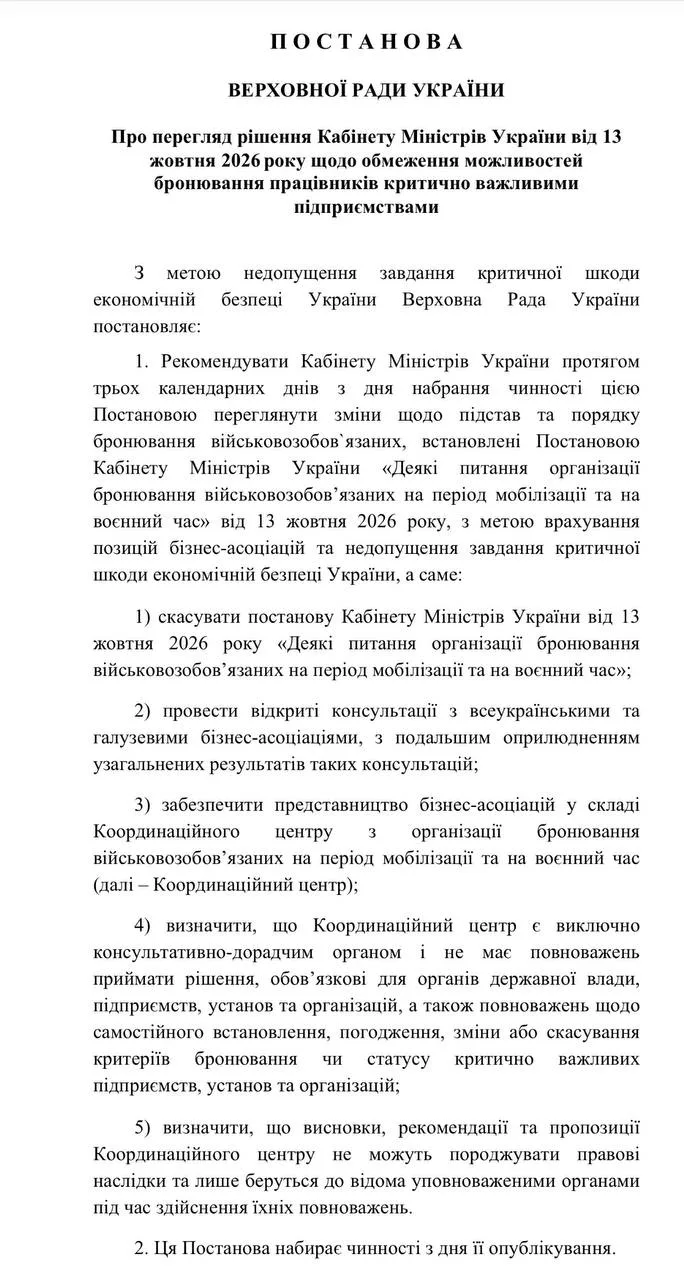
He noted that Parliament would hardly have time to consider this initiative during the current plenary week.
But tomorrow there will be Question Time with the Government. And the presence of dozens of members of parliament who support this position will clearly signal to the Government that the decision needs to be reconsidered