


More than half of tax revenues come from four industries: who contributes the most to Ukraine’s budget
Kyiv • UNN
Over the ten months of 2026, four industries paid UAH 177 billion more in taxes. Payments from the financial sector grew the fastest.

Over the ten months of 2026, just four sectors of the economy accounted for more than half of tax revenues to Ukraine’s Consolidated Budget. Manufacturing and trade companies paid the most. By contrast, tax payments grew fastest in the financial sector. Overall, compared with the same period last year, revenues from the four leading sectors increased by UAH 177 billion.
Which sectors became the main financial donors to the state budget in the outgoing year, how the structure of tax revenues changed over the year, and how much in duties Ukraine received overall is explained by UNN.
Who contributes the most to Ukraine’s budget
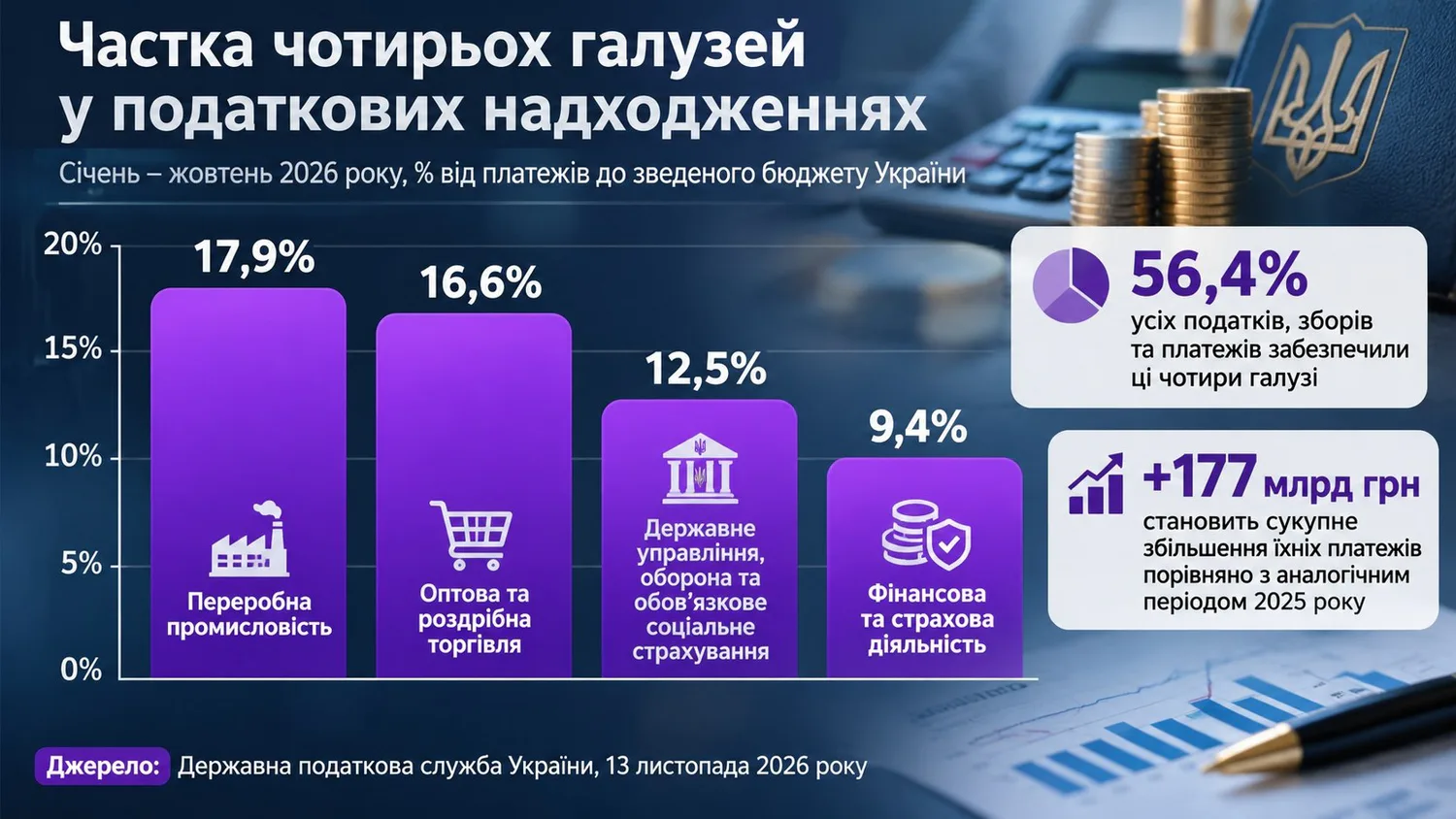
Manufacturing remains the largest source of tax revenues among the sectors of the economy. In the first ten months, its share amounted to 17.9% of all payments to the Consolidated Budget. This sector includes companies engaged in food production, metallurgy, mechanical engineering, the chemical industry, the manufacture of construction materials, and other products. In other words, they create finished products or process raw materials.
Wholesale and retail trade, including the repair of motor vehicles and motorcycles, ranks second. This sector accounts for 16.6% of tax revenues. Together, industry and trade provide 34.5% of all payments to the Consolidated Budget. That is, more than one-third of tax revenues is generated through the activities of these two sectors.
Public administration and defence and compulsory social security rank third. Their share is 12.5%. This category covers the activities of public administration bodies, defence, and the compulsory social security system.
Financial and insurance activities rank fourth, accounting for 9.4% of revenues. This sector includes, in particular, banking institutions, insurance companies, and other financial-market participants.
All other sectors of Ukraine’s economy together accounted for 43.6% of tax payments.
Taxes increased by UAH 177 billion: who delivered the largest increase
A comparison of the results for January–October 2026 with the same period in 2025 shows an increase in tax revenues across all four leading sectors.
Manufacturing demonstrated the largest increase in monetary terms. Companies in this sector paid UAH 52.8 billion more than last year. The increase amounted to 17.6%. Wholesale and retail trade ranked second. Tax payments by companies in this sector increased by UAH 45.1 billion, or 16%.
Public administration, defence and compulsory social security provided an additional UAH 39.6 billion. Compared with last year, the relevant revenues increased by 19.2%. Financial and insurance activities increased payments by UAH 39.5 billion. At the same time, this sector demonstrated the highest growth rate among the four sectors: 26.9%.
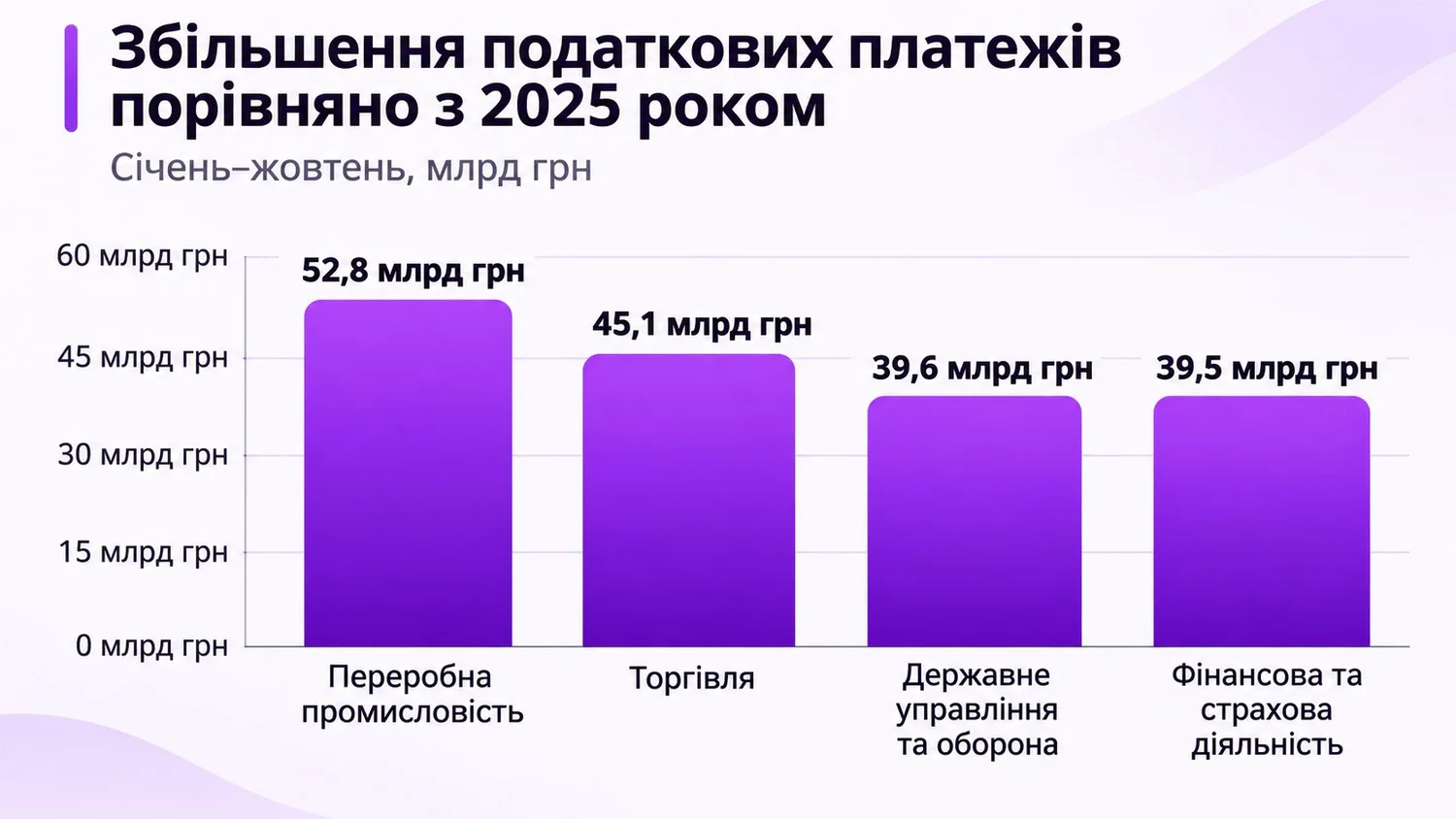
As we can see, although the financial sector ranks fourth by its share of total revenues, it outpaces industry, trade, and public administration in relative growth.
At the same time, manufacturing made the largest contribution to the increase in budget payments in hryvnias. Together, the four sectors generated UAH 177 billion more in revenues than in the corresponding period of 2025.
How the structure of tax revenues changed throughout the year
Data from the State Tax Service show that the list of the largest taxpayers by sector remains stable. At the same time, the shares of individual sectors are gradually changing.
According to the results for January–August, manufacturing accounted for 17.9% of revenues, trade for 16.3%, public administration and defence for 11.9%, and financial and insurance activities for 10.8%. After nine months, manufacturing’s share remained at 17.9%, while trade’s increased to 16.6% and public administration and defence’s to 12.3%. At the same time, the share of the financial sector decreased to 10.1%.
As of the end of the ten-month period, industry retained the lead, while the share of public administration and defense rose to 12.5%. Financial and insurance activities accounted for 9.4% of revenues.
The amount of additional payments from the four sectors also increased compared with the corresponding periods of 2025. Over eight months, the increase amounted to UAH 142.8 billion; over nine months, UAH 157.4 billion; and over ten months, it had already reached UAH 177 billion.
How much tax did Ukraine receive over ten months
According to operational data from the State Tax Service, in January–October 2026, UAH 1.101 trillion in taxes and fees administered by the tax service was paid into the general fund of the state budget. This is UAH 74.7 billion, or 7.3%, more than in the same period last year.
Positive dynamics were also recorded at the local level. Over ten months, community budgets received almost UAH 473.2 billion in taxes and fees. Compared with last year, revenues increased by UAH 69.9 billion, or 17.3%. The largest source of tax revenues for local budgets was personal income tax. It generated almost UAH 290 billion. The single tax provided another UAH 72.4 billion, while property tax accounted for UAH 55.6 billion.
According to the Ministry of Finance, overall, from January to October, UAH 2.71 trillion from all sources was received by the general fund of the state budget. This figure includes not only tax revenues but also other revenues, including international grant assistance.
Why tax revenues are increasing despite the war
The increase in tax payments is taking place amid a full-scale war, Russian attacks on manufacturing enterprises, energy infrastructure, and logistics facilities.
Several factors may influence revenue dynamics at the same time. These include changes in companies' turnover, the volume of sales of goods and services, prices, wages, as well as tax legislation and the administration of payments.
At the same time, it should be understood that an increase in taxes paid does not always mean a corresponding increase in production or companies' profits. For example, rising prices may increase the nominal value of products sold and the corresponding tax liabilities even without a significant increase in physical production volumes. Likewise, higher wages may affect personal income tax revenues.
Changes in tax payment deadlines and specifics of tax administration may also play a separate role. However, without detailed sectoral indicators, it is impossible to determine which particular factor ensured the largest increase in revenues. The State Tax Service emphasizes that Russian attacks on production facilities and logistics chains have a negative impact on economic activity. Despite this, taxpayers continue to fulfill their tax obligations.
Which sectors remain the foundation of budget revenues
The results for the ten-month period of 2026 show that the main sources of tax revenues among economic sectors remain manufacturing and trade. Together, they account for more than one-third of all payments to the consolidated budget. At the same time, revenues from public administration and defense are becoming more significant, while financial and insurance activities are demonstrating the highest growth rates among the four leading sectors.
Further dynamics will depend on the state of the economy, the ability of enterprises to operate amid the war, the restoration of damaged infrastructure, and changes in tax policy. Despite the difficult economic and security conditions, regular tax revenues remain one of the key domestic sources of funding for state needs, defense, social payments, and the operations of territorial communities.
Reminder
Earlier, we wrote about how many billions the budget received from the "Google tax".