










Where in Europe is it easier for university graduates to find employment - Euronews study
Kyiv • UNN
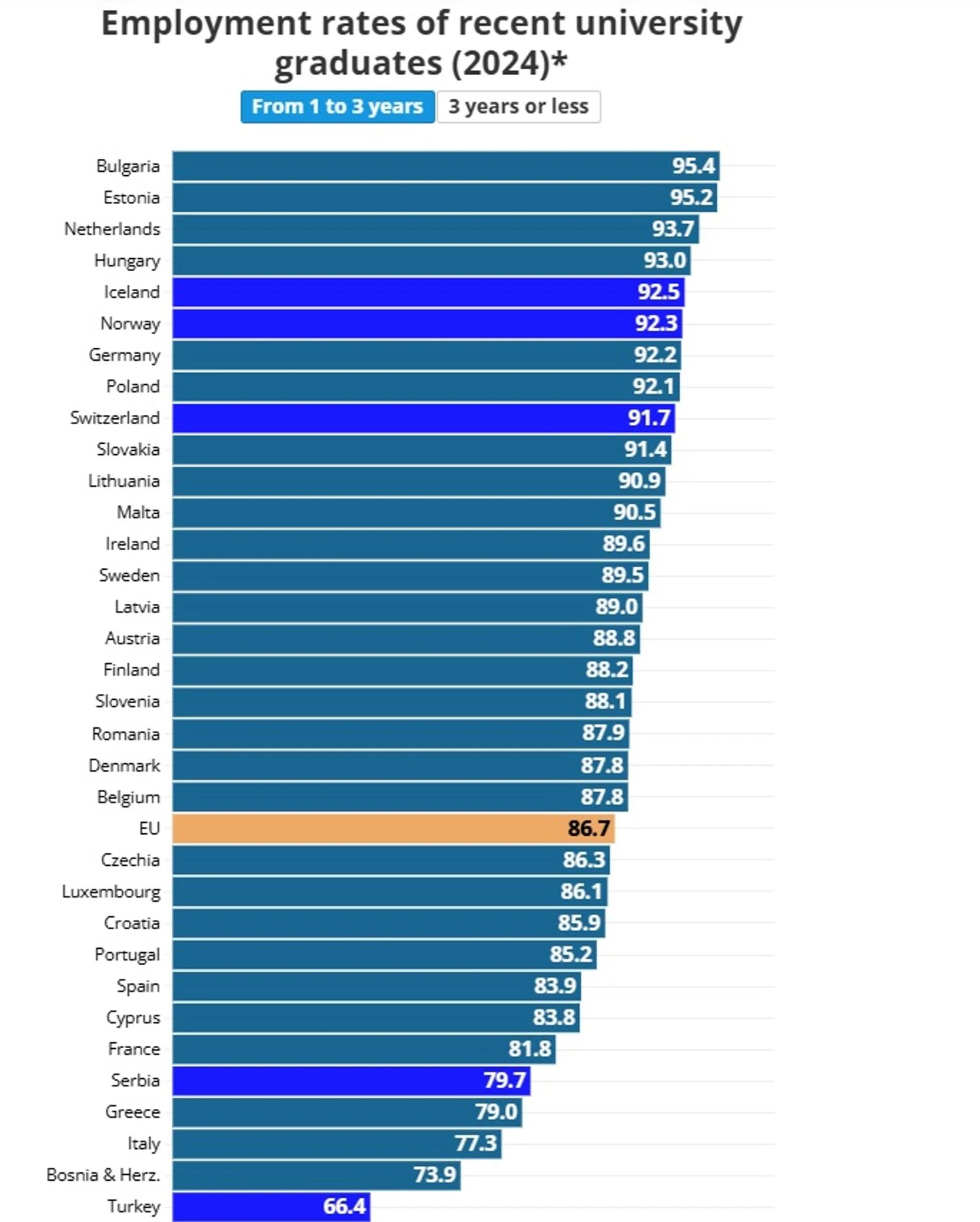
The employment rate of university graduates in Europe varies significantly. Bulgaria, Estonia, the Netherlands, Norway, Iceland, Germany, Hungary, and Poland have the highest employment rates among young graduates.

The employment rate of university graduates in Europe varies greatly depending on the country, and in most cases is associated with factors of the highest competition in recent decades.
This is stated in the Euronews Business material, reports UNN.
Details
For many recent graduates in Europe, finding a job can take a long time. According to the Institute of Student Employers (ISE), based on observations over the past three decades, what is currently being observed can be considered the highest level of competition.
At the same time, a high level of education still provides advantages in job searching. This also affects higher lifetime earnings.
Data from the Institute of Student Employers (ISE) as an example. In the UK, for approximately 17,000 vacancies in 2024, employers received over 1.2 million applications. According to calculations, this is an average of 140 applications for each vacancy.
Employment rate among young university graduates in Europe
Almost 85% of higher education graduates in the EU in 2024 were employed. This refers to individuals aged 20 to 34 who completed their studies within the last three years and are not currently in education or training.
Euronews reports that the employment rate of recent university graduates varies greatly across Europe:
- among EU member states, the lowest indicator is in Greece – 72.7%;
- Turkey also occupies the lower ranks of the overall rating, having the highest "labor market slack rate" in Europe – in the second quarter of 2025, it reached 25.8%;
- Northern and Central European countries show a much higher employment rate;
- among the countries of Southern and Southeastern Europe, Bulgaria holds a leading position, while others significantly lag behind.
In total, in eight European countries, the employment rate of recent higher education graduates exceeds 90%. These include: Bulgaria (93.7%), Estonia (93.6%), Netherlands (92.7%), Norway (92.3%), Iceland (92.0%), Germany (91.9%), Hungary and Poland (90.5% each).
Recall
UNN analyzed the cost of studying at ten leading foreign universities where Ukrainians can obtain higher education. The review includes universities in the Netherlands, Germany, Great Britain, Switzerland, Poland, the Czech Republic, Latvia, Lithuania, Austria, and Ireland.