










Sowing Campaign 2026 in Ukraine: How Fuel, Fertilizers, and Personnel Shape the New Cost of Harvest
Kyiv • UNN
The 2026 sowing campaign in Ukraine will become more expensive due to rising fuel prices, fertilizer shortages, personnel deficits, and energy supply problems. This will affect the cost of the future harvest and the financial condition of farmers.

This year's sowing campaign will be more expensive, experts warn. Possible re-sowing entails additional costs for seeds and work, rising fuel prices and a shortage of certain types of fertilizers increase the cost of resources, staff shortages increase personnel costs, and problems with energy supply add to electricity and generator operating costs.
The sowing campaign in Ukraine in 2026 will start against the backdrop of a combination of resource and military risks that can affect both the pace of field work and the cost of the future harvest. Among the key factors, agrarians name a possible increase in fuel prices due to the escalation in the Middle East and risks to the logistics of imported energy carriers, especially during the peak load period in regions where work begins earlier.
A separate problem remains the provision of mineral fertilizers. The market remains tense due to reduced domestic production and more complex import logistics, and additional restrictions apply to certain items. In particular, agrarians record a shortage of ammonium nitrate for early spring fertilization, and large-scale sea imports are limited for security reasons.
Weather conditions also add uncertainty: uneven snow cover and temperature fluctuations increase risks for winter crops, and in some regions, waterlogging and flooding of fields become a problem, complicating the assessment of crop conditions and decisions regarding possible re-sowing. In parallel, the agricultural sector operates in conditions of personnel shortages due to mobilization and limited booking opportunities, which can affect the ability of farms to perform work within optimal agricultural terms.
UNN journalists spoke with Pavlo Koval, CEO of the Ukrainian Agrarian Confederation, about the main trends of this year's sowing campaign.
Sowing-2026 in current figures
According to data from the Ministry of Economy, Environment and Agriculture of Ukraine, the winter crop for the 2026 harvest was mainly formed in the autumn of 2025. According to official operational information from the Ministry of Economy, Environment and Agriculture of Ukraine as of November 28, 2025, 6,429.9 thousand hectares of winter crops were sown, including 4,692.8 thousand hectares of winter wheat, 586.1 thousand hectares of winter barley, 66.3 thousand hectares of winter rye, and 1,084.7 thousand hectares of winter rapeseed.
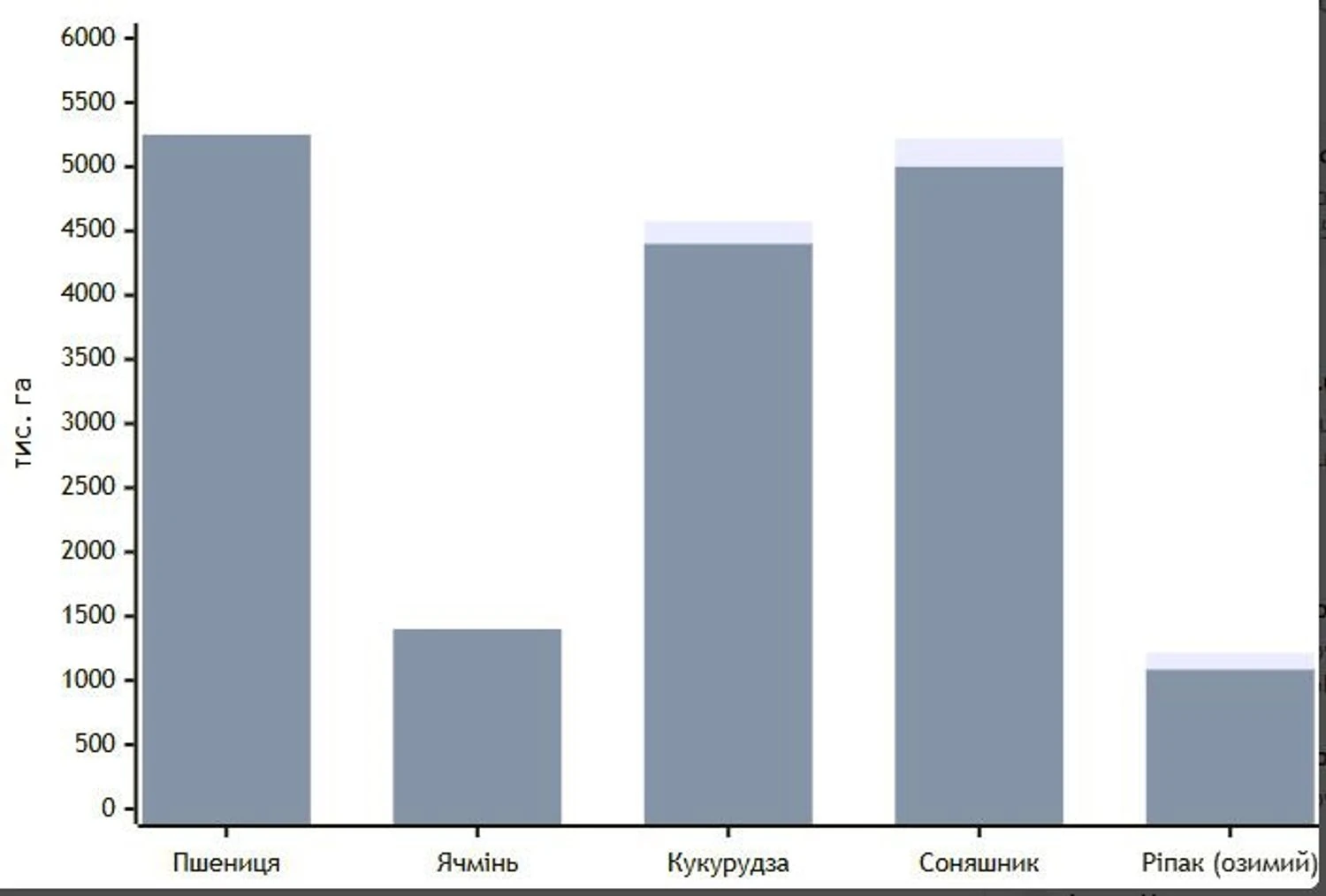
If we rely on the current and forecast data published by the State Statistics Service, and information from the Ukrainian Grain Association, the current situation with crops as of March 2026 in Ukraine is as follows:
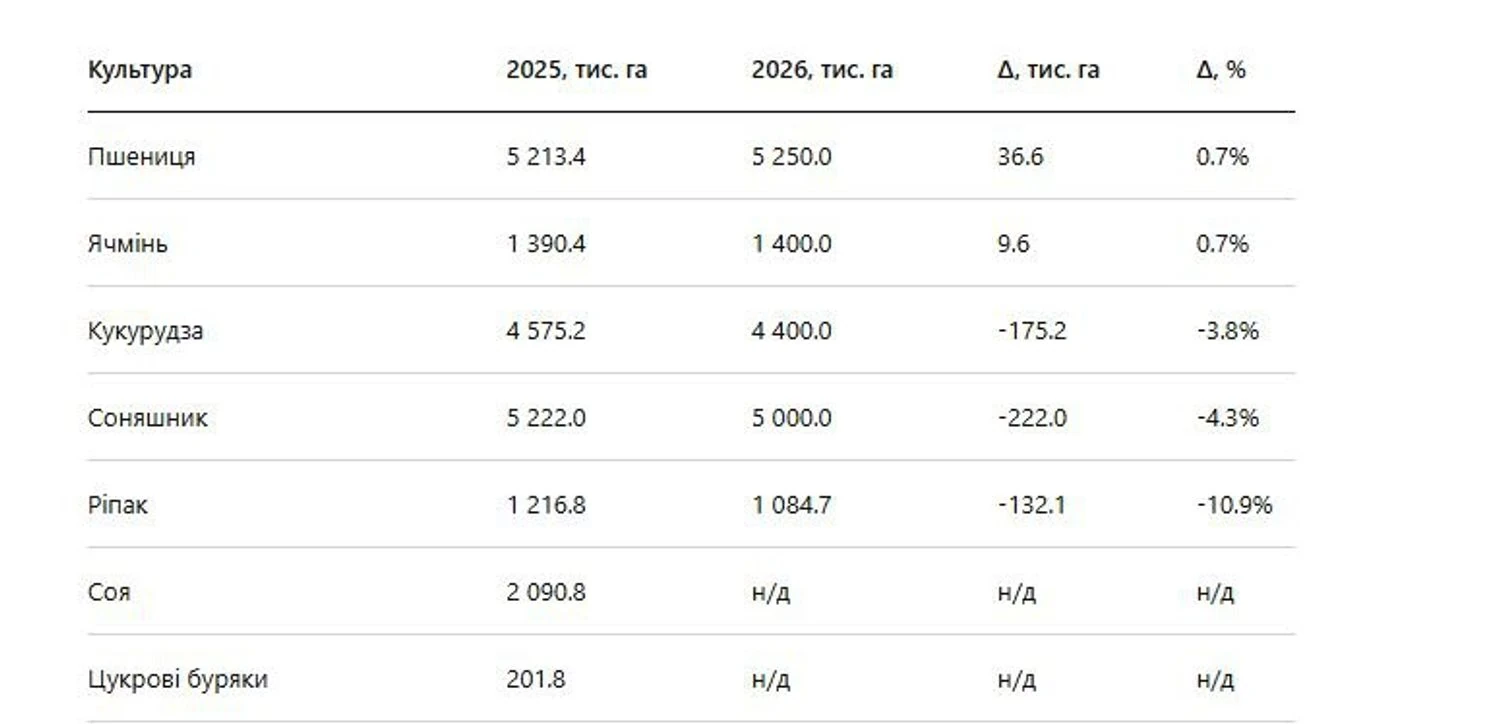
Areas under wheat in 2026 are estimated at 5,250.0 thousand hectares, which is 36.6 thousand hectares more than in 2025 (+0.7%). Barley also adds: 1,400.0 thousand hectares compared to 1,390.4 thousand hectares last year (plus 9.6 thousand hectares, +0.7%).
Against this background, corn is reduced to 4,400.0 thousand hectares from 4,575.2 thousand hectares in 2025 (minus 175.2 thousand hectares, -3.8%).
Meanwhile, sunflower crops decrease to 5,000.0 thousand hectares from 5,222.0 thousand hectares (minus 222.0 thousand hectares, -4.3%). Rapeseed falls most sharply in percentage terms: 1,084.7 thousand hectares compared to 1,216.8 thousand hectares (minus 132.1 thousand hectares, -10.9%).
UNN journalists also asked their interlocutor, Pavlo Koval, CEO of the Ukrainian Agrarian Confederation, about the specific figures for the 2026 sowing campaign. According to his assessment, the expected volume of crops, if the current situation is maintained, he estimates at 22 – 22.5 million hectares. However, the sowing campaign itself will become more expensive compared to last year due to potential re-sowing, resource constraints, and energy costs.
Fuel: risk of price increase and local threats of shortage
The first powerful factor for the 2026 sowing campaign, according to Pavlo Koval, is the increase in fuel costs against the backdrop of events in the Persian Gulf and hostilities in the Middle East.
Part of Iranian oil disappears from the market and there are attempts to block tanker routes
However, he emphasizes that currently Ukraine does not record a jump in fuel prices, but sees trends towards price increases and risks for imported batches in logistics.
Separately, the CEO of UCC emphasizes the start of field work from the south and the need to provide the region with energy carriers in advance to avoid a fuel shortage during the most critical days. After all, even short supply disruptions at the peak of work quickly affect the price (due to competition for resources and increased logistics costs), and farmers' expenses increase.
Panic or real cost - the fuel situation in Ukraine04.03.26, 15:52 • 88965 views
Mineral fertilizers: production decline and import bottlenecks
The second factor, which the UNN speaker calls key, is the tension regarding mineral fertilizers. He links it to the consequences of attacks on energy infrastructure and reduced domestic production.
Relatively constantly (operating, - ed.) two chemical plants - "Rivneazot" and "Cherkasyazot" - operate at 30-40% capacity, sometimes less, with forced shutdowns. As a result, Ukraine produces less than 2 million tons (of mineral fertilizers, - ed.), while in good years (production and consumption, - ed.) it was many times higher
To understand the scale of the imbalance, the expert cites pre-war benchmarks: in 2021, fertilizer consumption reached almost 8.5 million tons, and for 2022, contracts and import plans projected 9 – 9.2 million tons. This is important in the context of productivity: higher technological nutrition standards were one of the bases for the record grain harvest of 2021 (107–110 million tons, according to the speaker).
A separate risk node in the 2026 season is nitrogen fertilizers for early spring work. The agricultural expert speaks of a shortage of ammonium nitrate for fertilization and work on ice crusts on winter crops.
He directly states the reason:
"Ammonium nitrate is an explosive substance, and the military has banned its import by ship. The option of importing alternatives (calcium nitrate) in large batches is being discussed, but time is being lost and this decision needs to be made faster," says Koval.
The CEO of UCC warns: even if a solution appears, the security component remains: the military fears substitution of nomenclature, and Ukrainian ports are constantly being bombed. To avoid a series of destructions of port infrastructure, which could be a consequence of the detonation of cargoes with explosive substances, alternative channels are being considered. But railways from the EU and car shipments mean more expensive and slower logistics due to small tonnages.
In this configuration, farms are looking for ways out of the current situation and are forced to use other types of fertilizers. Pavlo Koval talks about carbamides and ammonium sulfates. But even the reserves of these substances are insufficient to meet the needs of farmers. This creates a double effect: some farms switch to more expensive or less convenient products, and some potentially reduce application rates, which shifts the risks to the area of yield and quality.
Weather and winter crops: how meteorological conditions are already affecting the 2026 harvest
The third block of risks in 2026, according to the UNN interlocutor, is related to meteorological conditions.
(There was, - ed.) a rather dry autumn during the sowing of winter crops and a not very easy winter with uneven snow cover. Temperature fluctuations formed an ice crust on winter crops. And the forecasted night frosts and daytime thaws increase the risk of losses
Koval does not assess the situation in the country as critical, but sets a threshold after which the problem becomes systemic: if 10 to 15% of early crops are weak or lost, then it will be necessary to think about what to re-sow them with." That is, the key risk is not only the loss of winter crops itself, but also the time window for decision-making (to leave or re-sow) and the repeated costs for seeds, fuel, fertilizers, and equipment operation.
A separate problem that may "shoot" with a delay is the flooding of fields during a thaw on frozen ground. The speaker cites examples in Poltava, Kharkiv, Kirovohrad, and Sumy regions, where "water is knee-deep in the fields," and directly states: assessing the condition of winter crops under water requires several weeks. For the farm's economy, this again means uncertainty: the decision to re-sow is postponed, and resources (seeds, fertilizers, fuel, people) need to be planned now.
Personnel shortage as a factor that cannot be fully covered by money
Another factor that will set the tone for this year's sowing campaign is the shortage of labor.
There will be difficulties with personnel due to mobilization, due to booking. Even now, there is a shortage in all positions
The expert mentions situations when even orchards are cut down in western regions due to a lack of labor, and emphasizes that the problem manifests itself in logistics, the elevator segment, and during harvesting.
The personnel shortage, in turn, threatens to slow down the pace of sowing, which will inevitably affect the quality and quantity of the future harvest.
In spring, a day feeds a year. If you lose a spring day, you can lose the harvest
Even if a farm is willing to pay more, human resources do not scale instantly, and peak loads, when all crops need to be sown almost simultaneously, increase the risk of technical and organizational failures.
Sowing-2026: basic scenario and how the war will affect it
According to the basic scenario, UCC CEO Pavlo Koval expects that the 2026 crops will be close to last year's.
"We will sow 22 – 22.5 million hectares, if there are no sharp changes on the front line," he predicts.
At the same time, the expert frankly speaks about the risks of retreat or changes in the line with the creation of 5- and 20-kilometer zones along the front, which may affect crops. Thus, territorial restrictions not only reduce the area, but also change the planning of finances, equipment, and purchases, because part of the costs have already been incurred before the field becomes inaccessible.
Crop structure in 2026: which crops will be grown most actively
The UNN interlocutor does not expect radical structural changes in crops, but admits correction if two factors coincide: problems with resources and wintering of winter crops.
According to the expert's assessment, more than 6.5 million hectares of winter crops – wheat, barley, rapeseed – have already been sown in the country.
If we start from 22 million hectares of the total campaign, another 16 million hectares need to be sown: about 5 million hectares of sunflower, 4 million hectares of corn, 180 – 200 thousand hectares of sugar beet
As insurance options, he names late crops that can be used to re-sow problematic areas.
(These are, - ed.) soybeans, corn, perhaps even buckwheat, given that some areas will have to be put into operation later due to the condition of winter crops or due to the need to re-plow unharvested (last year's, - ed.) crops
As an additional argument in favor of late crops in 2026, he names the so-called "tail" of the last season. This is part of the harvest that overwintered in the fields; currently, where possible, agrarians are completing its harvesting.
How much will the sowing campaign cost Ukraine in 2026?
Pavlo Koval, in an exclusive comment to UNN, does not hide: this year's sowing campaign will be more expensive. There are several reasons:
- re-sowing means a double need for seeds and double costs for them;
- risks for fuel and scarce fertilizers raise the price of resources;
- staff shortages force higher personnel costs;
- energy disruptions increase electricity and generator costs.
For the market, this means that in 2026 there will be no cheap sowing, even in a scenario without sharp force majeure. Further, costs will either be partially included in the purchase prices for raw materials (grains, oilseeds), or they will reduce the financial safety margin of farms. In the conditions of active hostilities currently ongoing in Ukraine, the second option is more dangerous: it is the liquidity reserve that often determines whether an agrarian will be able to purchase resources at a peak moment and complete work on time.