










Firefighting aviation is more than just an aircraft: how XENA organizes international forest-firefighting operations
Kyiv • UNN
XENA deploys the An-32P Firekiller in less than a day and fights fires in Turkey, Georgia, and Montenegro. The aircraft drops 8,000 liters of water.

Forest fires are becoming larger in scale and more intense, so Europe is seeking additional rapid-response capabilities. Under these conditions, the role of aerial firefighting is growing. Behind every sortie lies much more than just a specialized aircraft: crew training, technical support, logistics, coordination with local services, and the readiness to deploy an operation in another country at short notice.
The Ukrainian airline XENA—the world's only commercial operator of the An-32P Firekiller firefighting aircraft—has been participating in international forest-firefighting operations in Turkey, Georgia, and Montenegro since 2021. How this work is organized and what is required for a specialized aircraft to begin fighting a fire within just a few hours of receiving an alert was explained in an exclusive interview with UNN by XENA Director Yevhen Sokol and the company's Chief Operating Officer Ihor Komarov.
From contract to first sortie
When the scale of a fire requires additional aviation resources, a specialized aircraft cannot simply fly into the country and begin operating. First, the operator must be officially engaged in the operation.
XENA operates under contracts awarded through tenders conducted by specialized agencies and authorities. These procedures assess the financial offer, the quality of services, and compliance with safety requirements. Such contracts may be either multi-year or short-term—when an emergency requires a rapid decision.
Once the contract is signed, the operation is deployed directly. A base must be designated, the aircraft supplied with fuel and water, the necessary clearances obtained, operations coordinated with local aviation authorities, and the crew prepared for the flight rules and zones.
Under the contract, the aircraft must be ready to take off within 20 minutes of an alert, and XENA has repeatedly demonstrated its rapid deployment in practice—from arrival to the start of operations, less than a day may pass
During a fire, the aircraft becomes part of the local response system. The areas of operation and priorities are determined by the client and local authorities, while coordination is ensured through joint chains: fire detection, task assignment, and crew support.
Four flight-crew members work on board—the captain, first officer, navigator, and flight engineer. They are joined by a local pilot-observer, who helps maintain communication with ground services and coordinates the drops. On the ground, technicians, a base manager, and specialists responsible for water, fuel, and team support are at work.
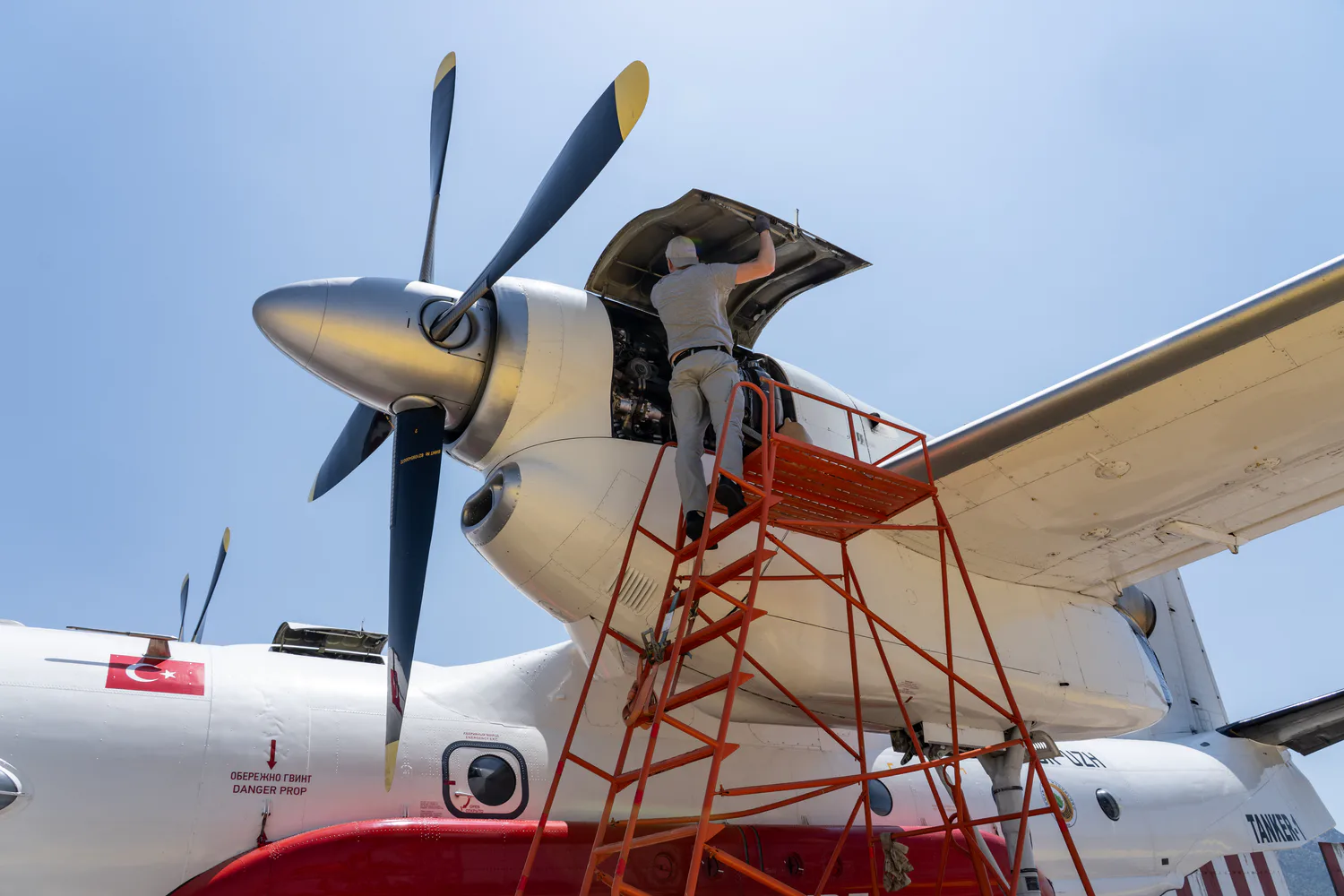
Photo credit: Patrick Zweiger, Dalaman, 2026
According to XENA, in Turkey, for example, detection is carried out through a multilayered system—drones with infrared cameras, patrol aircraft and helicopters, and ground-based forestry services.
In the air, the crew simultaneously maintains contact with air-traffic control, with other firefighting aircraft and helicopters on the coordination frequency, and with ground services through the pilot-observer on board specifically to coordinate the drops. One minute before dropping the water, the crew announces its actions over the radio to ensure safety in the drop zone. This has been practiced to the point of becoming automatic—this is how one aircraft operates effectively in crowded airspace alongside dozens of other assets
Flight over the fire: crew requirements
Working abroad means that the crew encounters new conditions each time. The work requires taking into account the terrain, climate, sudden weather changes, local regulations, and the specifics of interaction with other services.
Working in the mountains is particularly challenging.
The An-32P drops water from extremely low altitudes—approximately 40–60 meters above the fire, so the pilots, without exaggeration, "descend into the very heart of hell." In mountain valleys, the wind behaves unpredictably, as in a wind tunnel; smoke "eats up" visibility and is dangerous for the engines. There is virtually no room for error here
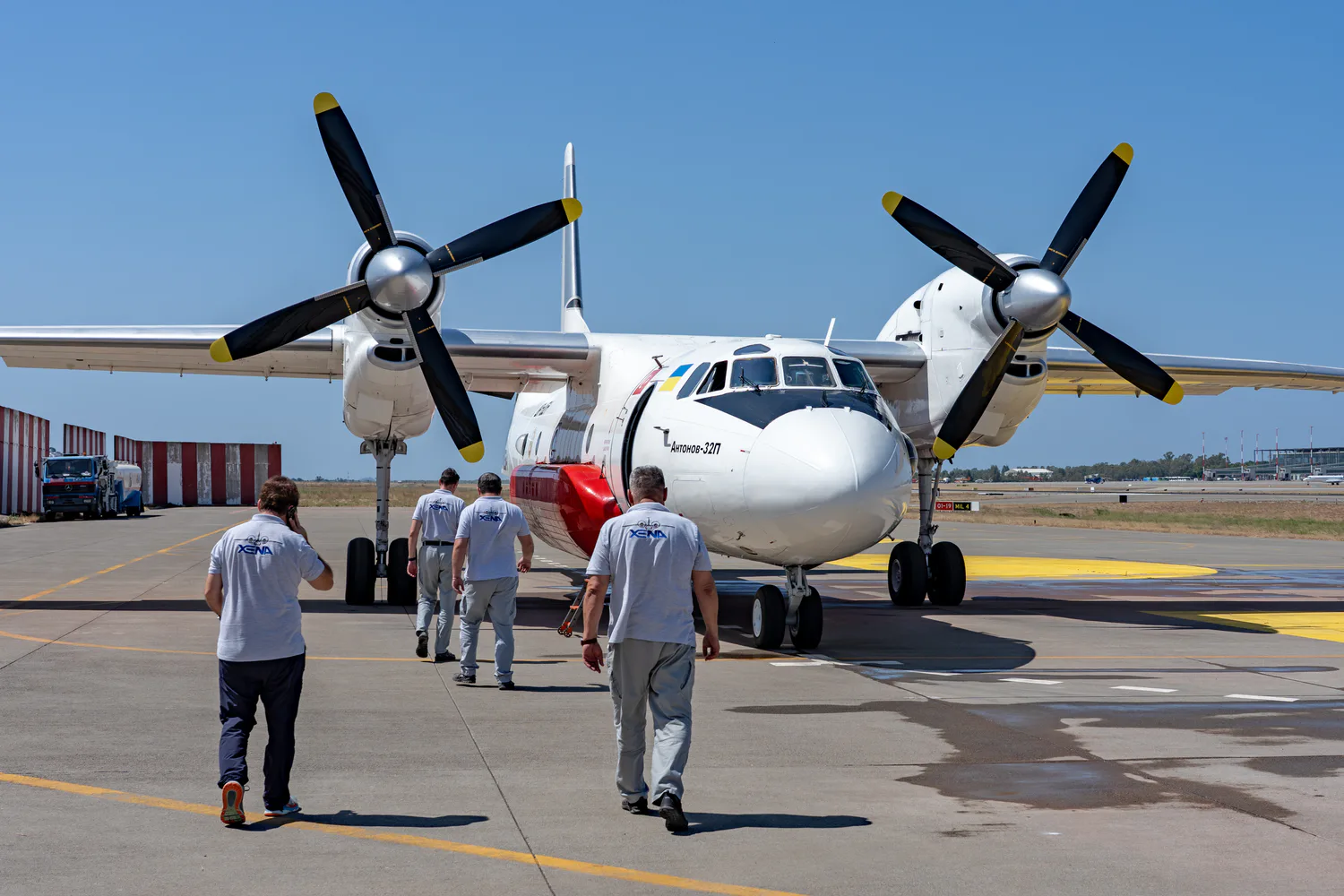
Photo credit: Patrick Zweiger, Dalaman, 2026
The requirements placed on crews for firefighting missions are extremely high, and they begin even before the first mission.
XENA is built around its pilots—mostly former military aviators with an average of approximately 20 years of experience. New pilots undergo intensive theoretical and conversion training at the Antonov training center, after which they need up to six months of additional training to fully master the specifics of firefighting flights. Before working in a new country, the crew separately studies the local flight zones, airfields, restrictions, aviation regulations—and even communication practices
The flight over a fire itself also has its own specific features and requires exceptional physical and psychological readiness. The aircraft is flown manually, without an autopilot, at an altitude of 40–60 meters above the flames. In mountainous areas, an instant reaction, excellent vision, and the ability to clearly assess the terrain and see the development of the fire literally several steps ahead are required. High temperatures add to the challenge. On the apron, temperatures can reach +70°C, while in the air they are 40–45°C. During busy periods, a crew may carry out 10–12 sorties a day, so after arriving in a new country, it is important to take the acclimatization period into account as well.
Our operational capabilities are unmatched in high-precision firefighting. Flying at 40–60 meters in challenging conditions requires exceptional skill—and our crews demonstrate the highest level of technical excellence every time
What the An-32P Firekiller can do
One of XENA’s aircraft involved in fighting forest fires in Europe is the An-32P Firekiller. It is a specialized firefighting version of the An-32 transport aircraft.
The company emphasizes that its key advantages are the combination of power, precision, and versatility.
The An-32P takes off and lands in challenging conditions—from unpaved and minimally prepared strips—thanks to its high-mounted engines and low-pressure tires. It operates immediately and at low altitude: it drops 8,000 liters of water or retardant from an altitude of approximately 40 meters at a speed of 230–260 km/h. In a single pass, the aircraft covers a strip measuring 35×160 meters, while two consecutive drops of 4,000 liters each cover an area of 20×300 meters. Its four independent tanks can be filled in 5–8 minutes, providing up to 32,000 liters per hour
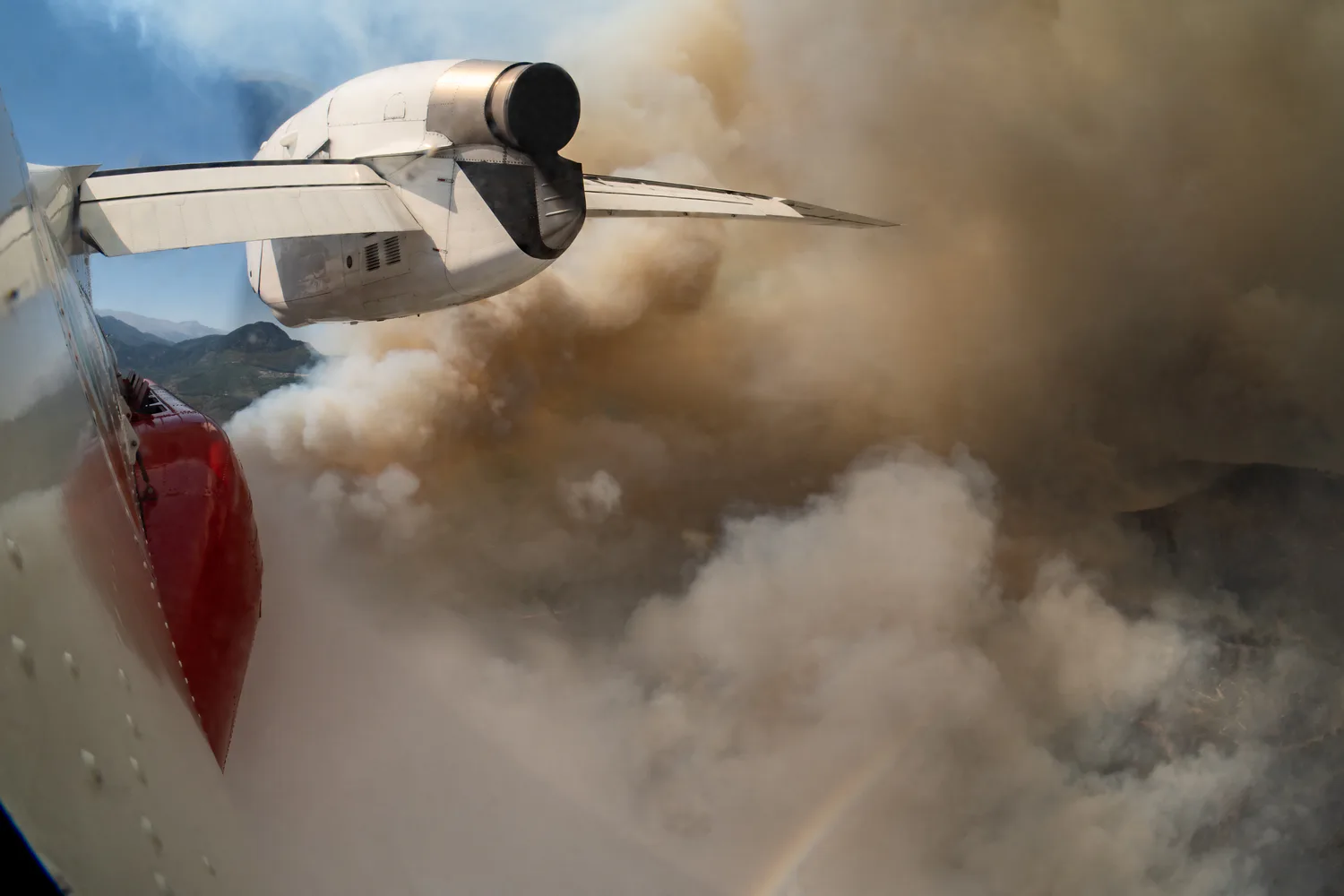
Photo credit: Patrick Zweiger, Dalaman, 2026
At the same time, firefighting is not the An-32P’s only function. The aircraft can carry up to 6,700 kg of cargo in a 66 m² cargo compartment, be used as a medical platform for up to 24 stretchers, or deploy up to 27 firefighter-paratroopers. It can also transport and drop emergency equipment.
The aircraft operates at temperatures of up to +55 °C and at airfields up to 4,500 meters above sea level.
It is no wonder that pilots call it a "rocket": its two Ivchenko turboprop engines produce a combined output of more than 10,000 horsepower
XENA’s experience in international missions
The Ukrainian airline XENA has already operated in Turkey, Georgia, and Montenegro. The largest number of missions took place in Turkey: since 2021, the company’s crews have carried out more than 1,000 firefighting missions there and delivered over 7 million liters of water to fire zones. During the 2025 season, XENA carried out 450 missions in Turkey and Montenegro. In Georgia, the company’s work received public recognition from the local authorities.
Montenegro became XENA’s newest destination—the company has been operating there since 2025. This country became an example of how quickly an international firefighting operation can be deployed.
In 2025, during a challenging fire season, an XENA-operated An-32P Firekiller was deployed to Montenegro with the support of the United Arab Emirates.
We deployed to Montenegro in the shortest possible time, fully within the terms of the contract. Less than 24 hours after arrival, the crew was already operating from Podgorica and carried out ten firefighting missions the following day
The aircraft’s commencement of operations was officially announced by Montenegro’s Prime Minister Milojko Spajić, while the country’s Ministry of Internal Affairs highlighted its professionalism, effectiveness, and compliance with safety and quality standards.
In 2026, XENA is operating in Montenegro again. In particular, the company was involved in fighting a fire that lasted several days in the Orjen area near Herceg Novi, where ground forces have difficulty reaching some of the fire’s hotspots.
What European firefighting aviation will need
Fire seasons in Europe are becoming longer and more intense, meaning that countries need not just individual aircraft, but ready-made aviation capabilities that can be rapidly deployed.
This primarily concerns rapid deployment, a high intensity of operations, and the ability to integrate into the national response system—together with drones, other aircraft, and ground services.
It is precisely this comprehensive capability that makes it possible to use firefighting aviation as a fully fledged part of the response system for large-scale wildfires.