


Who creates the menu and where to complain about low-quality products — how the army procures food for military personnel
Kyiv • UNN
AOZ DOT procures food products for the Armed Forces of Ukraine and the State Special Transport Service through Prozorro, while military units order them via DOT-Chain Food. Quality complaints are submitted in the system.

Who orders food for military personnel, how the procedure has changed, where to complain about poor-quality food, and how suppliers can join in—the Ministry of Defense has prepared detailed explanations of how the army purchases food for military personnel, reports UNN.
All servicemembers of the Armed Forces of Ukraine and the State Special Transport Service (SSTS)—from infantrymen on the front line to clerks in the rear—have the opportunity to receive meals at the state’s expense.
The Ministry of Defense noted that the procurement of food products, field rations, and property for the food service is carried out by the DOT Defense Procurement Agency (DOT DPA), while military units place orders in the digital DOT-Chain Food system.
What Armed Forces of Ukraine and SSTS personnel are fed depending on their service conditions
Quality nutrition is extremely important for restoring strength and preparing servicemembers to carry out combat missions. Wherever possible, personnel are provided with hot meals three or four times a day. However, the format depends on the nature of combat operations, logistical capabilities, and location.
The basis of nutrition for servicemembers of the Armed Forces of Ukraine and the SSTS is hot food. Depending on availability and logistical capabilities, it is provided using fresh, chilled, frozen, or canned products.
If it is not possible to organize or provide proper hot meals, soldiers are supplied with field rations.
Hot meals in dining halls and field feeding points
When possible and under appropriate conditions, those responsible for providing meals organize the preparation of food from chilled meat, fresh seasonal vegetables and fruit, as well as other products. This format is the most balanced, healthy, and rich in nutrients.
This type of diet is most commonly provided at unit bases near the line of contact, where logistics and the organization of dining halls can be ensured, at permanent deployment locations, training centers, and military universities.
With three meals a day, hot food is prepared and served three times a day: for breakfast, lunch, and dinner. Aircrew, servicemembers of the Naval Forces (Navy), and cadets receive four meals a day. For them, a second breakfast or second dinner is additionally organized.
If security conditions are more difficult, products with a longer shelf life are used to provide hot meals—from frozen meat to canned products, biscuits, and more.
In such cases, the unit organizes field feeding points in the area where the combat mission is being carried out, wherever this can be ensured. Food is prepared in the same way according to an approved menu and product schedule. It is drawn up taking into account the location of the combat mission, the basic menu, and the available range and quantity of products.
Usually, personnel eat this way in areas where combat missions are being carried out, when the combat situation changes, or when relocating, when it is impossible to organize a permanent place for meals.
On the line of contact: field rations
If it is impossible to organize hot meals, servicemembers of the Armed Forces of Ukraine and the SSTS receive field rations.
Field rations are designed to provide complete nutrition throughout the day and consist of different menus and combinations of dishes. The Armed Forces have two types: a daily field food pack and an enhanced daily field food pack.
A standard field ration contains three meals (breakfast, lunch, and dinner), as well as food and non-food products. Also, in October 2026, a new alternative field ration was approved: it contains more calories and includes special heaters and water-disinfection supplies.
The alternative field food pack is intended for designated categories of servicemembers of the Armed Forces and the State Special Transport Service who participate in combat operations directly on the line of contact.
Armed Forces of Ukraine food catalog: 360 items with calorie counts
The nutrition of military personnel is organized according to the universal Food Products Catalogue of the Armed Forces of Ukraine. It contains 360 nomenclature items. This is a wide range: meat and meat products, fish and fish products, dairy products, eggs, vegetables and fruit, nuts, pasta, grains, spices, honey, chocolate, bakery products and beverages.
All 360 items in the Food Products Catalogue have updated descriptions as of June 2026, and the procurement for 2027 for the Armed Forces of Ukraine and the State Special Transport Service has already been announced by the DOT Procurement Agency under the new requirements. Caloric content has been added for each item, and for some products, including meat, fish and dairy products, the protein and fat content per 100 g has also been added.
The list takes different needs into account. The Catalogue includes products permitted under halal and kosher laws, as well as items for those who refrain from consuming animal products due to ethical, religious, environmental or aesthetic views.
The Catalogue is compiled by the Logistics Forces Command, while it is approved by the Ministry of Defence. During procurement, the DOT Procurement Agency contracts suppliers for all items in the Catalogue. Suppliers operate under contracts within a particular region or cluster (several regions).
Providing food involves not only purchasing and delivering products, but also food-service property: tableware, kitchen utensils, equipment and inventory for kitchens, dining facilities and food distribution points.
DOT-Chain Food: requests, delivery notes and acceptance certificates without paper
DOT-Chain Food is an IT system for managing food supplies: from submitting requests to preparing acceptance certificates and expenditure invoices, as well as drawing up reports on breaches of contractual obligations.
The entire supply chain, from submitting a request to confirming delivery, is automated: without paper bureaucracy, with an electronic signature and secure access for each participant.
Before the system was introduced, document management was paper-based, and documents were delivered physically. This was how orders for food products from military units, expenditure invoices, the signing of acceptance certificates and complaints were processed. The request was sent to the supplier by email, whereas now it is submitted in the system.
From November 2026, all documents related to food supplies for the Armed Forces of Ukraine and the State Special Transport Service must be processed in the DOT-Chain Food system.
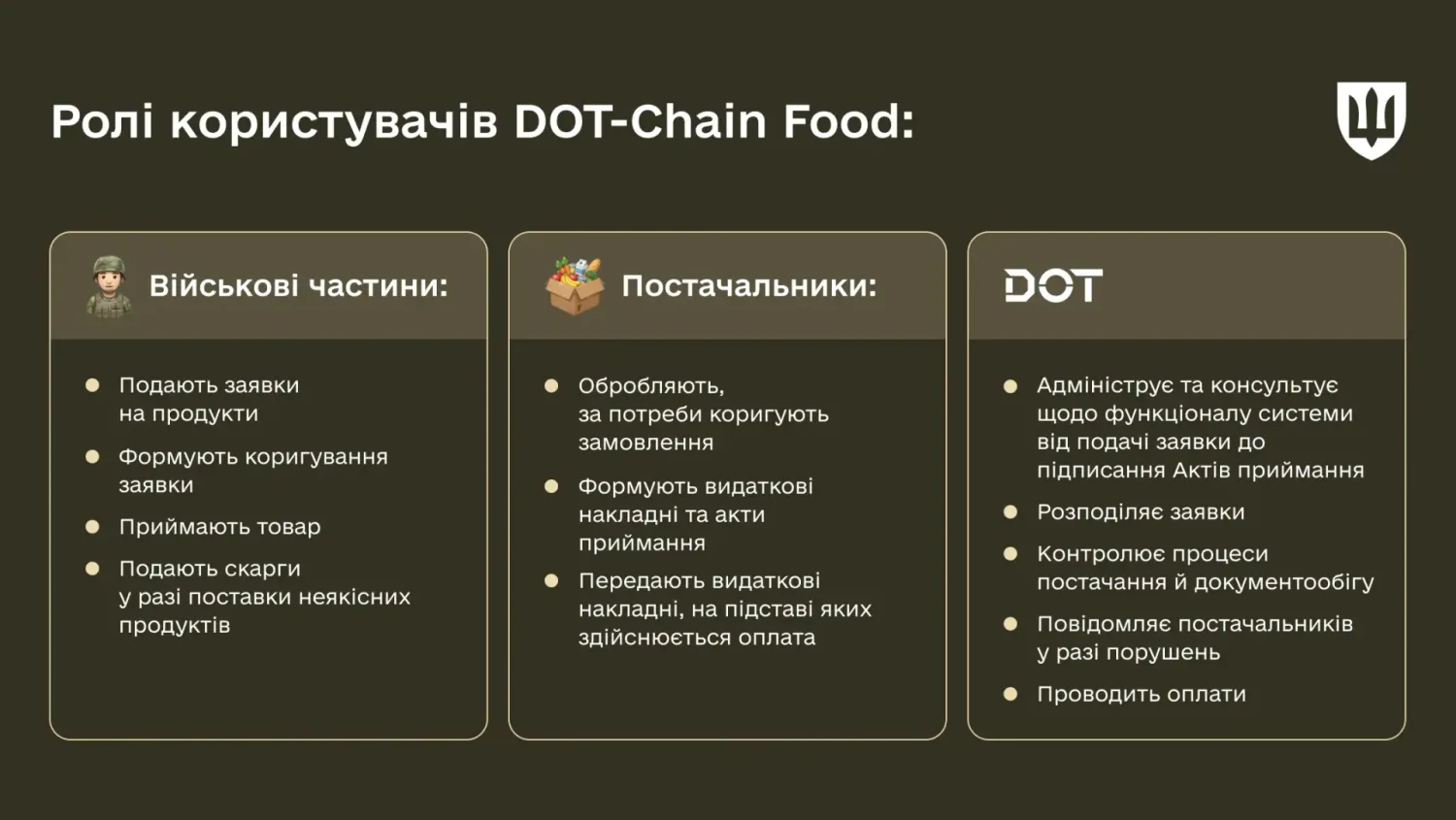
In the DOT-Chain Food system, each participant works with their own part of the process. Military units submit requests for products and accept delivered goods; if the products are of poor quality, they file a complaint.
Suppliers create expenditure invoices in the system, which the DOT Procurement Agency uses to verify the fulfillment of contractual obligations. After that, if there are no comments, the supplier creates a tripartite acceptance certificate in the system, on the basis of which payment is made.
Request for products: from the head of the food service to the supplier
The commander of the military unit is responsible for food supplies. He determines how to feed the personnel, taking into account the intensity of combat operations and the unit’s tasks. Based on this, the head of the food service organizes the nutrition of military personnel and prepares the relevant requests.
The process works as follows: as a rule, the head of the food service of a military unit prepares a weekly menu and a list of required products, and calculates their quantities from the Catalogue depending on the number of personnel. The request must be prepared 10 days before the final delivery date.
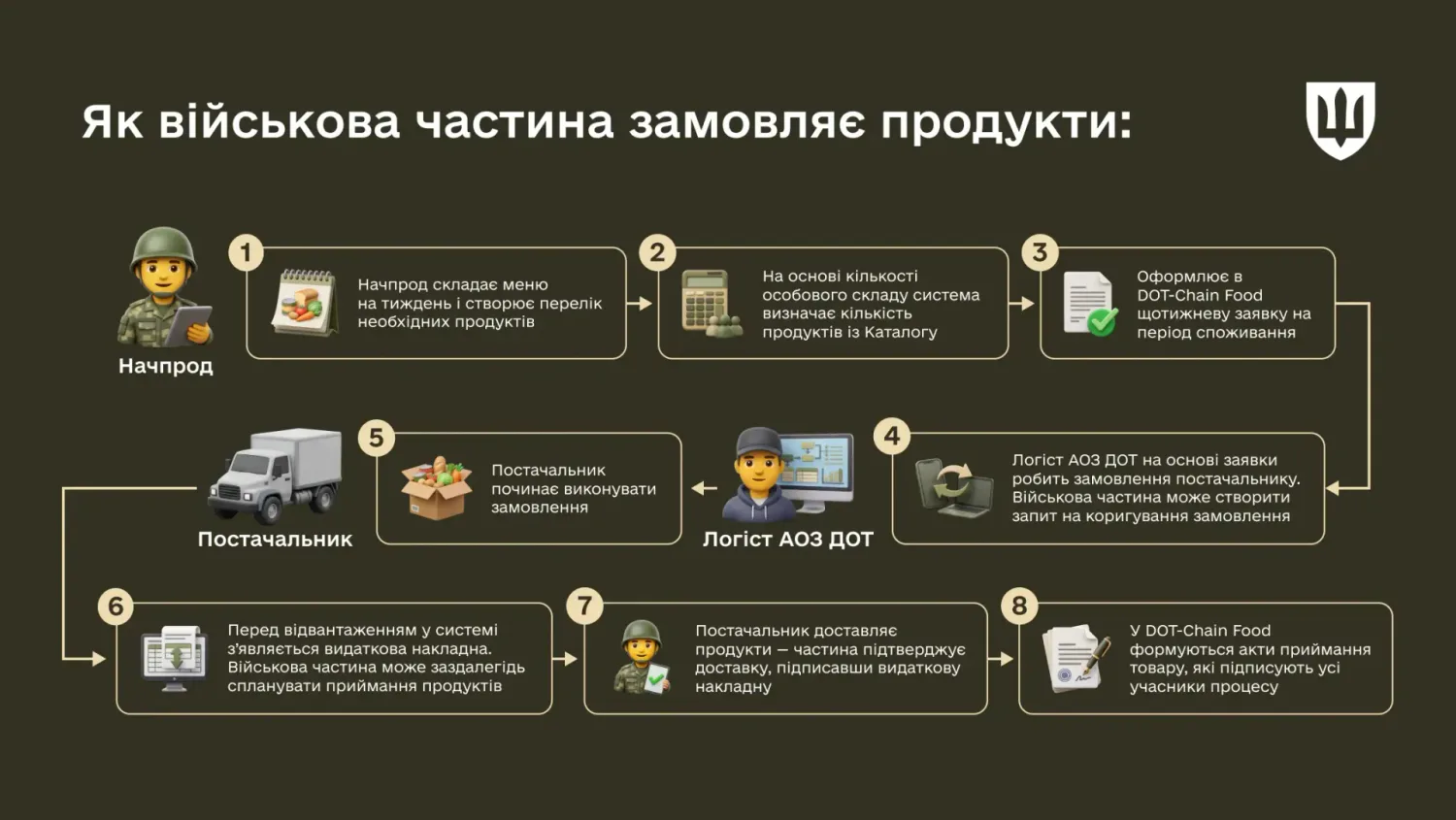
The DOT Procurement Agency logistics specialist distributes requests from military units among suppliers, forming orders under the relevant government contract. If necessary, the military unit may submit a request for an adjustment.
The signed acceptance certificates serve as the basis for paying the supplier and complete the food-supply cycle.
How the head of the food service creates a menu from the Catalogue
The head of the food service prepares the order list within the available budget and ensures that the menu is balanced. To do this, several factors are taken into account simultaneously:
- price and quality: whether the product is fresh or frozen, and how much each option costs;
- caloric content and composition: for example, whether there is enough protein;
- packaging: for example, juice in a large package is cheaper, but military personnel on combat missions sometimes need individual serving packs;
- seasonality: fresh vegetables, fruits and berries, and, when necessary, canned vegetables.
In addition to the basic set, the food service officer may order additional products: nuts, chocolate, sweets, tea, coffee, jam and honey. Thus, the weekly menu is based on a balance between the budget, the needs of military personnel and the conditions of service.
Complaint about poor-quality products: a claim in DOT-Chain Food
If the products are delivered late or in an incorrect quantity, the automatic claims mechanism of DOT-Chain Food will be triggered: the system compares the data and independently identifies discrepancies between the order and the actually signed delivery notes.
If the issue concerns inadequate product quality identified upon receipt or during the week, the military unit can likewise submit a complaint through DOT-Chain Food. Also, starting in September 2026, a quality claim in the system can include photographs confirming the poor quality of the products.
After receiving a claim, the system automatically prepares a report on the violations identified and calculates the amount of penalties in accordance with the contract previously concluded with the supplier. The authorized representative of the military unit only needs to review the report, add comments if necessary and sign the document.
The Agency assesses suppliers using the SLA (Service Level Agreement) methodology. It digitizes the quality of performance: whether each delivery arrives on time and in full, and whether the supplier complies with the contract.
How a supplier can participate in food procurement
Suppliers of food products for the military are selected through tenders in the Prozorro electronic system. Tenders for food supply are announced once a year—this is when suppliers are selected to provide products in accordance with the Catalogue.
Additional tenders are also announced if new needs are substantiated during the year.
To supply products to the military, monitor tender announcements in Prozorro and participate in them. More information about the program is available on the food supply page on the website of the DOT Defence Procurement Agency.
After winning, the supplier works with military units through DOT-Chain Food: it receives orders, fulfills them and signs the relevant acts.
Who is responsible for what: the commander, the food service officer, the DOT Defence Procurement Agency and the supplier
Several links are involved in food supply:
- The General Staff of the Armed Forces of Ukraine (or structural units designated by it, such as the Logistics Forces Command) and the State Special Transport Service determine the need;
- On this basis, the Ministry of Defence compiles a list of what is required (products, field rations, etc.) with prices in accordance with the budget;
- The DOT Defence Procurement Agency announces procurements, signs contracts, and oversees their implementation and logistics.
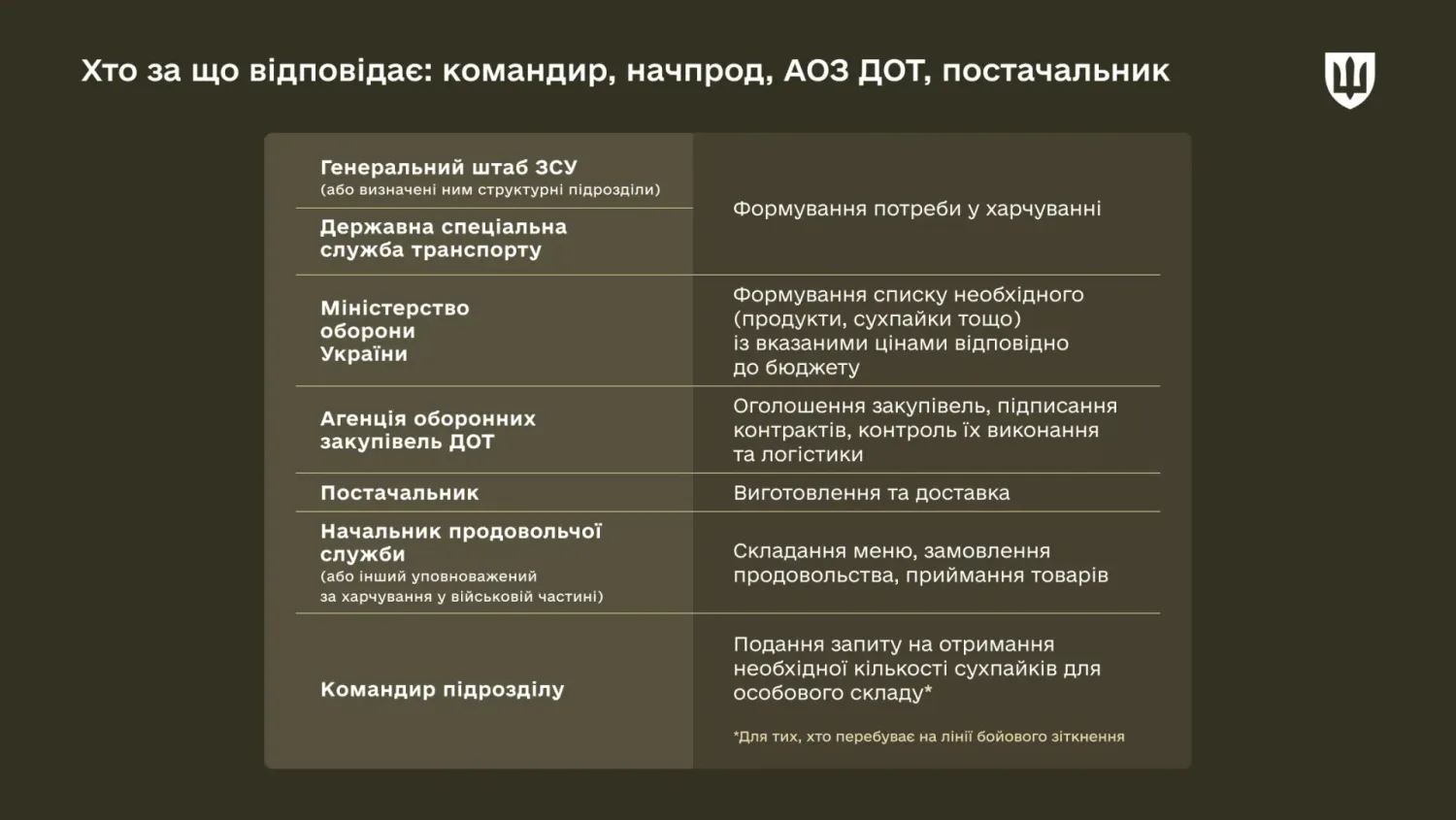
The supplier produces and delivers the products. In the military unit, the food service officer or another authorized person prepares the menu, orders food products and accepts the goods.
For those on the line of contact, the final link is handled by the unit commander: they submit a request for the required quantity of field rations for the personnel.