










No sanctions, act through Russia
Kyiv • UNN
NielsenIQ's Russian subsidiary is actively recruiting staff for high-risk markets, including occupied Ukrainian territories and Iran, as revealed by job postings on HH.ru. The company's internal research previously labeled occupied Ukrainian lands as "new Russian regions."

The Russian subsidiary of NielsenIQ, Europe’s largest marketing agency, has been actively recruiting staff to work in high-risk, sanctions-hit markets. Relevant NielsenIQ vacancies are posted on HH.ru, a major Russian recruitment platform used by vetted corporate employers.
The job descriptions openly state that new hires will service clients in occupied Ukrainian territories and in Iran.
Earlier, in June 2025, NielsenIQ's internal research policy became the subject of media discussions. In its market studies, the company’s Russian arm labels occupied Ukrainian territories as "new Russian regions", while media coverage and company’s public remarks envisage the "high potential" of these markets.
Such framing is dangerous. Studies like these effectively boost the market capitalization of international companies if they include sales from sanctioned or occupied regions in their reporting.
Although the NielsenIQ parent company declares that it has deconsolidated its operations with the Russian office, which is autonomously managed by local specialists, its real financial relations with Moscow team remain in question. The headquarters in Chicago does not comment on the situation and remains the owner of the Russian subsidiaries.
NielsenIQ is a global B2B agency that helps multinational brands navigate national markets. Some of its potential clients chose not to leave Russia in 2022, despite the mass exit of Western companies on moral and ethical grounds. Brands such as Leroy Merlin and Auchan to name just a few have earned hundreds of millions of dollars and paid substantial taxes to the Russian budget by staying, even as they publicly claimed to be scaling back investment.
This is what makes NielsenIQ’s stance so dangerous: it helps to build an ecosystem of companies that reinforce one another’s decision to stay in the Russian market and, in doing so, to bankroll cooperation with the Kremlin’s current regime.
Russian authorities understand these dynamics well and are steadily working to erode Europe’s ethical firewall.
Searching for job options in Iran is NielsenIQ 's next escalatory move. Having faced no serious consequences for the misbranding of the occupied parts of Ukraine, the agency has entered an even more murky borderland. The emphasis is shifting: it is no longer just Russia looking for ways to dodge EU sanctions, but European firms themselves using Russia as a gateway to work with unrecognized or sanctioned jurisdictions.
How it works.
As of mid-November 2025, around 16 active NielsenIQ job ads were listed on the HH.ru website. For example, job opening #127256719, "Head of Client Relations (DPR, LPR, Crimea, Zaporizhia and Kherson Oblasts)," can be found at: https://hh.ru/vacancy/127256719. Responsibilities include recruiting personnel for the occupied territories and building partnerships in sanctioned zones.
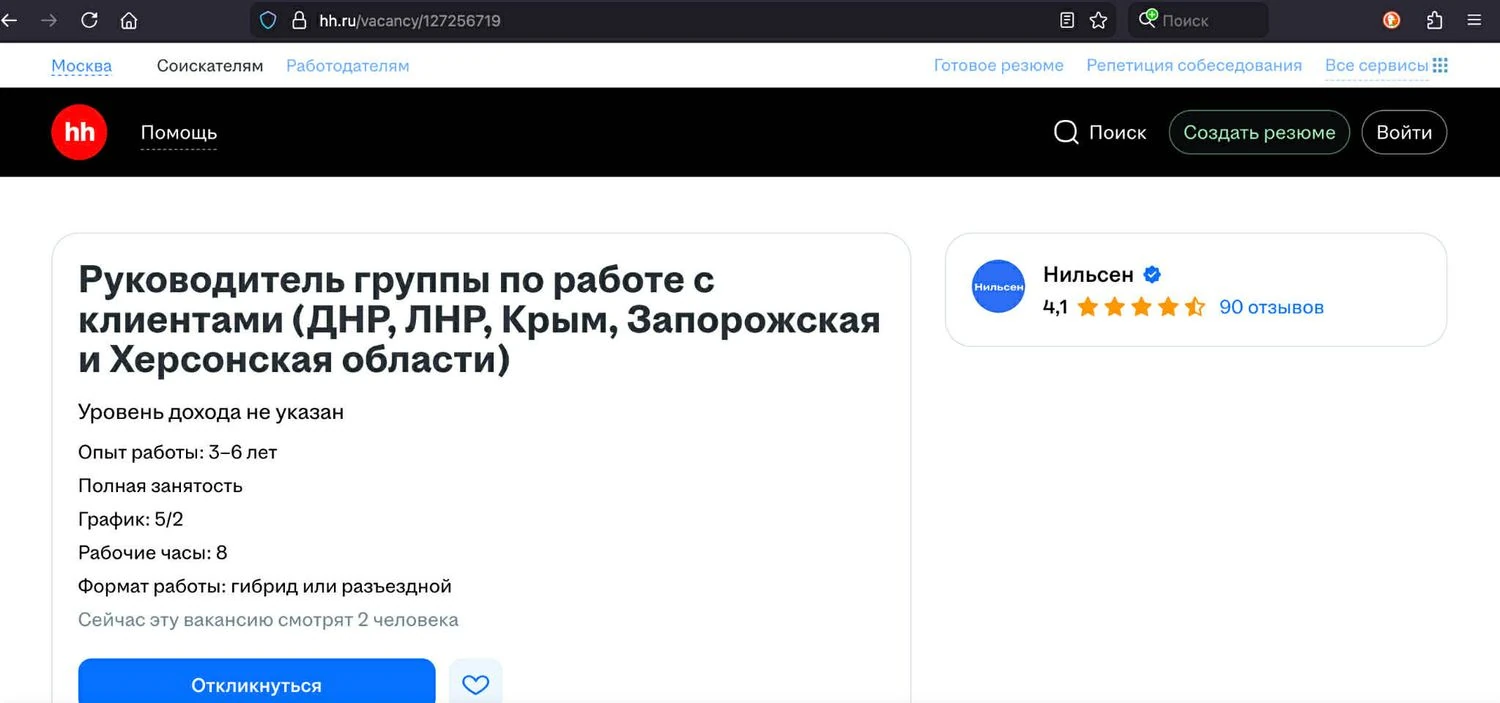
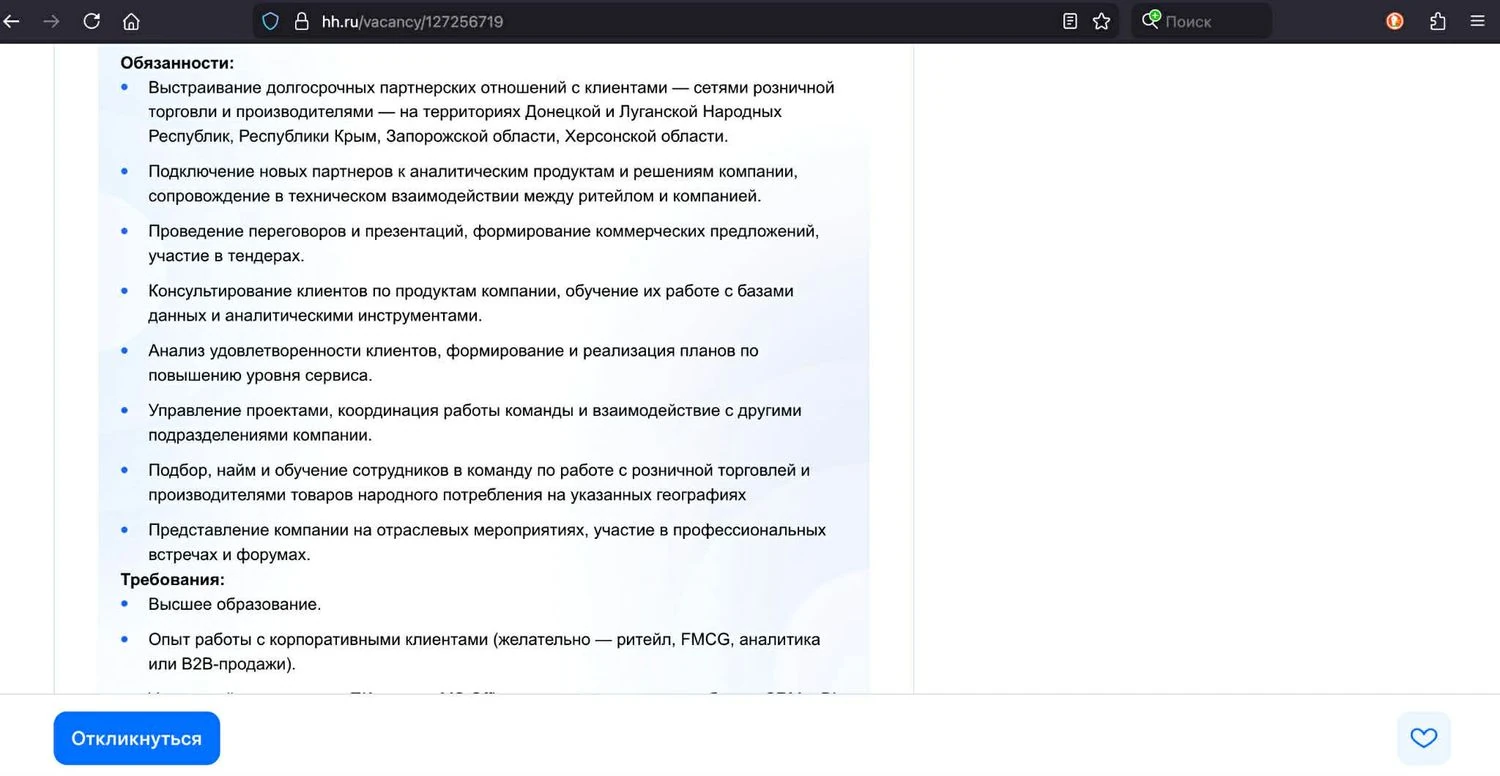
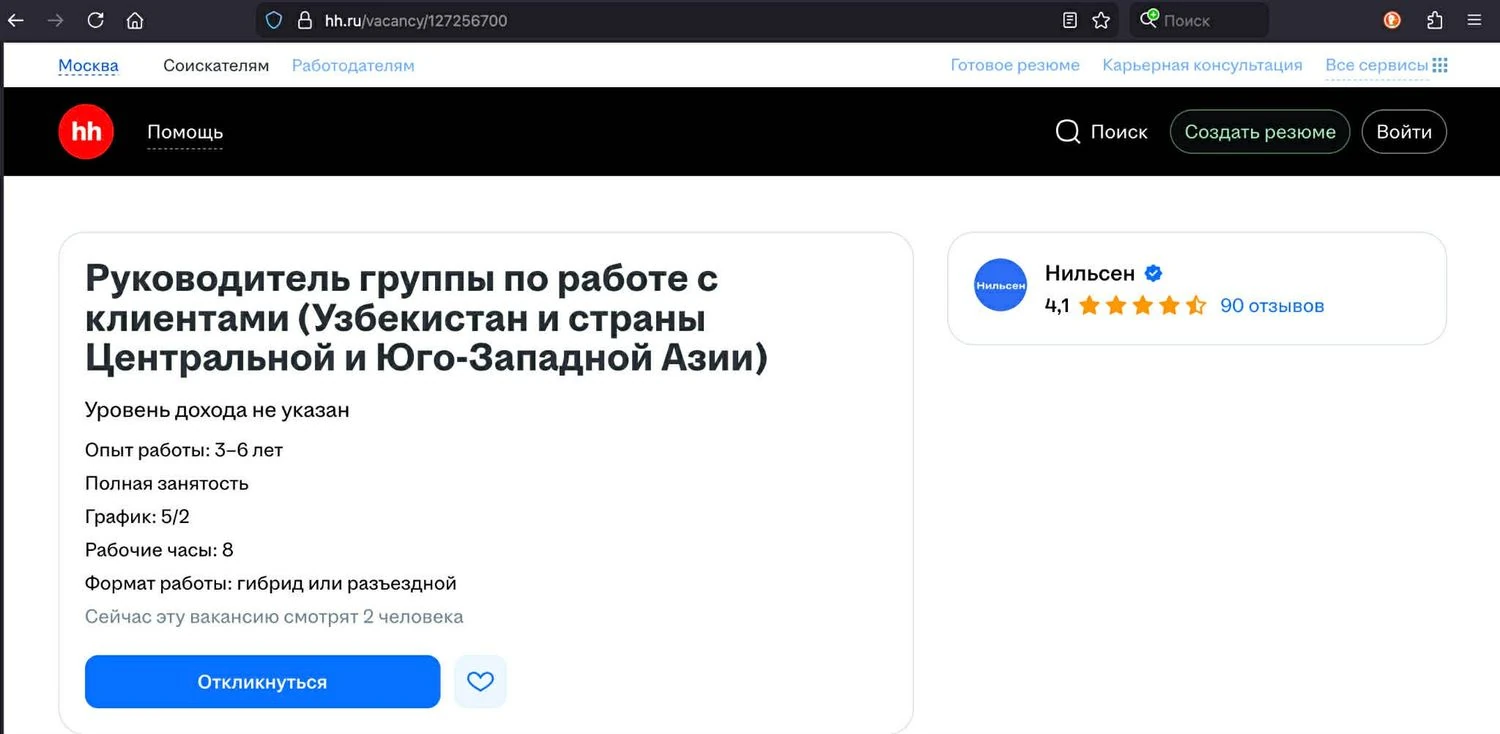
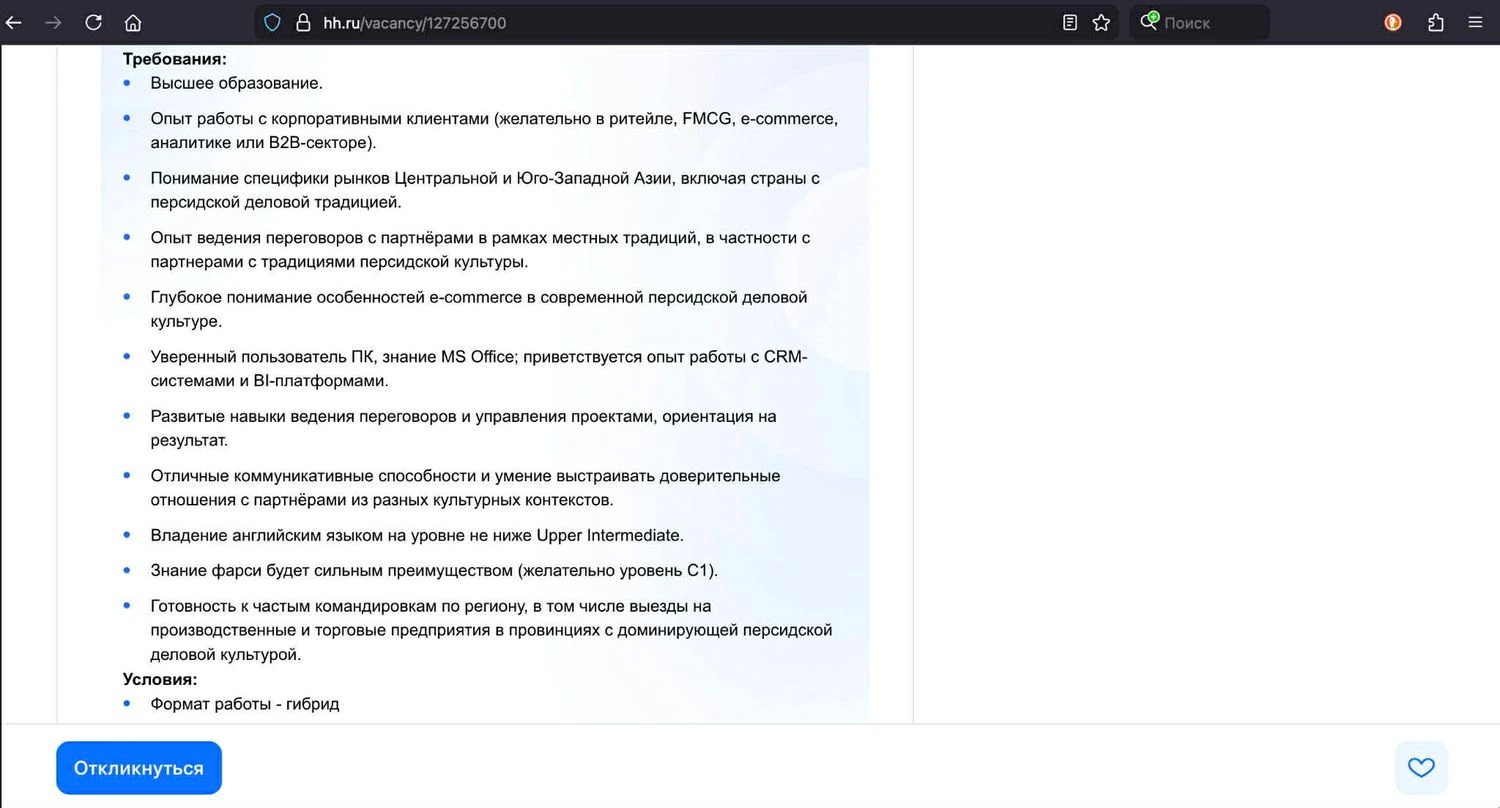
Another posting, vacancy is #127256700 (dated Nov. 3, 2025) on the link: https://hh.ru/vacancy/127256700. Requirements include a C1 level proficiency in Farsi (the official language of Iran) and repeatedly stresses familiarity with "Persian business culture." The successful candidate must be ready for "business trips to provinces with a Persian business culture." Although the location is formally listed as Moscow/Tashkent, that is almost certainly meant to mask the role’s link to Iran: only Iran requires this level of Farsi and such deep knowledge of Persian culture.
Marketing and research companies can work with sanctioned Iran only under strict limitations. For online B2B companies, such activities risk triggering secondary sanctions that could cripple their parent offices.
In practice, the very idea of an agency outside Iran providing a full range of marketing and advertising services to local (Iranian) clients is almost entirely prohibited if those services involve entities in sanctioned jurisdictions and rely on Western payment systems, technology, software or infrastructure.
For a global B2B marketing company based in a jurisdiction that enforces sanctions on Iran – or that uses US or other Western banks, payment systems, software and platforms – cooperation with Iran is legally possible only in very narrow cases. These may include basic communication or information services that are not tied to marketing or advertising and do not involve agents working on the ground inside Iran.
Once a business model moves into full-scale marketing, digital advertising, promotion, B2B sales support, brand building, media planning or targeting, it hits serious legal barriers: such work is often outright banned, extremely risky or subject to special licenses. In practice, even firms not registered in the US can fall under sanctions if they rely on American technologies, platforms, banking systems, payment channels or software.
This is where Uzbekistan comes in. Its jurisdiction is used as a loophole because it is considered neutral and has not joined sanctions against Iran. A marketing agency registered in Uzbekistan can, in principle, work with Iranian B2B clients, provided that it:
- does not use US banks;
- does not route payments through the US or EU;
- does not sell technologies covered by export controls.
In the NielsenIQ case, there appears to be a direct chain linking the Chicago headquarters, its Russian subsidiary, and its marketing in Iran. The job ad on the website specifically states that they are looking for someone with experience in electronic marketing – a detail that should raise red flags and may attract close scrutiny from the US Treasury.
The integration of international companies into Russia’s bespoke economic regimes can be seen as part of the Kremlin’s effort to shore up its allies within a putative anti-Western bloc.
Russia could become a hub for sanctions evasion on behalf of other members of that bloc. For example, technologies previously acquired through cooperation with the open European market and the exchange of international scientific information are being re-exported to sanctioned states. Iran and North Korea, in particular, are receiving sensitive technical documentation – especially in the military sphere.
Inside Russia, sanctions evasion is treated almost like a national sport – an extension of a long-standing, semi-criminal culture of outsmarting tough state restrictions. Russian analysts and economists routinely boast that Western measures are ineffective and relatively easy to circumvent.
The Russian economy is much more integrated into the global economy than Iran, North Korea, Belarus, and, ultimately, the so-called "New Territories" (occupied eastern Ukraine).
It is precisely this deep integration with international markets and financial structures that allows Moscow to sidestep sanctions. The EU has discovered the opposite of what it expected: instead of binding Russia, its reliance on the global economy has given the Russian business elite multiple channels – many of them running straight through Europe and the US – to keep bypassing restrictions.
How ethical is this? How systematic? How dangerous? These are not abstract questions. All of the above forms part of Russia’s broader hybrid war strategy. In the short term, cooperation with the aggressor state may look profitable. In the long run, Russia will consume not only itself but also the partners that choose to stay in its orbit.