










Accessibility in the conditions of war: what has changed and why inclusion still does not work to its full extent
Kyiv • UNN
The war has exacerbated the need to adapt infrastructure for people with disabilities, the number of which is growing. Without control and investment, accessibility will remain on paper.

Despite the Barrier-Free Strategy adopted back in 2021 and the updated state building codes, inclusiveness in Ukraine remains more of a declaration than a reality. The war has only exacerbated the need to update approaches to adapting infrastructure, transport, housing and the labor market for people with disabilities, the number of which is growing rapidly. But without effective control, social investments and responsibility for compliance with the norms, accessibility may remain on paper. This was stated in a comment to UNN by MP Olena Shulyak, Head of the Verkhovna Rada Committee on the Organization of State Power, Local Self-Government, Regional Development and Urban Planning.
Have any changes been made to existing standards and regulations on accessibility in connection with the war? Are there any special programs to adapt residential buildings to the needs of people with disabilities?
"The Barrier-Free Strategy was approved in Ukraine back in 2021, which is quite progressive, but, unfortunately, its full implementation is still far away. In particular, the regulatory framework needs to be improved in some areas. In addition, many aspects related to ensuring inclusiveness should be brought into line with international standards. This is what will make it possible to realistically assess whether the Barrier-Free Strategy is being implemented in practice, or whether it remains just words and paper. Because in fact, we have created a regulatory framework, but without responsibility for its compliance, it is just paper. Society has changed, but the inclusion system has not. We need 3 things: strict control, local responsibility, social investment," Shulyak said.
“Kyiv Digital has launched an accessibility map26.02.25, 17:19 • 35925 views
According to her, as of today, any new construction in the country must be carried out according to the principles of accessibility. New state building codes (DBN) are already in place, which provide for increased requirements for inclusiveness. Contractors are obliged to be guided by them during the design, construction and restoration of damaged facilities. However, non-compliance with these norms is not uncommon.
"You can get on public transport and assess how things have changed in practice. Or haven't changed. The same applies to construction, in particular. We have created a fairly good legislative framework in this area when we developed these state building codes, but in practice they are not always followed, and this is a big problem. Accessibility should become part of national security after the war. Unfortunately, violation of these state building codes is currently one of the most common violations by expert organizations that review project documentation for facilities. And when we ask them why such project documentation passed their expertise, we hear in response that, for example, this particular school, or institution, or even residential building, simply does not need it. Regarding the school, I was recently told that the measures necessary for inclusion are not necessary for it. That is, children with disabilities will not study at this school. In fact, this is the main problem - not all residents, and sometimes representatives of inspection institutions, understand the scale of the problem. That is, they actually have no idea about the current number of people with disabilities and the number that will be after the war," Shulyak adds.
She stressed that it can be stated that a lot has already been done at the legislative level to ensure accessibility and inclusion, but at the same time, it is necessary to understand how exactly to implement all this technically, that is, at the infrastructural level.
We should have a clear understanding of how to solve this problem, in what time frame it needs to be done, for what money and who will be responsible for it. Without this, the desired accessibility may remain at the level of words and on paper.
Are the needs of people with disabilities taken into account when planning new public spaces and reconstructing existing ones?
The MP noted that cities without barriers are cities where you want to stay, and the above-mentioned state building codes, which relate not only to residential and infrastructural construction, but to any new construction in Ukraine, are designed to take into account the needs of people with disabilities and the needs of inclusive design in general.
"The modernization of existing spaces is also taking place, but, of course, not as quickly as we would like and as modern Ukrainian realities require. This concerns the use and observance of the principles of universal design in the field of services, so that the information provided in it is understandable to everyone. For example, there are already standards for simple language and easy reading, and mechanisms are being introduced to encourage translation into Ukrainian sign language, subtitling, audio commentary, etc. I would also like to add that approaches are already being developed regarding the accessibility of public spaces of all forms of management where services are provided to citizens, and businesses will be able to use them to create an inclusive space. These will be specific recommendations for catering establishments, retail facilities, and other public places," the MP noted.
How is inclusiveness ensured in the field of work for people with disabilities under martial law?
"I'll start with statistics. According to the latest research, an average of 20% of all Ukrainians with disabilities are employed, and this figure is catastrophic, as the number of such people in Ukraine is growing rapidly due to the war. For example, in European countries, it is up to 50%. At the same time, there is a gradual increase in the number of businesses that consider people with disabilities as candidates for a particular vacancy. Moreover, there are already encouraging cases where the employer offers candidates with disabilities a slightly higher rate in their vacancy compared to what is offered to people without disabilities. The figure can be up to plus 20-30%. But this is not yet a typical practice, unfortunately," Shulyak emphasizes.
She said that the most common obstacle to employment for Ukrainians with disabilities is prejudice, that they cannot effectively perform their job, which leads to personnel discrimination, although in reality this statement is false.
Currently, employers declare that they do not face problems when employing people with disabilities. However, according to the results of an EBA study, about 40% of job seekers with disabilities say they have experienced discrimination due to their disability, and almost 60% - due to stereotypes and prejudices on the part of employers. Unfortunately, non-compliance with accessibility and inclusion standards leads to the fact that public infrastructure in general is not adapted to the needs of people with disabilities. Workplaces, unfortunately, are no exception in this regard.
Are there any plans to create or improve a system for monitoring and evaluating the effectiveness of accessibility and inclusion measures in Ukrainian cities, including Kyiv?
Shulyak notes that the monitoring system itself is already working, and its results for each region are presented at the Accessibility Councils, which are created in territorial communities to take care of the implementation of the principles of inclusion.
Meetings of the Accessibility Councils are held throughout Ukraine, not only in Kyiv. In particular, in Ternopil, Cherkasy, Odesa, and Volyn, but the results of monitoring the degree of accessibility of social infrastructure presented at them are still far from those that can be considered fully acceptable, that is, those that will characterize Ukraine as an inclusive and accessible country, despite the fact that citizens themselves consider inclusion a new value of society.
For example, in Volyn, during the last meeting of the Accessibility Council, participants considered data from the monitoring of the accessibility of educational institutions, administrative service centers, healthcare facilities, etc. For healthcare facilities, the percentage of accessibility is slightly more than 60%. For educational facilities - 84%, but only 16% are fully accessible, among administrative service centers, a third are accessible, as are railway stations. At the same time, the indicator of accessibility of civil protection facilities is horrifying - only 4% of them can be considered as such.
At the same time, it should be noted that it is the community, not the state, that better understands which priorities for accessibility are urgent for it. The support of citizens - residents - is crucial here. Only they know and can say what is currently more relevant for them - the accessibility of public spaces, the employment of specialists with disabilities, social services, accessible routes, etc.
"It is noteworthy that the Accessibility Council was created in Kyiv in January of this year, but, as we can see, even in the capital, the situation with at least the accessibility of the transport sector is quite sad. Almost half of Kyiv's pedestrian approaches still do not meet the requirements of inclusion. And only a quarter fully comply, that is, despite all our conversations about the need to introduce an inclusive approach where it is needed in the first place, there is still a lot of work to be done. As I have already emphasized, it is now crucial to review all the rules by which the city should develop, and in Kyiv this remains a public conversation and a subject of self-promotion by the local authorities," Shulyak says.
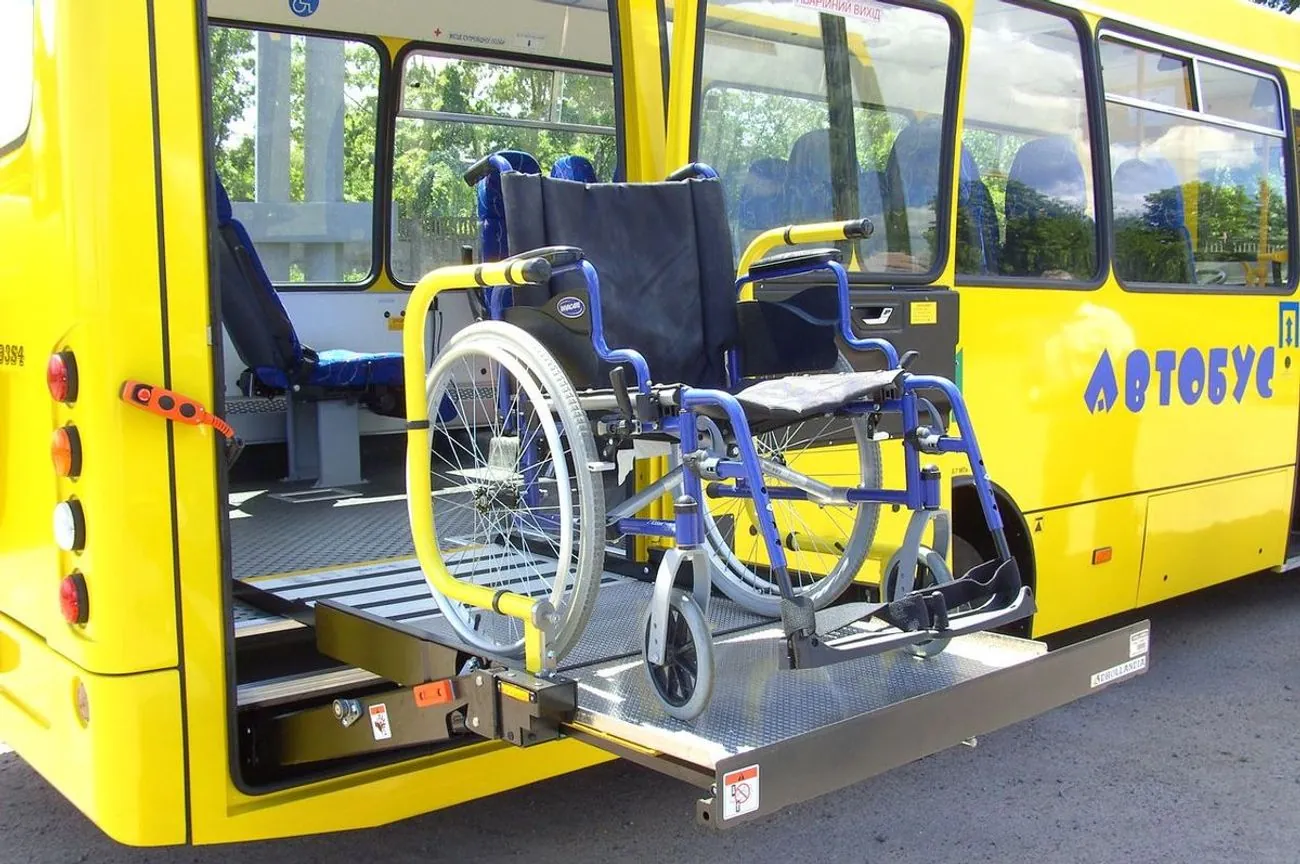
How is the inclusiveness of the transport system ensured? What specific measures have been taken to adapt public transport to the needs of people with disabilities?
According to statistics, Ukraine is moving in this direction, but slowly. Barriers in public transport, unfortunately, leave millions of Ukrainian citizens outside of full public life. There are numerous surveys that show that only a quarter of people with disabilities are satisfied with the accessibility of transport services. A third of such citizens still cannot freely reach the place of boarding transport. All this is a consequence of the fact that the issue of the need for accessibility in Ukraine has simply not been updated for a long time, and only the war, unfortunately, highlighted for the state the huge need to change these approaches and move in this direction to European practices, which have been in place in the EU countries for decades.
"Given that the state previously often ignored the needs of low-mobility groups and people with disabilities, we have a lot of work ahead of us, as we must be very clear that after the war there will be a huge number of veterans with disabilities in our country. Therefore, we need to prepare our cities and towns now - accessibility should become one of the important principles in the process of rebuilding Ukraine. Reconstruction based on the principles of accessibility of roads and sidewalks is needed. This concerns the application of horizontal and vertical guide paths in all settlements, the voicing of pedestrian crossings, the arrangement of landscaping and park areas, entrances to residential buildings, the reuse of roads and pedestrian paths with depressions for access to sidewalks," the MP emphasizes.
How do you estimate how many people with disabilities and low-mobility groups are currently in Ukraine?
Shulyak notes that there is currently an official figure in Ukraine - more than 3 million people with disabilities. However, it must be understood that due to the war, the number of such people is constantly growing.
We can see that the number of such people has increased by at least 10% due to the war, but I think that as of now this percentage is already higher. Moreover, the criteria for establishing disability are also changing. The last update was at the end of 2024, when the Cabinet of Ministers made relevant changes to the regulatory document that defines these criteria. So I think that, unfortunately, the real number of people with disabilities is already higher. In Kyiv alone, there are currently almost 150,000 people with disabilities, almost 13,000 of them are children, and almost 10,000 received disabilities as a result of the war
In her opinion, after the end of the war, the number of veterans and families who lost loved ones due to the fighting may increase by at least 4 times.
"We are already seeing that at least 30% of Ukrainian veterans are people with disabilities. 45% of such citizens have a group II disability, that is, these are people who are able to take care of themselves, but cannot work in normal conditions. Another 47% are citizens with a group III disability, that is, these are people who can work in easier conditions. It is crucial for us to develop social entrepreneurship in Ukraine for such people. Ukraine should develop social entrepreneurship. This concept has existed since the 1950s. For example, social enterprises are recognized as a powerful mechanism for combating poverty, empowering women, a catalyst for social transformation and institutional change, and a factor in increasing the living wage. There are also such cases in Ukraine - for example, bakeries where people with mental disabilities work, social workshops where veterans and people undergoing treatment for alcohol and drug addiction work. There are many such examples. The catalog of social enterprises in Ukraine published several years ago includes more than 150 companies. They are all different in terms of areas of influence, business models and scale, but they all change the rules of the game," the people's representative noted.

Currently, more conditions should be created in Ukraine for the development of social enterprises. For example, in the EU, a few years later, there were more than 2 million social enterprises, which is 10% of all businesses. More than 11 million people - about 6% of EU workers - work in social economy enterprises. In the last decade alone, 16 EU countries have adopted new legislation and 11 countries have created a clear policy to support the social economy. To introduce and develop real accessibility, Ukraine must borrow and use their experience.
"I believe that the final adoption of draft law "On Veterans' Entrepreneurship" No. 10258 will significantly improve the situation in the field of professional and personnel accessibility. Supported in the first reading in October of this year, it can become the first step for, on the one hand, a more complete reintegration of veterans into civilian life, and on the other hand, a powerful incentive for the number of businesses launched by veterans in the social entrepreneurship segment to increase by a third. Finally, I would like to note that accessibility is not just a ramp. This is the creation of a social space with respect for the needs of different people. And these are not only physical obstacles, but also obstacles to work, education, leisure, and life in general. Therefore, for Ukraine, which is currently planning and implementing its recovery according to the principle of "Better than it was", it is crucial to take care of both the physical accessibility of cities and the social inclusion of servicemen and IDPs, improving the digital accessibility of services, accessibility to education and the social economy," the MP summarized.