










Everest is no longer the highest: scientists have found giant structures under the Earth that are 100 times taller than it
Kyiv • UNN
Researchers have discovered two giant underground zones beneath Africa and the Pacific Ocean, reaching 1000 km in height. These structures, formed billions of years ago, are changing our understanding of the planet's internal structure.

Researchers have discovered gigantic structures deep beneath the Earth's surface. They are so massive that Mount Everest appears tiny in comparison. This is reported by UNN with reference to Daily Galaxy and Nature magazine.
Details
A new study published in Nature magazine indicates the existence of two gigantic underground zones that extend from the core-mantle boundary deep into the planet. Their "height" reaches about 1000 km – almost a hundred times more than the height of Mount Everest. They are located under Africa and the central Pacific Ocean.
Despite the fact that these structures are not mountains in the usual sense and are not composed of ordinary rock, in terms of their size, they are the largest known objects inside the Earth.
Almost 900 people evacuated from Everest after heavy snowstorm08.10.25, 10:42 • 3377 views
It is noted that the discovery actually changes the understanding of the planet's internal structure and opens up new possibilities for studying its development.
These super-dense regions are believed to have formed billions of years ago, preserving chemical traces of early Earth and playing a role in the origin of volcanoes, tectonic processes, and mantle convection.
Scientists at Utrecht University obtained these results by applying a new approach to seismic analysis. They studied waves passing through the Earth after powerful earthquakes, tracking how their energy gradually dissipates as they move deeper into the planet. This allowed for the first time to create a three-dimensional model of energy propagation within the mantle.
In the course of the study, they discovered zones under Africa and the Pacific Ocean where shear waves propagate slower and attenuate less intensely. According to scientists, the combination of such characteristics indicates the existence of gigantic anomalous formations known as large low-shear-velocity provinces (LLSVPs).
These are not mountains in the classical sense. These are thermochemical structures that rise from the core-mantle boundary and influence mantle flows.
According to researchers, each of these structures can reach up to 5000 km in width, and their "height" is so enormous that if such formations were brought to the Earth's surface, the very concept of "height" would have to be rethought. The QS4L3 model became the first global model to describe the properties of wave attenuation in the Earth's interior.
One of the main mysteries of LLSVPs is their origin. The most common hypothesis, confirmed by new results, is that these are remnants of very ancient tectonic plates that sank into the mantle billions of years ago through subduction and subsequently accumulated in its lower layers, forming peculiar "plate graveyards."
Due to their special chemical composition and increased density, these massive structures hardly mix with the surrounding mantle, making them some of the most stable and long-lived formations within the Earth.
It appears these are chemically distinct domains that have existed since the earliest stages of Earth's history.
This is indicated by a combination of low attenuation and low shear wave velocity, which suggests high density, high temperature, and a unique composition.
The location of these structures directly above the core makes them a potential source for the formation of mantle plumes – hot flows of matter that create volcanic "hotspots" such as Hawaii, Reunion, or Iceland. Their shape and scale can also influence global mantle flows responsible for plate movement and continental breakup.
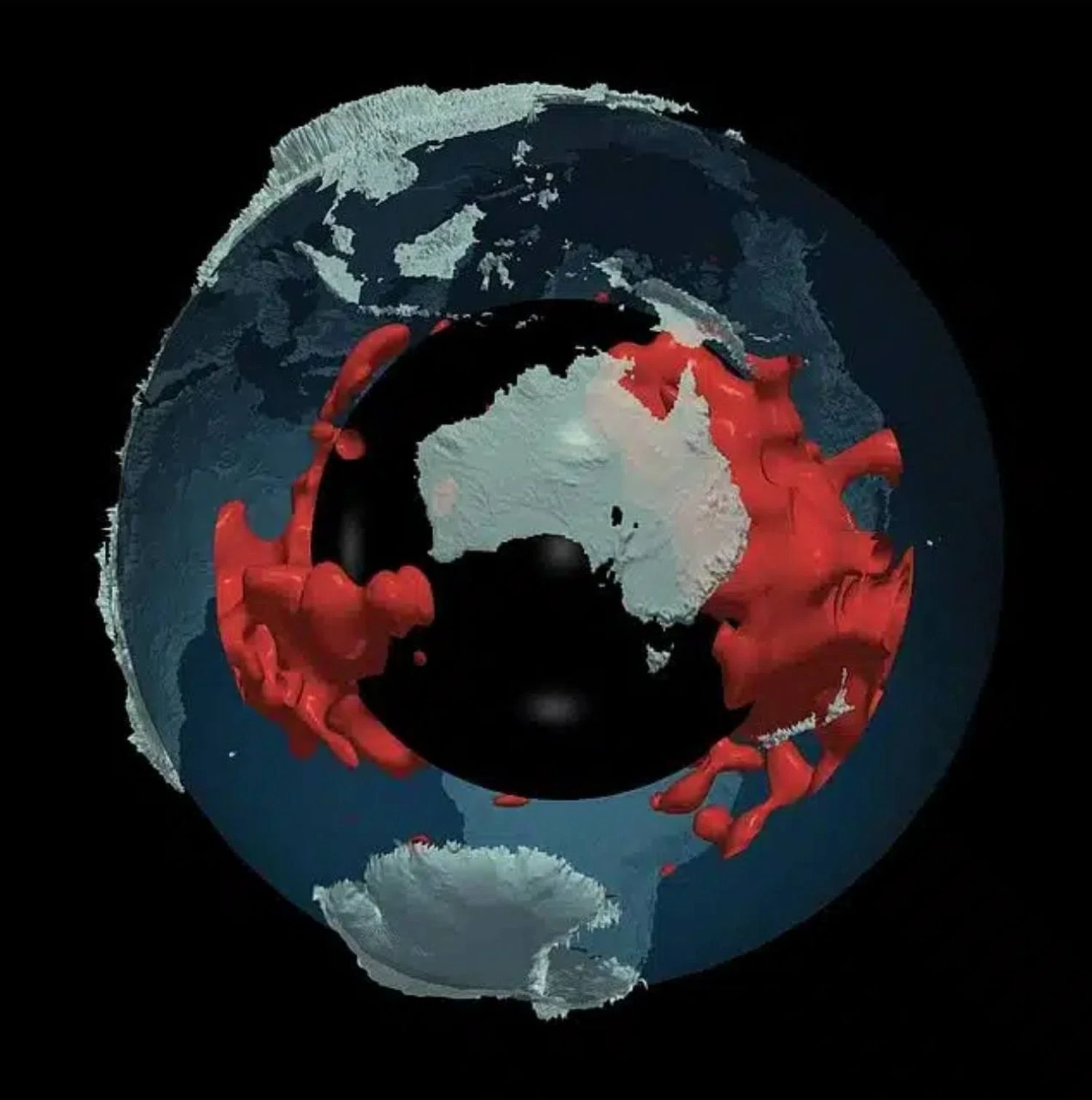
The new seismic model not only shows these anomalous structures – for the first time, it allows for a separate assessment of the influence of temperature and chemical composition at a global level. This discovery provides important clues to understanding the processes that determine the formation of the Earth's surface.
According to researchers, LLSVPs can act as peculiar "mantle anchors," remaining in their positions for hundreds of millions of years and influencing the directions of convection currents. Thanks to such stability, they can play a significant role in the cycle of supercontinent formation and destruction, adding new details to modern ideas about plate tectonics.
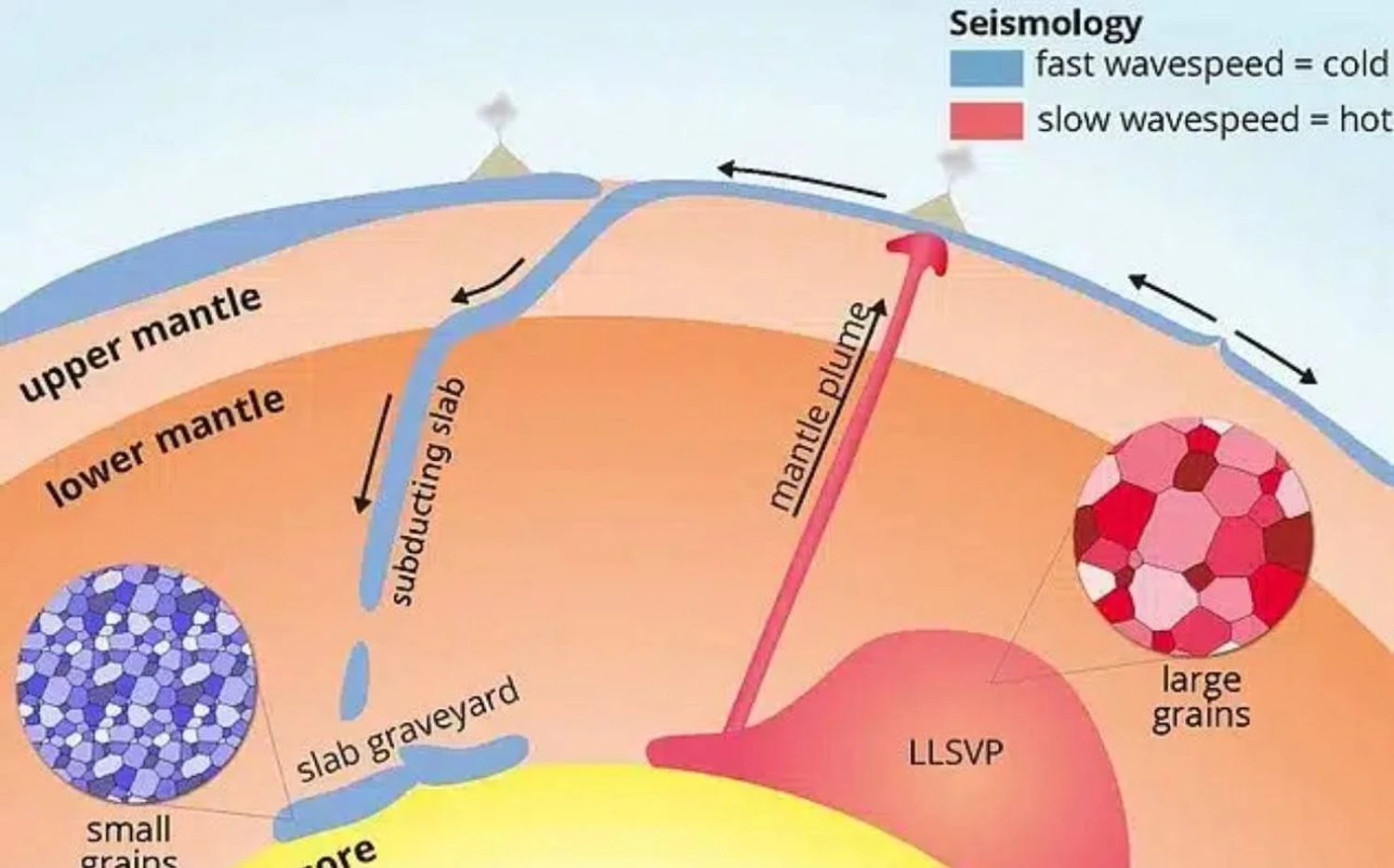
While previous models were primarily based on analyzing the speed of seismic waves, the new approach, based on studying energy attenuation, shows how efficiently it propagates in the mantle. This expands our understanding of its thermal and chemical properties. The results confirmed that the areas with the lowest attenuation completely coincide with LLSVPs, indicating their chemical, and not just thermal, origin.
Scientists note that although most of the mantle is constantly mixing, LLSVPs remain isolated areas. They can preserve very ancient material and potentially serve as a source of volatile elements that affect climatic and biological processes on the planet's surface.