










Ukrainians' cash on hand increased by 12.6% in a year: NBU named the main reasons
Kyiv • UNN
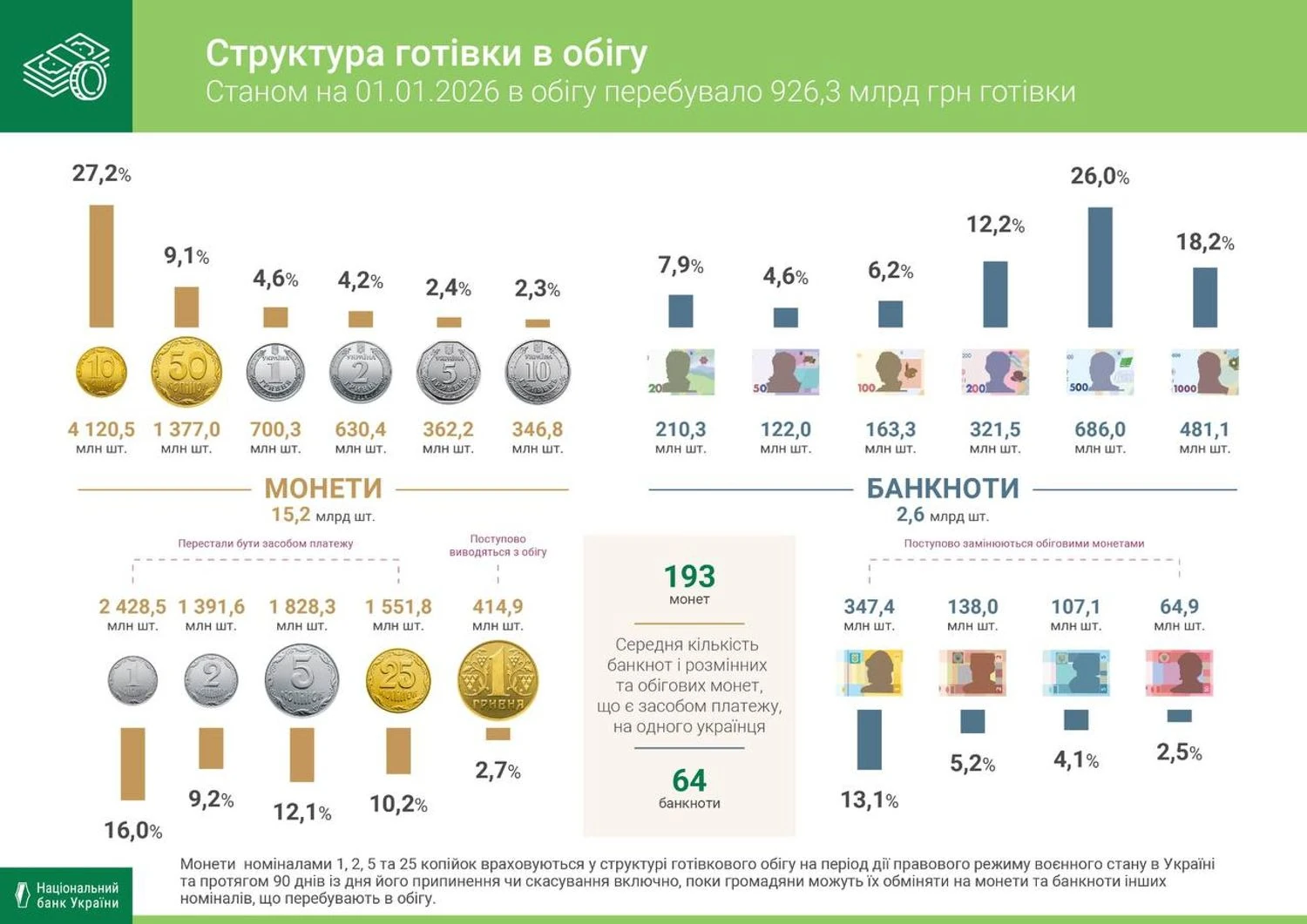
In 2025, the amount of cash in circulation in Ukraine increased by 12.6% to UAH 926.3 billion, due to the recovery of economic activity and the risks of attacks. 500-hryvnia banknotes are most in circulation, and the number of 100- and 50-hryvnia banknotes increased for the first time in years.

Cash in circulation in Ukraine increased by 12.6% over the year - to UAH 926.3 billion, with cash reserves being encouraged, in particular, by Russian attacks. The 500-hryvnia banknotes are the most common in circulation, but for the first time in recent years, the number of 100 and 50 hryvnia banknotes in circulation has increased. This was reported by the NBU on Wednesday, writes UNN.
In 2025, the amount of cash in circulation in Ukraine increased by 12.6% (or by 103.9 billion hryvnias) and as of January 1, 2026, amounted to 926.3 billion hryvnias.
Last year, the growth rate of cash in circulation, according to the regulator, "somewhat accelerated (in 2024, the growth was 7.6%)". "This is due, in particular, to the further recovery of economic activity, part of which is served by cash circulation," the National Bank explains.
"This was facilitated, in particular, by an increase in wages and social payments to the population, stable consumer demand for goods and services, and a slowdown in inflation," the NBU says. "At the same time, the increase in the volume of cash in circulation was also affected by risks associated with the growing intensity of attacks, including on energy and other infrastructure. This encourages citizens to make a certain reserve of cash hryvnia."
Interesting facts
According to the NBU, updated statistics as of January 1 show that:
- there are 2.6 billion banknotes in cash circulation for a total amount of 916.9 billion hryvnias, as well as 15.2 billion coins (excluding commemorative and investment coins) for an amount of 9.3 billion hryvnias;
- at the beginning of this year, there were 64 banknotes and 193 payment change and circulation coins per inhabitant of Ukraine (as of January 1, 2025 - 63 and 186 units, respectively);
- among banknotes, the 500-hryvnia denomination is the most common, and the 50-hryvnia denomination is the least common (26% and 4.6% of the total number of banknotes in circulation, respectively).
- among circulating coins, 1-hryvnia coins are the most common, and 10-hryvnia coins are the least common (4.6% and 2.3% of the total number of circulating coins, respectively). In 2025, 3.1 million 10-kopeck coins were already withdrawn, and their share among all coins is currently 27.2%. In contrast, there is a stable demand for 50-kopeck change coins, particularly from the trade and services sector. Their share of the total number in circulation is 9.1%;
- the dynamics of coin volumes in circulation indicate that the largest growth rate in 2025 was for 5 and 10 hryvnia coins. Their number in circulation increased by 21% and 29%, respectively, compared to the beginning of 2025;
- the number of 25-kopeck coins in cash circulation decreased the most last year, by 0.1% compared to the beginning of 2025, which is due to the withdrawal of these non-payment coins from circulation;
- in 2025, for the first time in recent years, the number of 100 and 50 hryvnia banknotes in circulation increased (by 4.5% and 6.3%, respectively, compared to the beginning of the year). This may be a consequence of the NBU's tariff policy change aimed at increasing the divisibility of banknotes;
- among the banknotes that support cash circulation, the largest reduction in number is for 200-hryvnia banknotes, whose number in circulation decreased by 17.6% last year (in particular, due to their active replacement with 1000-hryvnia banknotes and the gradual withdrawal of old samples of this denomination from circulation);
- the number of 10 and 5 hryvnia banknotes significantly decreased (by 10% and 8%, respectively), as, as already noted, they are gradually being withdrawn from circulation and replaced with corresponding coins.