










The one who adapts faster wins: how the latest developments of Ukrainian arms manufacturers are changing the course of the war
Kyiv • UNN
The Ukrainian defense industry has created innovations based on flexibility and rapid adaptation to the challenges of war, changing the balance of power against a numerically superior army

The modern Ukrainian defense industry has been shaped under the pressure of a full-scale war, which has already been called the first war of drones. Ukrainians have realized that the ability to adapt and quickly implement innovations, scale technologies, and find the most effective and relatively cheap solutions provides an advantage. Flexibility and understanding of challenges are reflected in most products of the domestic defense industry after 2022. Read about the most iconic ones that have appeared recently in the material of UNN.
Recently, information emerged that the first Ukrainian ballistic missile has passed tests. It is likely about the operational-tactical missile system "Sapsan", developed by the "Pivdenne" Design Bureau. From open sources, it is known that this is a single-stage solid-fuel rocket about 7 meters long with a launch mass of 3–3.5 tons, with a monoblock warhead weighing 480–500 kg, capable of destroying both point and area targets. However, based on the latest reports about the missile, it can be assumed that it has been refined.
Another missile program has been launched by the private defense company Fire Point. It involves two ballistic missiles, the FP-7 and FP-9. The first has a stated flight range of up to 200 km, and the second – 855 km. However, serial production has not yet begun.
While Ukraine expects that our military will be able to actively use ballistic missiles against the enemy, they are already actively using various types of combat drones: FPV, strike drones of various types and classes, including "mid-" and "deep strikes", naval drones and ground robotic systems. One of the breakthroughs of recent months has been the use of modernized FP-1 drones, capable of covering at least 3,000 km to the target.
On June 20, the Deep Strike units of the Special Operations Forces of the Armed Forces of Ukraine struck the Tyumen oil refinery – the drones successfully covered about 2,500 kilometers to the target. But even more impressive was the strike on the Omsk oil refinery – the attack drones had to fly over 2,500 km to the target. In Russia, they still do not believe that the UAVs were launched from the territory of Ukraine.
The changing nature of combat operations, the expansion of no-fly zones, and the need to engage a variety of targets have contributed to the emergence of unmanned systems that become carriers of other types of weapons. An example of such a combat platform is the MOBIDIK unmanned surface vessel from the company "Avarid". It has a range of up to 1400 km and an endurance of up to 120 hours. MOBIDIK can serve as a platform for FPV drones, interceptor drones, and carry attack unmanned aerial vehicles.
A similar upgrade was received by the FP-2 attack UAV – such drones are equipped with two launchers, each carrying four unguided S-5 rockets. This allows engaging flammable and lightly armored targets even during the flight to the main objective.
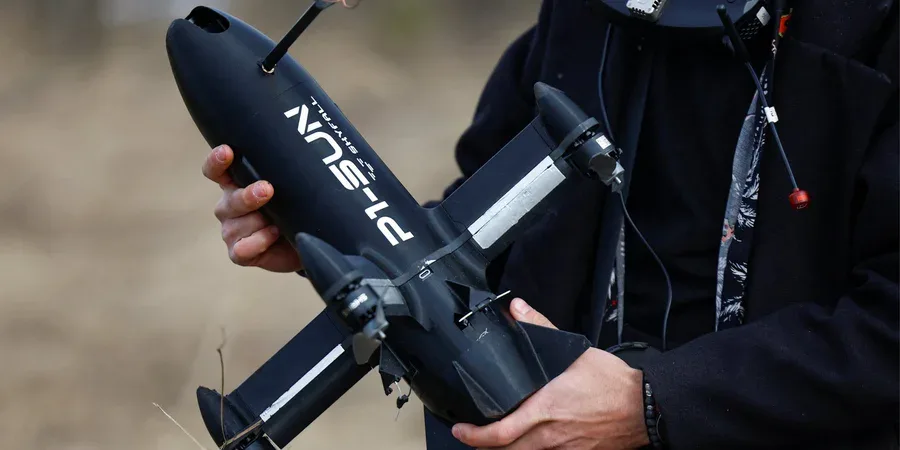
At the same time, interceptor drones remain one of the key trends. In February 2026 alone, interceptor drones destroyed over 10,000 Russian unmanned aerial vehicles. According to various estimates, interceptors neutralize between 30% and 40% of "Shahed" drones, and the overall effectiveness of such drones can reach 90%. One of the most famous interceptors became the P1-SUN, which the military nicknamed "Pisun". The manufacturer SkyFall claims that this drone is 90% assembled from Ukrainian components and the cost of one interceptor does not exceed one thousand dollars. When other countries became interested in "Pisun" this spring amid the escalating situation with Iran, information emerged that the interceptor had successfully destroyed at least a thousand targets.
Ukraine needs a defense line at sea with interceptor drones - Zelenskyy04.07.26, 21:55 • 8528 views
But Russia strikes Ukraine not only with "Shaheds," but also with missiles of various types and guided aerial bombs. Ukraine is learning to counter these threats as well, without relying solely on "classic" means of counteraction, such as, for example, anti-aircraft missile systems. Thus, it recently became known that the domestic electronic warfare system "Lima," which was created in 2022 primarily to counter drones, has demonstrated effectiveness against Russian aeroballistic missiles as well. According to the developer, Cascade Systems, in the first three months of 2026 alone, the system successfully deflected or neutralized 26 Kh-47M2 "Kinzhal" missiles. In total, since the beginning of the use of this system, it has managed to neutralize 58 missiles of this type.
"Lima" operates as a strategic-level electronic warfare system. Its main operating principle consists of a powerful electronic influence on the satellite navigation of targets, in particular on GNSS systems. Due to such counteraction, enemy missiles lose guidance accuracy and critically deviate from their set course. This technology also works with guided aerial bombs.
Ukraine develops DART missile: it ignores EW and launches from balloons17.06.26, 03:46 • 11984 views
In general, the latest developments of the Ukrainian defense industry increasingly have the potential to counter enemy electronic warfare systems and resistance to jamming, often achieved by integrating artificial intelligence into the product.
Ukrainian arms manufacturers in recent years have designed and begun producing a fairly wide range of means, both for defense and for destroying the enemy. All this became possible thanks to a forced deep rethinking of approaches to defense, and accordingly to the production of weapons. Most of the above-mentioned means share common features: a short path from idea to production, relative cheapness and maximum efficiency for their cost, and the ability to quickly scale production.