









Reservations under the new system: why the government’s assurances failed to allay the concerns of business and parliament
Kyiv • UNN
The Cabinet of Ministers is finalizing amendments to the rules for reserving employees of critical enterprises, despite warnings from businesses and members of parliament about risks to defense capabilities and the economy. At the same time, the National Agency for the Prevention of Corruption identified a number of corruption risks in the government initiative.

The government resolution on reducing reservation quotas for critical enterprises has sparked a wave of outrage among business representatives, the public, and parliament. Today it became known that the Cabinet of Ministers has not yet made a final decision, but the debate around the proposed changes is gaining momentum. Despite assurances from Prime Minister Serhii Koretskyi that there would be no radical changes for the defense industry and energy sector, business representatives and members of parliament continue to insist that the initiative be canceled and that consultations be held with business representatives, reports UNN.
Government decision to restrict reservations
On October 13, the Cabinet of Ministers of Ukraine considered amendments to Resolution No. 76, which regulates the procedure for reserving military-liable employees. According to media reports, during the meeting the government did not make a final decision on reducing reservation quotas for critically important enterprises.
The draft resolution proposed reducing the percentage quotas for reservations for enterprises in the defense-industrial complex and energy sector—from 100% to 85%, and for the municipal sector—from 75% to 60%. The relevant changes are to be revised within 5 days.
The document removed the provision excluding employees who have a deferment (students, parents of many children, and others) from the calculation.
The government decided to establish a Coordination Center involving the Security Service of Ukraine, the Defence Intelligence of Ukraine, the Foreign Intelligence Service, and the National Police, with the relevant decision to be further revised.
At the same time, business representatives pointed out that the proposed changes had not been discussed with them and that business had not received any official clarifications regarding the decisions made. Business associations sharply criticized the government initiative, noting that such a decision would deepen the personnel shortage in critical sectors and cause economic losses for the state.
The details will be provided when they are made public
Commenting on the issue of reducing reservation quotas for critical enterprises, Prime Minister Serhii Koretskyi confirmed that the government had not discussed this initiative with business.
This resolution is currently being worked on; it will definitely be revised, adopted, and published. There is no betrayal here. All the details will be provided exactly when they are published and all the relevant decisions are made. So the skepticism currently being discussed in society has no basis. There are no official decisions, so there is nothing to criticize at this point
At the same time, Koretskyi added that the mobilization process needs improvement.
There is no need for critical enterprises that are genuinely critical for both the defense complex and the energy complex to worry. I can say with great confidence that there will be no radical changes for these people, these enterprises, or these production facilities
At the same time, Koretskyi did not mention other critically important sectors that had already expressed concern about changes to the reservation rules and reductions in quotas.
According to the Prime Minister, 100% reservations create opportunities for manipulation, and enterprises with critical status can endlessly expand their workforce and reserve employees regardless of their qualifications.
Unfortunately, this system has already grown to a considerable scale. Therefore, this is the only reason why we are considering the 100% threshold—whether to modify it or nevertheless leave it as it is, because, unfortunately, there are many abuses
Koretskyi said that he considers enterprises that support defense capability and life-sustaining services to be critical. At the same time, the Prime Minister did not mention enterprises in related sectors that also help provide for the army or fulfill government contracts.
As an example, he cited a company that carries out work for "Ukrenergo", where all personnel are reserved. According to him, only some of the employees work under contracts for the energy company, while the rest are engaged in business.
At the same time, Koretskyi is evidently deliberately ignoring the fact that, in order to be able to operate, private companies also need to have funds to maintain their personnel.
Parliament plans to cancel the government's decision
Just now, Resolution No. 16160 was registered in parliament, authored by me and 62 other MPs from all factions and groups. (…) I will not put the adoption of this resolution to a vote because I understand that it needs to be prepared, but I have an appeal and a request to the Prime Minister and the members of the Cabinet of Ministers. This is not only the position of members of parliament; it is the position of business, think tanks, local government and, most importantly, energy workers and the defense-industrial complex — stop this decision, hold consultations, and only after that adopt the final document
Iryna Friz, a member of the Verkhovna Rada of Ukraine Committee on National Security, Defense and Intelligence, said that the committee had considered the issue of changes to the reservation system announced by the government.
According to the report by representatives of the Ministry of Economy and the Ministry of Defense of Ukraine, as of now, there is still no final text of the Cabinet of Ministers' Resolution. It is still being coordinated, revised and awaiting a political decision….
According to her, during the discussion, parliamentarians pointed out that government officials had not substantiated the need to reduce reservation percentages for critical enterprises in certain sectors, nor provided methodological calculations or modeling of the consequences of such a decision.
She recalled that the Ministry of Defense had opposed reducing the reservation limits in the defense-industrial complex from 100% to 85%. In addition, according to her, committee members did not receive exhaustive arguments from government officials regarding the expediency of creating a Coordination Center, its functions and powers. The committee's decision points to the lack of justification and the risks of reducing quotas for the defense-industrial complex.
I must emphasize that the government's proposed reduction of reservation quotas to 85% for defense and energy enterprises and to 60% for heat and water supply enterprises and other utility services creates risks for the stable operation of both defense-industry enterprises and critical infrastructure
She added that the state's mobilization needs and the capabilities of the defense industry and critical infrastructure must be balanced.
The government must finally understand that without the people who produce weapons, restore the energy system and ensure the country's vital functions, it is impossible to guarantee the state's resilience during wartime. That is why changes must be developed and adopted exclusively on the basis of sectoral audits, an analysis of compliance with criticality criteria, and accountability and the inevitability of punishment for corrupt schemes involving personnel reservations
NACP warns: the government's decision carries corruption risks
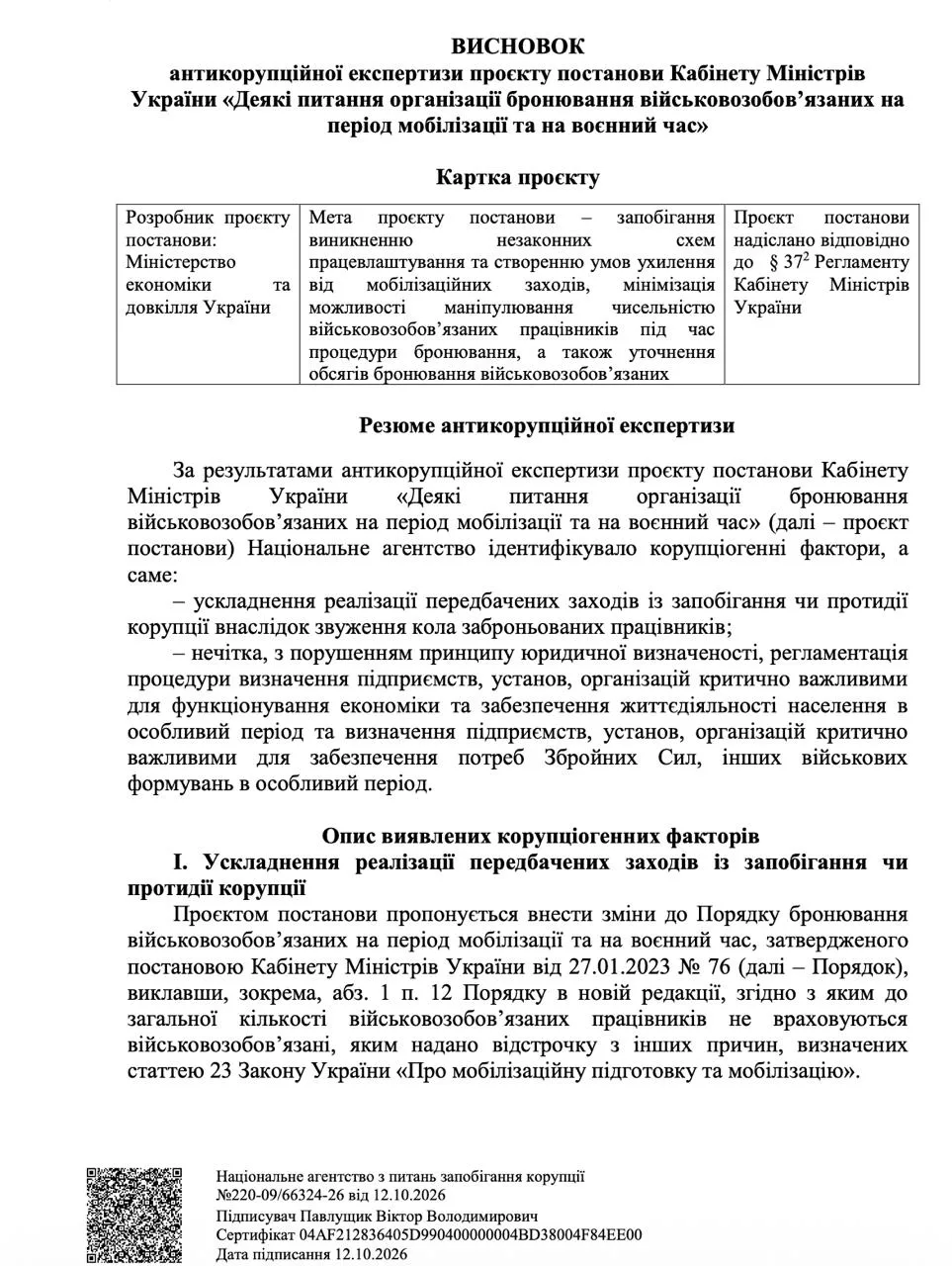
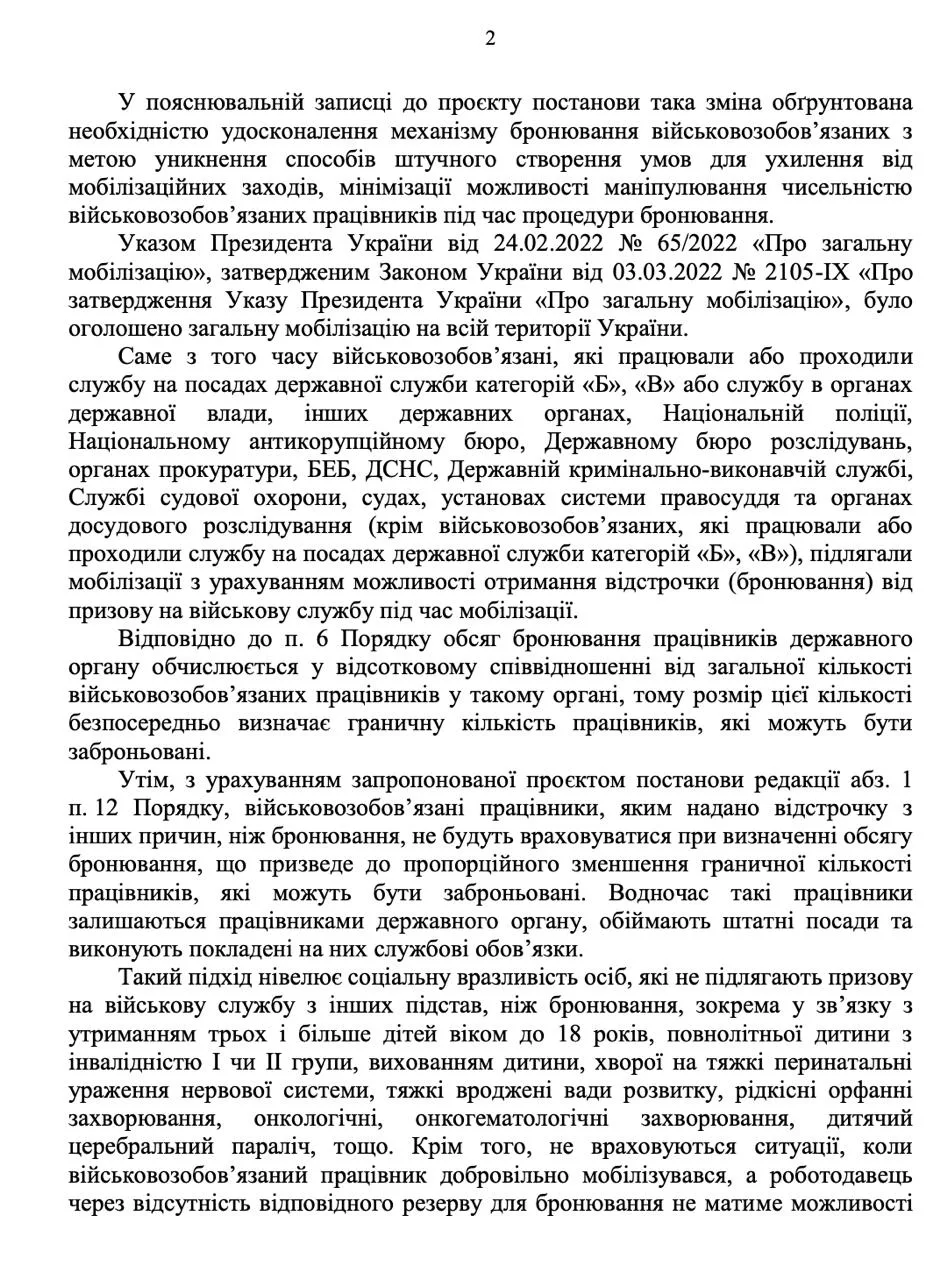
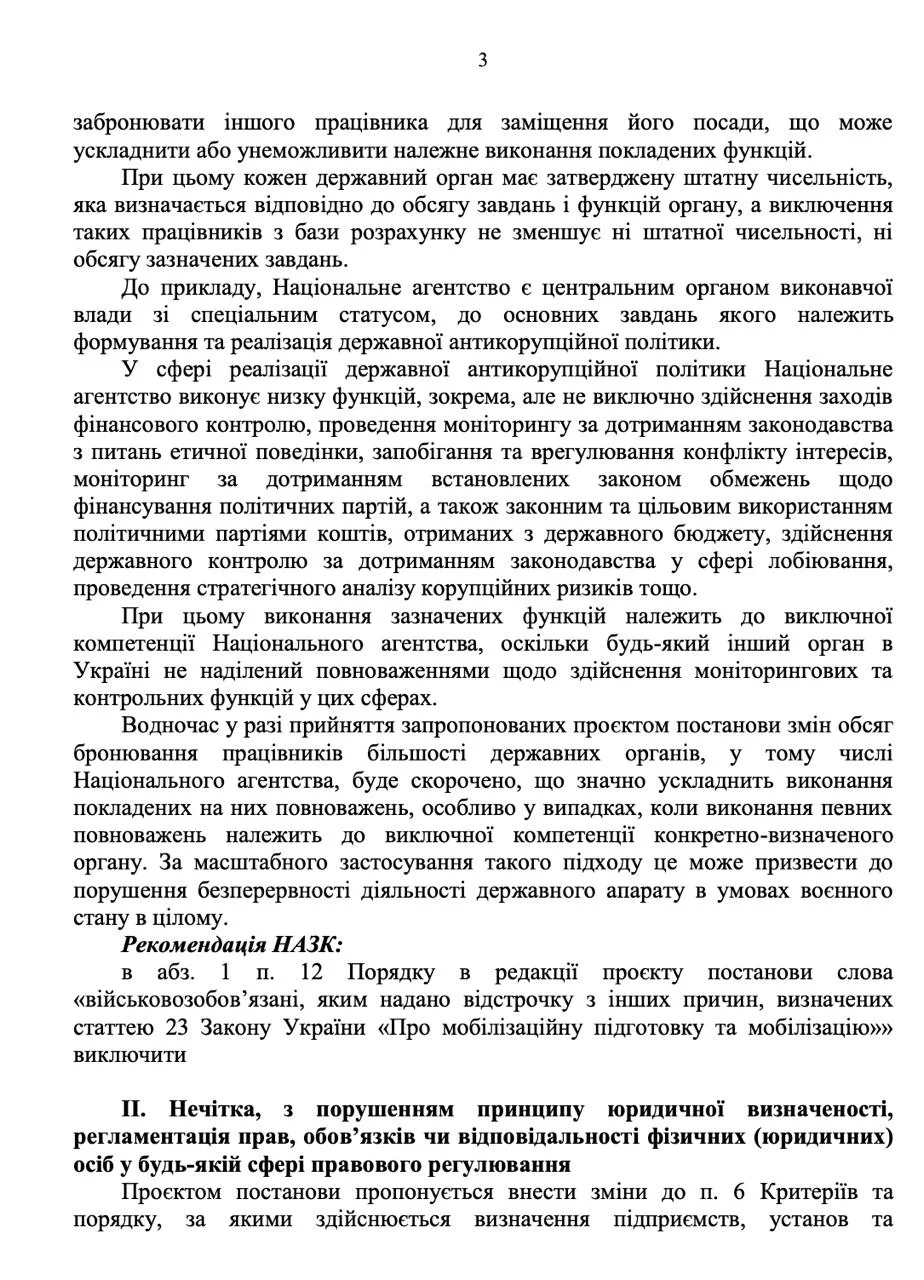
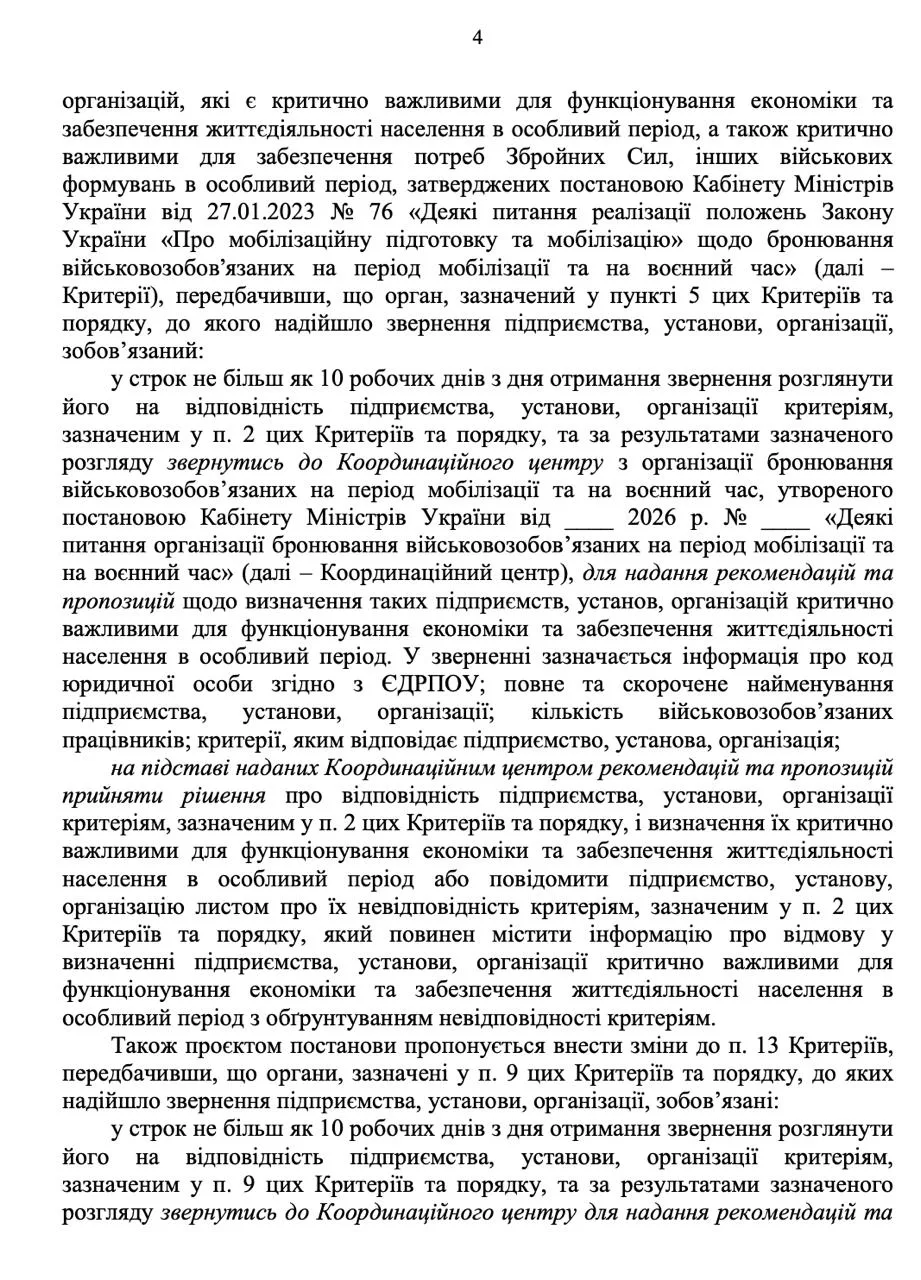
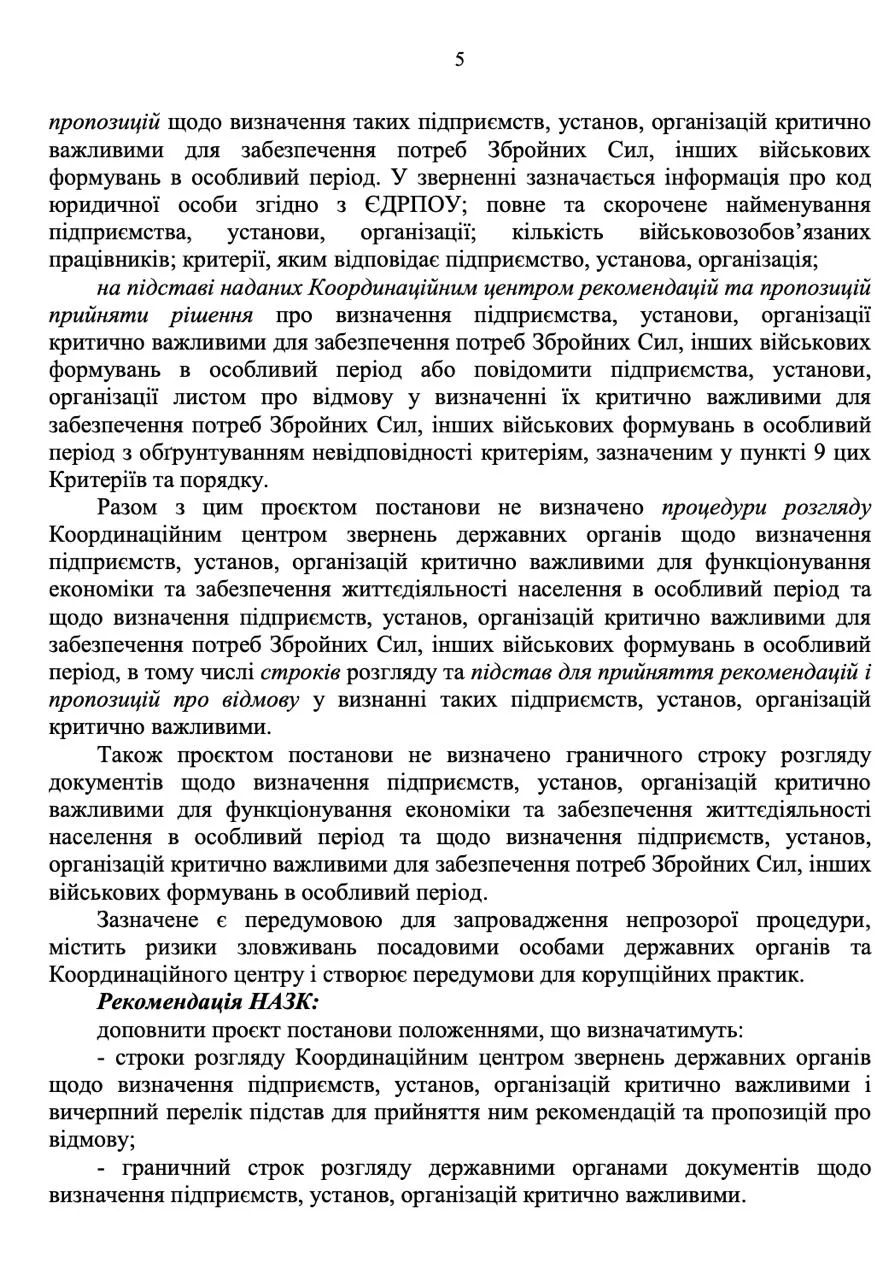
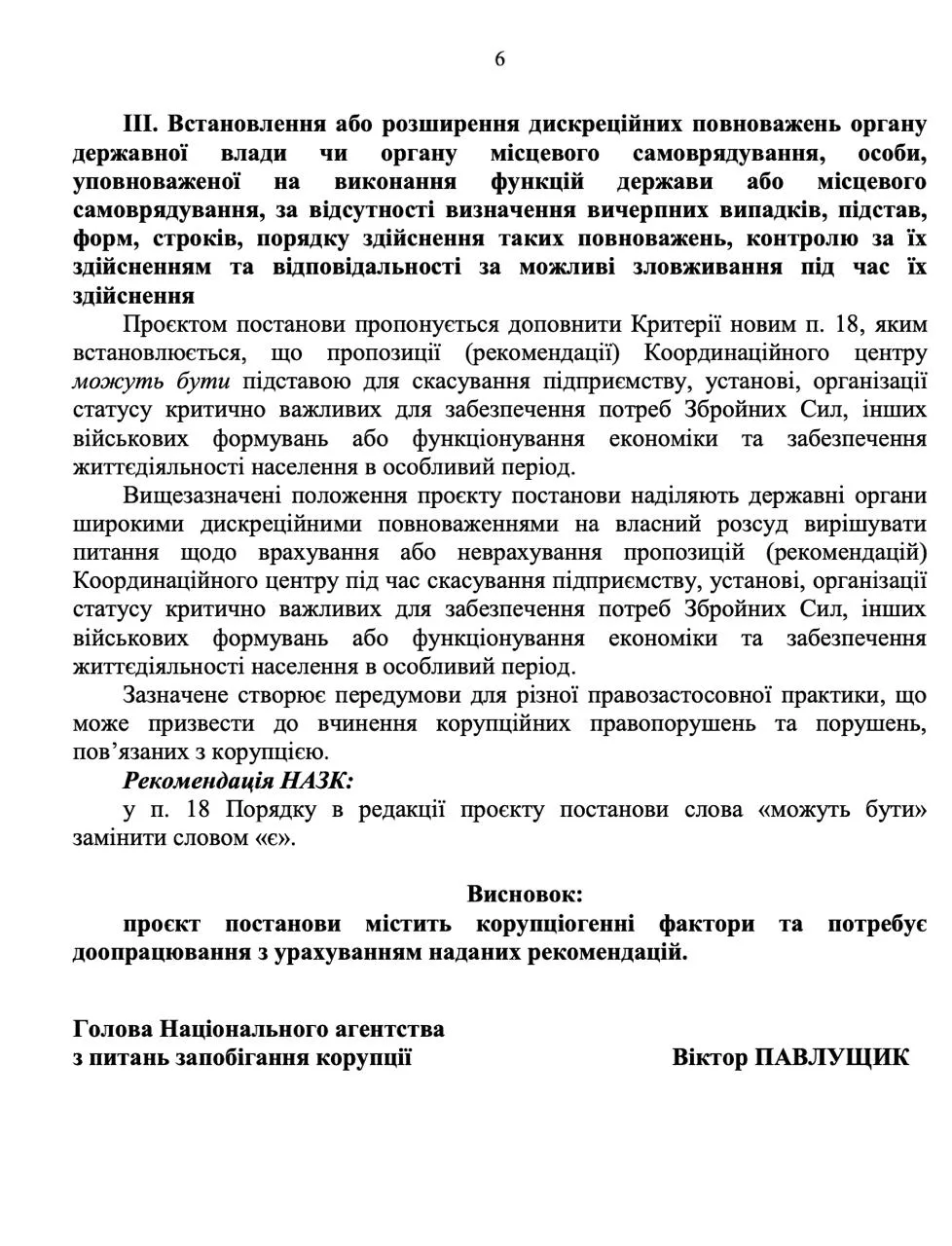
The UNN editorial office has a decision by the National Agency on Corruption Prevention at its disposal, which contains comments on the government resolution.
In particular, the NACP recommended removing the provision under which the government proposed excluding employees with deferments from the calculations of the quotas, which significantly reduced the calculation base. In this regard, the Cabinet of Ministers took the comments into account and, as already mentioned, the provision was removed.
In addition, the Agency pointed out that the creation of a Coordination Center in the version proposed by the Cabinet of Ministers — without specifying the rules of operation, the deadlines for granting enterprises critical-importance status, and the grounds for refusal — "creates preconditions for corrupt practices".
According to the government resolution, the Coordination Center will provide recommendations, while the final decision on critical status will be made by the ministry. The NACP also has comments on this provision; the Agency believes that under such conditions, the recommendations should be mandatory in order to eliminate opportunities for abuse.
Thus, despite the government's assurances that there will be no radical changes for critically important enterprises, the proposed amendments to the reservation rules continue to raise a number of questions. The lack of economic calculations, proper consultations with businesses, and the NACP's comments regarding corruption risks indicate that the document requires further work. The government has not modeled the consequences of the changes either for the defense industry and energy sectors or for related critically important industries. Clearly, combating abuse in the reservation system is necessary, but it should not create new risks for enterprises on which the state's resilience during the war depends.