










Protests continue in Serbia: people block streets, there are arrests
Kyiv • UNN
Anti-government protests continue in Serbia, leading to street blockades and arrests. Students called for a “complete blockade of Serbia” due to police brutality and demand early elections.

Anti-government protests continue in Serbia. On Friday, July 4, residents of several Serbian cities spent almost the entire day setting up barricades and blocking streets. This was reported by the Balkan service of "Radio Free Europe", as conveyed by UNN.
Details
Thus, in the afternoon, students and citizens blocked the intersection of King Alexander Boulevard and Roosevelt Street in front of the technical faculty building. The rally was guarded by traffic police, while gendarmerie officers did not appear at the scene.
Residents of the Zemun municipality built barricades from containers and car tires, and traffic on this central street of Zemun was suspended. They announced that for 24 hours, this area would be exclusively for pedestrians.
One of the streets in Belgrade's Konjarnik district was also blocked. Traffic in this part of the city was suspended, N1 reports.
Traffic was also blocked at the roundabout in Belgrade's Voždovac municipality.
In the afternoon, people briefly blocked Republic Square and went to the Stari Grad police station. Police reinforcements arrived there, and people were pushed off the road. Some protesters were detained.
Large-scale protests against President Vučić in Serbia: what is known29.06.25, 01:02 • 6783 views
Near the Misdemeanor Court building in Novi Sad, approximately eighty kilometers north of Belgrade, protesters organized a blockade due to arrests that took place in the morning.
In Niš, a city in southeastern Serbia, citizens also blocked parts of this third-largest Serbian city in the morning.
According to RTS, the main road Užice-Zlatibor, leading to Montenegro, was blocked in western Serbia.
Throughout the day, protesters tried to block the highway near Čačak. They gathered near the toll booth in Pakovraće near Čačak, but the police prevented the highway from being blocked.
On Friday evening, blockades were also organized in Smederevo, Zaječar, Kragujevac, Šabac, and Kruševac.
Earlier that day, police in riot gear removed most of the protest blockades in Serbia, which had been in place since early morning.
Several anti-government protesters were detained in central Belgrade. Arrests also took place in Zemun and New Belgrade near the Faculty of Dramatic Arts, where students were also detained.
At an intersection in the city center, police detained, among others, a minor student of the Mathematical Gymnasium, a Radio Free Europe reporter said.
Students and demonstrators were also detained in Novi Sad.
The day before, students called for a "complete blockade of Serbia due to police brutality."
This call came after police actions, during which almost 80 students and anti-government protesters were arrested in several cities on the night of July 2-3.
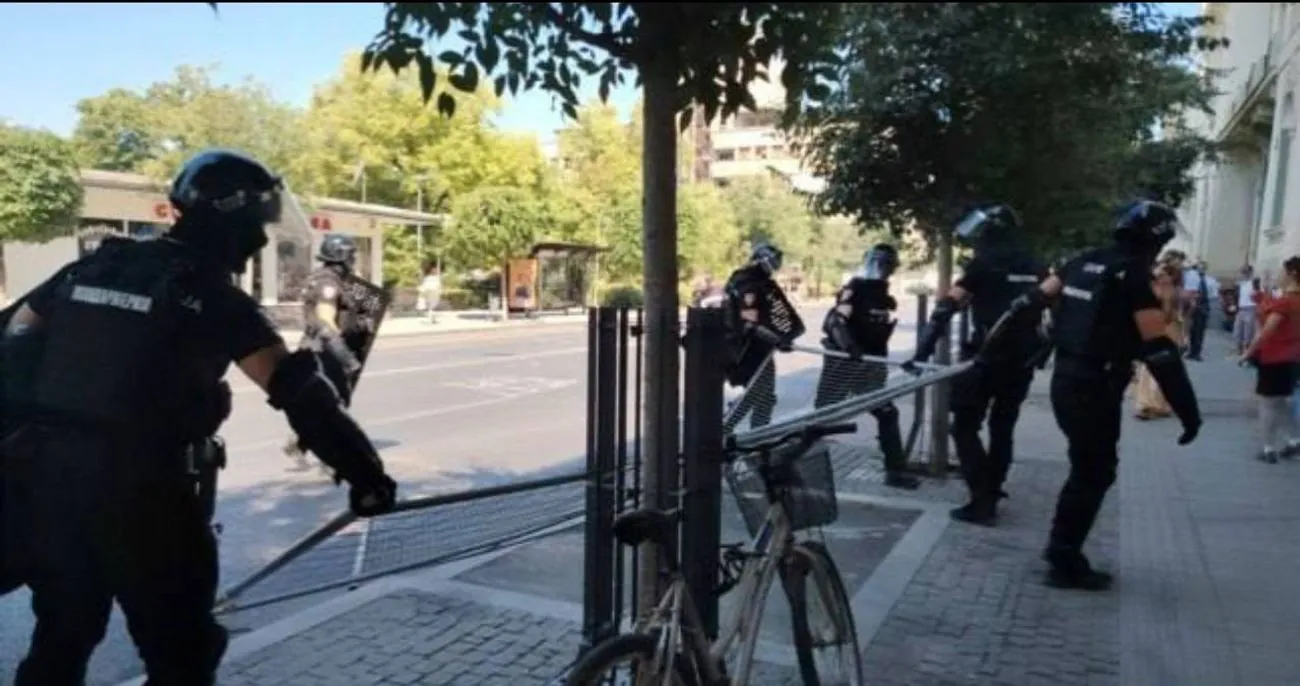
Students accused the police of excessive use of force during the breakthrough of multi-day blockades, demanding, among other things, early elections.
Interior Minister Ivica Dačić stated on July 4 that the police allowed gatherings in certain places in Belgrade that were not vital for traffic functioning, and that where they acted, they acted "without excessive force."
Dačić condemned the continuation of barricades, stating that they "endanger the normal life of all citizens and the functioning of the city."
Serbian President Aleksandar Vučić stated that during the morning "blockade attempts, the police had full control of the situation," and that the participants "had no chance."
The Higher Public Prosecutor's Office in Belgrade called on citizens to "refrain from restricting the right to freedom of movement by blocking public traffic," stating that otherwise, the police are authorized to obtain "permits provided by law."
Representatives of the Protector of Citizens, acting as the National Mechanism for the Prevention of Torture, visited 12 citizens on July 4 who had been arrested earlier that day during protests and blockades.
Protests in Belgrade: Almost 80 People Arrested Following Clashes29.06.25, 17:09 • 5699 views
Blockades in cities across Serbia began after students called for civil disobedience following a protest in Belgrade on June 28.
They demand early elections and the release of students detained during the demonstrations on June 28.
Mass protests and blockades of faculties across Serbia began after 16 people died on November 1 due to the collapse of a canopy at the Novi Sad railway station, and students and citizens demanded accountability from the authorities for the accident.
In Belgrade, protesters block streets and demand elections30.06.25, 09:40 • 3203 views