










Russian information and psychological operations against Ukraine: how the enemy manipulates us
Kyiv • UNN
Russia uses information and psychological operations to intimidate Ukrainians, discredit the authorities, and undermine trust in the country's defense capabilities.

Threats to destroy Kyiv’s bridges, leave Ukrainians without electricity and water, discredit the authorities, and undermine confidence in Ukraine’s ability to resist Russian aggression — the Kremlin uses fear as a weapon against Ukrainian society. How these information attacks work, why Ukrainians are becoming more vulnerable to manipulation, and how to protect yourself from pressure — read in UNN’s article.
While the Russian army attacks Ukraine’s energy infrastructure, propagandists are intensifying panic in the information space. Some of these messages are based on real threats, while others rely on unconfirmed forecasts, exaggerations, and outright lies. According to Andrii Shapovalov, an expert on hybrid threats and countering disinformation, the dissemination of such messages is part of Russia’s information and psychological operations (IPSO).
At the same time, Russian propaganda is not limited to intimidating Ukrainians. The enemy is trying to use the consequences of its own attacks to foment public discontent and intensify distrust in Ukraine’s leadership.
Their goal is to discredit the current Ukrainian authorities as much as possible and shift onto them responsibility for the problems and hardships caused by Russia itself… Another goal of such operations is to sow discord among Ukrainians, intensify fear and panic, and destabilize the situation in the country. Russia may later use these sentiments to promote initiatives aimed at capitulation
Shapovalov draws a parallel with the beginning of the full-scale invasion, when Russian propaganda massively spread messages claiming that Kyiv had allegedly been captured and that President Volodymyr Zelenskyy had fled. At that time, these fake reports failed to achieve the expected effect.
The situation is different now: the war is dragging on, people are becoming tired and are looking for simple solutions and quick results. Russia is trying to take advantage of this, especially on the eve of winter, when concerns about disruptions to electricity, water supply, and other basic services may intensify
According to him, Russian propaganda is trying to convince Ukrainians that the only way out of the situation is to make concessions to the aggressor or change the president. However, neither of these scenarios guarantees an end to Russian aggression.
How does Russia spread its narratives in Ukraine?
Social networks and messaging apps have become some of the main tools of Russia’s information war. It is there that unverified messages can gain millions of views within just a few hours and later make their way into media news feeds. Shapovalov urges Ukrainians to remember that we do not know who owns anonymous Telegram channels, who finances their activities, or whose interests their publications promote.
The Russians use this lack of transparency to promote narratives that serve their interests. Information first appears in anonymous channels, then spreads across other platforms and sometimes even reaches media outlets that treat it as verified
This creates a kind of mechanism for legitimizing fake news.
Another tool is Russian bot networks, which help massively disseminate desired narratives and create the appearance of public support for certain claims. During an address to participants of the Warsaw Security Forum, President of Ukraine Volodymyr Zelenskyy said that after Ukrainian strikes on the data centers of the Russian company "Yandex," "bot" activity had declined.
There is less hatred, less hostility, and fewer provocations. Because there are fewer bots
How is Russia trying to discredit Ukraine’s defense?
A separate area of Russia’s IPSO is the discrediting of the Armed Forces of Ukraine, the military command, and the defense-industrial complex. Propagandists are trying to cast doubt on the effectiveness of the Ukrainian army, the expediency of military operations and leadership decisions, as well as the country’s ability to independently produce modern weapons.
A telling example was the Ukrainian Armed Forces’ Kursk operation, which began in August 2024. The successful breakthrough by Ukrainian troops into Russian territory was accompanied by a large-scale information campaign aimed at discrediting the Defense Forces. As the Center for Countering Disinformation reported, Russian propagandists spread unsubstantiated accusations that Ukrainian commanders had allegedly shot their own subordinates, engaged in mass looting, and committed crimes against civilians. In this way, the enemy sought to discredit the Ukrainian army and undermine trust in the military command.
In August 2026, the Center for Countering Disinformation recorded a new wave of Russian reports in which propagandists attempted to portray the actions of the Russian army as an exceptional military success while simultaneously accusing Ukrainian troops of crimes without proper evidence.
Decisions concerning the army’s weaponry and supplies also come under information attacks. After the first F-16 fighter jets arrived in Ukraine in August 2024, Russian propaganda launched a campaign to undermine their combat capabilities. According to the CCD, one of the aims was to weaken the readiness of Western partners to transfer additional aircraft to Ukraine.
However, information attacks are directed not only at Ukrainian audiences. The reputation of Ukrainian military technologies abroad is also targeted. Thus, in March 2026, the Center for Strategic Communications SPRAVDI reported that Russian propagandists had manipulated statements by U.S. President Donald Trump in an attempt to discredit Ukrainian developments and weaken Ukraine’s position on the international arms market.
Another wave of propagandistic publications concerning Ukrainian weapons was triggered by a statement about the first use of the Ukrainian FP-7 ballistic missile against Russian territory. Following a statement by Fire Point CEO Iryna Terekh, some media outlets wrote that the missile had allegedly failed to meet expectations regarding its range because it had not struck Moscow.
And this despite the fact that back in August, Fire Point publicly reported that the missile’s maximum range was 300 km. Another ballistic missile, the FP-9, is being developed to strike targets at distances of up to 850 km. The first combat use of this missile is expected by the end of autumn 2026.
One of the main objectives of such campaigns is to undermine the trust of Western partners who support Ukraine and finance the development of its defense capabilities in Ukraine’s defense-industrial complex. Eroding this trust could negatively affect international cooperation and support for Ukrainian weapons production
Why are Ukrainians becoming more vulnerable to information attacks?
The prolonged war, constant shelling, losses, and uncertainty are exhausting Ukrainians. In precisely such a state, people may react more acutely to alarming reports and more often trust information that evokes strong emotions.
Psychologist Oksana Homel explains that Ukrainian society is experiencing not simply a stressful situation, but a prolonged traumatic crisis. Its main feature is uncertainty.
It is important for a person to understand the "framework of an event," and then they can allocate their resources. In a situation of uncertainty, however, this is difficult. It can be compared to a marathon in which you have not been told after how many kilometers or at what point the finish line will be
According to her, when a significant portion of one’s energy is spent every day overcoming difficulties, there may simply not be enough psychological resources left for carefully checking information.
In such a state, messages with a strong emotional thrust that touch on our fears, beliefs, or values can provoke a very rapid reaction: believing them, drawing a conclusion, or sharing the information without verifying it
This does not mean that Ukrainians have lost the ability to think critically. However, it is important to remember that under the influence of prolonged stress, people are more likely to react automatically, trying to reduce the burden on their psyche.
Moreover, a feeling of helplessness may develop: "I have no influence over anything." The belief that "we are insignificant people; nothing depends on us" has been familiar since Soviet times
However, Gomel emphasizes that it would be wrong to explain all the negative sentiments of Ukrainians solely by the influence of Russian propaganda. Fear, exhaustion, and distrust may be a natural reaction to real danger.
It is important to distinguish justified criticism from manipulation. Negative news is not necessarily manipulative, and criticism of the authorities is not the same as undermining trust in the country
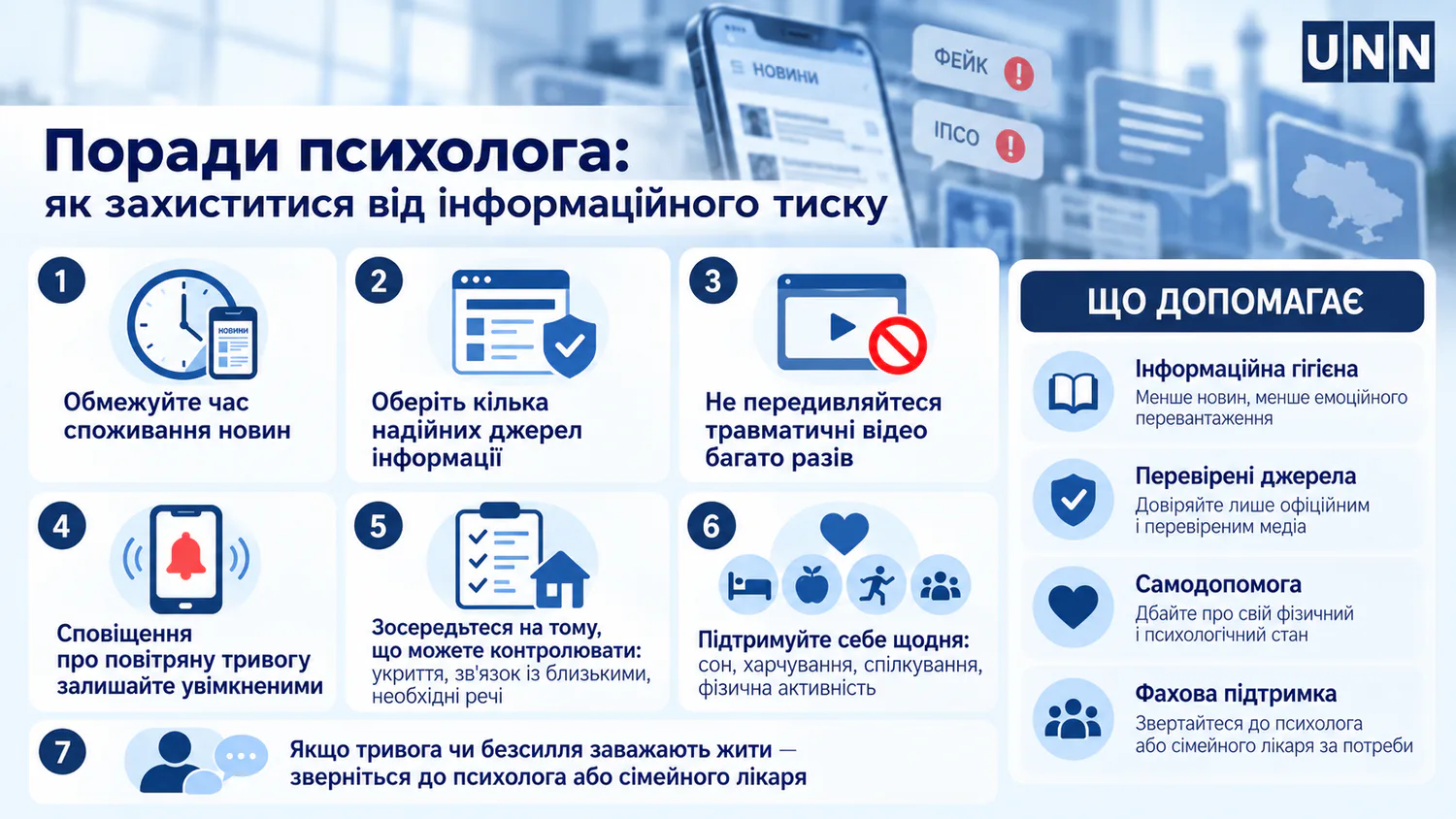
How can you protect yourself from information pressure?
It is impossible to completely give up the news during wartime. However, constantly monitoring reports about potential strikes, missile movements, or the aftermath of shelling may only increase anxiety. Oksana Gomel advises limiting the time spent consuming news, filtering out several reliable sources for yourself, and avoiding repeatedly watching traumatic videos.
Important!!! At the same time, official air-raid alerts must remain enabled.
Another way to reduce anxiety is to focus on what a person can genuinely influence: know the location of a shelter, have a plan for communicating with loved ones, take care of essential items, and maintain a regular daily routine.
According to Gomel, even simple daily activities help maintain psychological resilience: adequate sleep, regular meals, communication with loved ones, and physical activity. However, if anxiety, helplessness, or sleep disturbances interfere with daily life for a prolonged period, it is worth consulting a psychologist or family doctor.
Prolonged stress leads to memory problems and excessive anxiety15.11.24, 17:02 • 18320 views