









Marriages from the age of 14 will not happen - the corresponding amendment will not be introduced into the civil code: why they changed their mind and what experts say about it
Kyiv • UNN
Draft law No. 14394, which allowed marriage from the age of 14 under certain conditions, has been withdrawn after public discussions. The Chairman of the Verkhovna Rada, Ruslan Stefanchuk, confirmed the removal of the amendment.

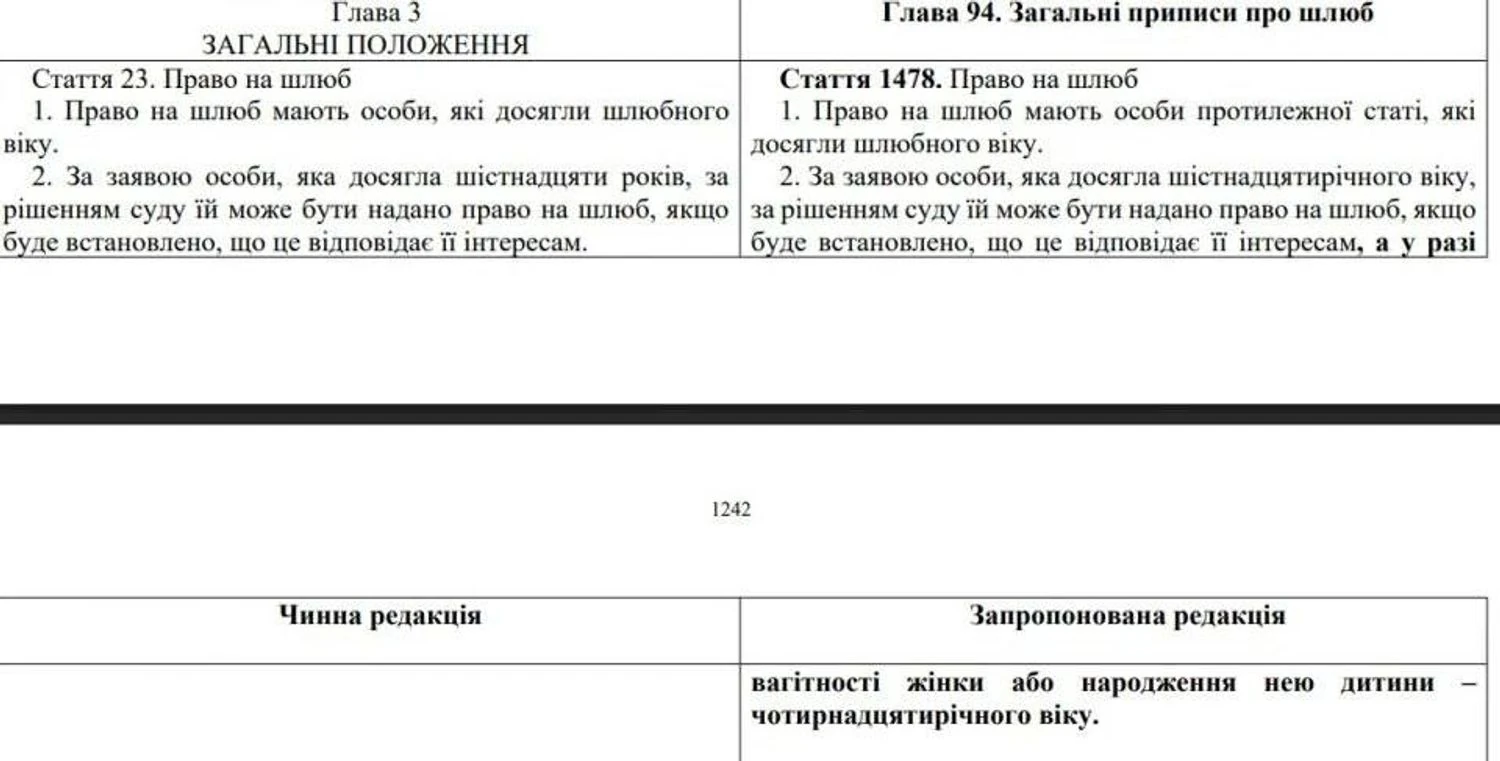
The draft law No. 14394, registered on January 22, 2026, caused a storm of emotions and outrage. It proposed to allow courts in exceptional cases to grant the right to marry from the age of 14 in the new Civil Code if the minor is pregnant or has already given birth to a child. However, the Speaker of the Verkhovna Rada, Ruslan Stefanchuk, announced: after discussions, the amendment was removed from the draft law.
At the same time, there were supporters of such changes, although there were fewer of them. UNN asked lawyers what the law says about marriages at 14, and doctors whether a girl at that age is ready for pregnancy and childbirth, both physically and psychologically. International practice was also analyzed.
Why were such changes needed: the position of lawmakers
The authors of the draft law - Ruslan Stefanchuk, Oleksandr Korniienko, Mykola Stefanchuk, Ivan Kalaur, Volodymyr Vatras - state in the explanatory note that the updated Civil Code should form a modern and consistent report on private law that better meets the practical needs of citizens and businesses and ensures the unity of legal regulation.
Separately, they emphasize the block of family law and call the approach child-centered, meaning one in which the child's interests are the key guideline. As specific tools, they, in particular, cite the requirement to promptly consider issues related to children, as well as the child's right from the age of 14 to directly apply to the court to protect their rights and interests.
Against this background, the norm on the possibility of marriage from the age of 14 seems controversial, but the initiators explain it with the same logic of protecting minors: in their opinion, this is not permission for child marriages, but an exceptional mechanism for cases where marriage objectively meets the best interests of the minor mother and her child.
Marriage at 14 would not become the norm: lawyers explained what the bill was actually supposed to change
Lawyers who commented on the draft law note that the proposed wording did not change the basic age norm - 18 years. The norm on the possibility of marriage from the age of 16 (and in an exceptional case - from 14) is presented as the implementation of the principle of the best interests of the child through a court decision, and not a direct permissive norm.
Ivan Zakharchuk, lawyer, co-founder and managing partner of "APRÁVOX", explains in an exclusive comment to UNN:
If this Code were adopted, the court would be able to decide on granting the right to marry to a person who has reached the age of 14 only if there is a pregnancy or the birth of a child.
At the same time, according to the lawyer, legal uncertainty would remain. After all, it follows from the wording of Part 2 of Article 1478 that the special ground at the age of 14 is directly related precisely to the woman's pregnancy or the birth of a child by her.
Therefore, it is unclear whether a male person aged 14 to 16 can obtain the right to marry by court decision, since the relevant norm did not provide a separate ground for him, and the wording is actually tied to the biological state of a woman. This creates a risk of different interpretations and a potential discriminatory gap that requires legislative clarification.
Instead, Ukrainian lawyer and attorney, specializing in family and civil law, Ihor Teterya believes that the criticism of the draft new Civil Code is based on the fact that:
Everyone immediately focused on the worst-case scenario: "a 14-year-old girl gave birth to an adult" and started criticizing.
But, as the lawyer explains, there are a number of nuances.
Firstly, according to this norm, the 14-year-old can also be the boy from whom an adult woman gave birth.
Secondly, in practice, the norm will apply to both minors.
Wouldn't it be better if they, if it happened, created a family and raised a child together, living with their parents, for example, and receiving help from them?
Separately, Ihor Teterya emphasizes that only a minor can submit an application for permission to marry. A man or woman over 18 years of age will not have such a legal right.
Ultimately, as the lawyer concludes, the current Family Code has an almost identical norm, only the age there is limited to 16 years. And from 2003 to 2012, there was even a norm where the age was as in the proposed version - 14 years and even without the condition of pregnancy or childbirth.
Legalization of exceptions or "lowering the bar": why society is divided over early marriages
The proposed changes to the Civil Code provoked an active public discussion. In essence, it is about allowing very early marriages in certain situations, and this affects both the rights of the child and how society as a whole perceives the institution of marriage itself.
Supporters of the initiative say it will solve practical issues. For example, if a 14-15-year-old girl is pregnant and consciously wants to officially formalize a relationship with the child's father, a court marriage permit will give her the status of a wife, and the child - legally established parents. This, in their opinion, will simplify access to social guarantees, alimony, establishing the child's origin, and other procedures.
Opponents, however, warn that by taking such a step, the state is effectively lowering the marriage age threshold and risks shifting the social norm: what is intended as an exception may eventually begin to be perceived as an acceptable practice.
On social networks, the idea is already sharply criticized: it is called a "return to the Middle Ages," compared to countries where child marriages are practiced, including Afghanistan, and even stated that such changes allegedly lead to the legalization of pedophilia.
This reaction shows the main fear of critics: that marriage will cease to be associated with adulthood and maturity, and early unions will begin to be perceived not as unequivocally unacceptable, but as one of the options.
Marriage before 18: risk of violence, loss of education, and a trap of dependence for girls
The main concern of society is the protection of the rights of minors who may potentially be in a marriage.
The international human rights community is unanimous that child marriages (where at least one person is under 18) are a violation of human rights and children's rights. Girls married at an early age are especially vulnerable to domestic violence and sexual exploitation, as they are in an unequal position with an adult man.
And early pregnancies pose a threat to health: it is medically proven that a teenager's body (14-15 years old) is not ready for gestation and childbirth, which is why young mothers more often face complications.
Vladyslav Smirnov, leading analyst at the EAC "Medical Constructor", speaks about this in more detail. In his opinion, early (teenage) pregnancies, which they wanted to legally make a reason for marriage, would turn into a "conveyor belt of disability and death" for Ukraine, not a "demographic miracle".
At 13-14 years old, a girl's body is in an active growth phase. She herself is still a child who needs resources for formation. Pregnancy during this period is a parasitic load (in a purely biological sense) that competes with the mother's growth.
In addition, young mothers risk falling into a number of life-threatening and health-threatening conditions:
- after childbirth, a girl may become disabled, unable to control the process of defecation;
- girls under 15 have a significantly higher risk of critical blood pressure increase, leading to seizures, strokes, and death;
- the fetus may be born non-viable due to low
weight and concomitant pathologies;
- the child of a young mother may have mental disabilities.
In addition, infant mortality could significantly increase.
This is a law of nature: an immature organism cannot produce quality offspring. Instead of reviving the nation, we will get a generation with weakened health, raised by children who themselves have not finished school. This is a path to the degradation of the gene pool, not its salvation.
Smirnov also explains: the development of the prefrontal cortex (responsible for impulse control, planning, and evaluating consequences) is completed much later, by 21-25 years, so teenagers aged 13-14 are less able to predict the consequences of decisions. Therefore, when an adult man persuades a 14-year-old to marry, this is not full consent, because the teenager is physiologically and cognitively vulnerable and cannot fully assess future risks.
Iryna Harmash, a psychologist-consultant, author of books, and member of the NPA, also emphasizes the risks for the unformed teenage psyche in a conversation with UNN.
According to her, the key problem of early marriages is not only social, but also psychophysiological: a teenager does not yet have formed mechanisms of self-control and forecasting consequences.
In teenagers, the prefrontal cortex, which is responsible for planning, emotional control, and awareness of actions and their consequences, is not yet fully developed... These are developmental features.
Harmash also drew attention to increased impulsivity and risk-taking in adolescence.
Impulsivity in teenagers, emotional lability. Risky behavior can occur. That is, what kind of marriage can there be, and can such parents give anything to a new child when they themselves are still children?
Separately, the psychologist questions the practical logic of marriage as a protection mechanism when it comes to underage parents who do not have the resources for independent living.
A young family that is financially incapable... they cannot support themselves. And this child. And then the question arises, why this marriage?
Another block of risks is mental health and hormonal factors that can increase stress in case of teenage pregnancy.
Teenagers already have a hormonal storm, puberty. And here she (the young mother - ed.) must also take care of this child. And school? These are children who go to school.
She also mentioned the possibility of severe postpartum conditions.
Postpartum depression can already occur. These are hormones. Teenagers already have a hormonal storm.
In the continuation of the conversation, the specialist focused on the identity crisis, which is typical for teenagers and can be exacerbated by early sexual relations and pregnancy.
Harmash also mentioned that in some ethnocultural groups, early marriages exist as a de facto tradition, but, according to her, this cannot be an argument for changing the rules for everyone.
There is a tradition. They (Roma - ed.) marry early there (early - ed.). However, we cannot agree to this norm only for their sake. We are talking about our children.
The psychologist calls not the legalization of the consequences of early sex, but the prevention of teenage pregnancies through systemic education, as a way out of the situation.
We need to have a nationwide sex education program. If this were introduced into the school curriculum as a mandatory lesson in ethics, family psychology, and a school of married life.
The UNN interlocutor also calls for a critical attitude towards rhetoric that normalizes early pregnancies under the guise of support. She cited an example of information campaigns in Russia.
In Russia, they started such a campaign "honey, give birth", the state will support it. Let's not copy what they have there - "women will give birth again".
The psychologist believes that state policy should focus not on the number of newly created families, but on the quality of child protection.
That is, we need not quantity, but quality, so that we have a happy, healthy society later.
In addition, early marriage almost inevitably leads to the cessation of education for the child-woman: according to UNESCO data, marriage concluded before the age of 18 significantly reduces the likelihood of continuing education. Thus, an underage wife loses opportunities for development, professional realization, and economic independence, which affects both her future life and the well-being of her children.
That is why UNESCO classifies marriages concluded before the age of 18 as a form of forced marriage, as a child objectively does not have enough will and maturity for a conscious, free choice of married life.
In Ukraine, the age of consent for intimate relations is 16, and any sexual relationship with a person under 16 is a criminally punishable act (Article 155 of the Criminal Code). Therefore, a situation where a 14-year-old girl is pregnant legally indicates that a sexual offense has occurred - rape by age or molestation of a minor. In current conditions, the detection of such a situation should automatically trigger an investigation and bring the perpetrator to justice. Instead, providing the opportunity to marry may shift the focus from criminal prosecution to legalizing relationships.
Critics warn: the consequence of a crime (child's pregnancy) cannot be used as a reason to avoid punishment, turning the rapist into a legal husband. In addition, there are fears that abusers may pressure the girl's family to marry instead of filing a police report, hiding behind "family values."
As one observer aptly noted, "pregnancy at 14 is a reason for criminal proceedings, not for a wedding," and the state should guarantee such a child protection and support (medical care, social payments, alimony from the child's father even if he is in prison, the opportunity to finish school), but not a marriage certificate.
Otherwise, there is a risk that the norm on early marriage could be used to avoid responsibility and public condemnation of child sexual abuse.
"Yes" can be said online: how to get married on Valentine's Day1/30/26, 3:21 PM • 2392 views