









How the war affected young Ukrainians - an interview with the Head of the State Service for Children's Affairs
Kyiv • UNN
The war has led to a significant displacement of children, as well as an increase in the number of orphans. Petro Dobromilskyi, Head of the State Child Affairs Service of Ukraine, told UNN about what is being done to support children in the country.

The full-scale war in Ukraine has greatly affected Ukrainian children, some of whom have become internally displaced persons, while others have gone abroad. The loss of loved ones is also a difficult situation, as Russia kills both military and civilians, as a result of which minors are left without parents.
Are children who left during the war returning from abroad? How much has the number of orphans increased, what is the situation with adoption and how are family forms of upbringing developing in Ukraine now? These and other questions were answered by UNN Head of the State Service of Ukraine for Children's Affairs Petro Dobromilskyi.
- How many children have left Ukraine, compared to previous years during the full-scale invasion?
Since the beginning of the full-scale invasion, thousands of children have been evacuated outside of Ukraine to save their lives and health. This war has led to one of the fastest and largest displacements of children since World War II, according to UNICEF. In the first months of the full-scale invasion, more than 1.8 million children were displaced outside of Ukraine. According to the latest UNHCR data (the UN Refugee Agency), more than 2 million children are currently abroad, most of them in the European Union. This, of course, is a great challenge for Ukraine to ensure that these children do not lose contact with the country and remain in the Ukrainian context. We must build this bridge through educational, cultural, and social programs.
We never forget about the children who were deported or forcibly displaced to the territory of the Russian Federation. This is one of the most terrible crimes that Russia is committing against Ukrainian children. Of course, it is impossible to establish the exact number of affected children due to active hostilities and the temporary occupation of part of the territory of Ukraine. According to official data from the "Children of War" platform, there are about 20,000 such children. At the same time, according to data from open sources voiced by the Russian Federation, 744,000 Ukrainian children have been deported.
Children's Day in Ukraine will be celebrated on November 2030.05.25, 10:35 • 3517 views
The aggressor continues to commit its terrible crimes, trying to destroy Ukrainian identity, our children. Russia simplified the procedure for granting its citizenship to Ukrainian orphans and children left without parental care at the beginning of the full-scale invasion. This is a direct violation of international law and an attempt to assimilate our children.
In addition, we have confirmed data that the invaders are forcibly issuing passports to children aged 14 and over, threatening their parents. This is an act of pressure and intimidation aimed at integrating Ukrainian children into Russian society and tearing them away from their own roots. Thanks to the efforts of the state, international partners, and human rights organizations, a mechanism has been developed to return our children home. And gradually it is possible to do this.
Ukraine is doing everything possible to return deported or abducted children. Thanks to the initiative of the President of Ukraine "Bring Kids Back UA", 1324 children have already been returned to Ukraine today.
- Are minors, in particular orphans, returning from abroad who left during the war?
Wherever Ukrainian children are, the task of our Service team is to take care of their interests and safety.
At the beginning of the full-scale invasion, more than 4,700 orphans and children deprived of parental care who were in round-the-clock institutions were evacuated abroad. During this time, more than 3.1 thousand of them have already returned to Ukraine, mostly to family forms of upbringing or were adopted. And 488 children who were in difficult life circumstances returned to their biological parents.
Yuliia Yarmolenko: "Sex education begins at birth"24.03.25, 13:02 • 231692 views
We understand that the return process must be safe and comfortable for the child. Our legislation allows the return of children to safe regions of Ukraine and, most importantly, to family or close to them forms of upbringing. An individual return plan is drawn up for each child, which takes into account their needs and circumstances.
The longer children stay abroad, the more they may lose contact with their culture, language and national identity. This also applies to social connections – our children should be raised here, in their native social environment, among their peers and teachers. So our team is focused on returning children home as quickly and safely as possible, helping them integrate into society and find a caring family.
- How much has the number of orphans increased due to the full-scale war?
During the three years of the full-scale invasion, territorial communities have identified about 23.9 thousand children who, for various reasons, were left without parental care, including in connection with the aggression of the Russian Federation against Ukraine. Each such child is a separate story, a separate pain.
However, among the children who were left without parental care, the vast majority are temporarily placed, in particular, in the families of relatives or acquaintances.
For reference: As of the beginning of April, more than 397,000 children in Ukraine had the status of a child affected by military operations and armed conflicts, and about 28,000 children received this status in the 1st quarter of 2025.
If we talk about the total number of orphans and children deprived of parental care, then in Ukraine, as of the first quarter of 2025, 61,276 such children are on primary registration. Of these, 55,860 are already in a family environment: 43,657 children are under guardianship or care, and 12,203 children are placed in foster families or family-type orphanages.
11 more Ukrainian children were rescued from occupation28.05.25, 17:00 • 2197 views
We clearly understand that thousands of children need family warmth and comfort, so we are actively working to develop and promote adoption and family forms of upbringing in Ukraine. One of the main goals of the State Service of Ukraine for Children's Affairs is to ensure that by 2028 at least 95% of orphans and children deprived of parental care find a caring family. This is provided for by the Strategy for Ensuring the Right of Every Child in Ukraine to Grow Up in a Family Environment for 2024–2028.
One of the vectors of our activity in this direction is training candidates for adoptive parents, foster parents, parent-educators, guardians/trustees, as well as foster parents. This is a project that the State Service for Children's Affairs launched together with the charitable organization "Partnership for Every Child" and the Ministry of Social Policy of Ukraine with the support of UNICEF. After completing their studies in July, trainers should continue to help future parents or legal representatives to best prepare for their new social role.
- How many children have been adopted this year? What is the situation with adoption in the 4th year of the war?
The priority direction of the work of the services for children is to ensure stable and harmonious living conditions, the best interests of the child by placing him/her for upbringing in the families of citizens, primarily for adoption.
The situation with adoption in the fourth year of the full-scale war has its own peculiarities and challenges, but we see positive trends. In the 1st quarter of 2025, 290 orphans and children deprived of parental care were adopted in Ukraine. There are 14,946 children on the local adoption register, of which 11,154 have already been placed in family forms of upbringing.
Last year, 1,270 orphans and children deprived of parental care were adopted, which is 343 children more than in 2023. We see an increase of 27% – this is a rather positive trend. But these are not just words or statistics. We must realize that behind every figure is the fate of an individual child.
- How are family forms of upbringing currently developing in Ukraine?
Globally, in the development of family forms of upbringing and support for children in difficult life circumstances, we rely on the Strategy for Ensuring the Right of Every Child in Ukraine to Grow Up in a Family Environment for 2024–2028, adopted by the state. This Strategy is our guide and is based on the principles of deinstitutionalization, which are successfully implemented in European countries.
And our efforts are already yielding tangible results. Over the previous year, the number of children receiving institutional care and upbringing decreased by 30% compared to 2023. What is especially important is that the number of children under 3 years of age in such institutions decreased by 80%. This indicates that we are actively developing family forms of upbringing, providing children with vital family warmth.
We are actively working to develop and promote family forms of upbringing. If you have a desire to open your heart and home to a child, creating a foster family or a family-type orphanage (DBST), or become a foster parent – contact us. We are ready to provide full information and advisory support.
Also, our team of the State Service of Ukraine for Children's Affairs has launched an important project to support family-type orphanages (DBST). Thanks to the state subvention, the Olena Zelenska Foundation and international donors, those who wish to create or expand a DBST can receive housing. For advice on who exactly can receive housing and what the conditions are, please contact the Service's e-mail address [email protected] or by phone numbers (044) 289 52 93, (067) 201 91 51.

- What work is being done with adolescents in boarding schools?
We are well aware that adolescence is a time of searching for oneself, and often young men and women face a lack of understanding of what they want to do in adulthood. For children in institutional care, as well as in foster families and family-type orphanages, this problem may be even more acute due to the peculiarities of their life experience.
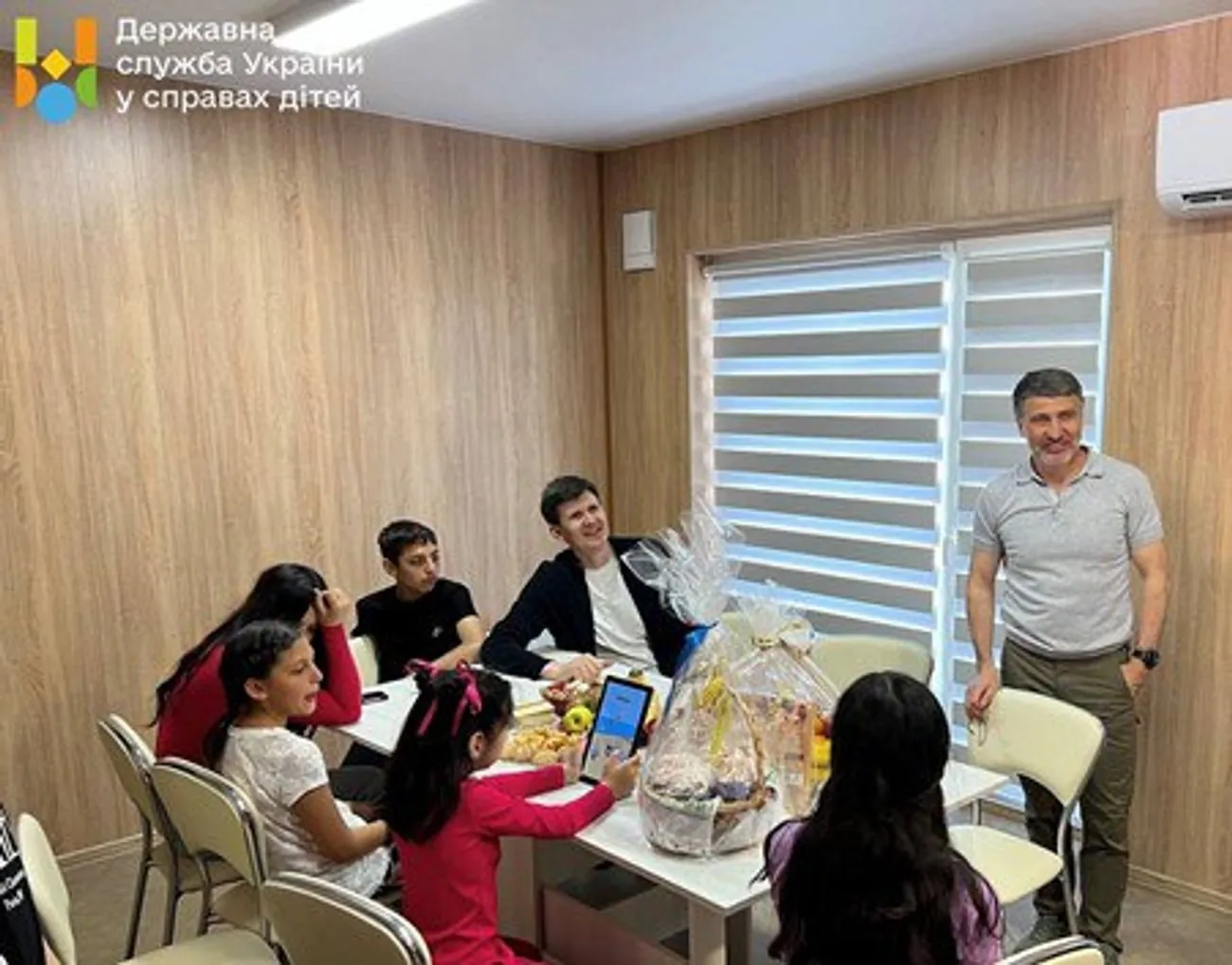
That is why, in April of this year, we launched an important career guidance project for children aged 14-17. This project is primarily aimed at helping orphans and children deprived of parental care to choose a profession.
We are convinced that the development of key competences and skills necessary for resilience, conscious choice of further education, profession and successful self-realization in the labor market requires early acquaintance with professions. Career guidance should be integrated at the level of primary and basic school, and not only in graduation classes. After all, without this, there is a problem of choosing a profession without taking into account the child's abilities and the real needs of the labor market, which can lead to low productivity, unnecessary training costs and the need for reorientation in the future.
Our teenagers should be as prepared as possible for the challenges of adulthood and make informed, balanced decisions.
Our plans include creating a chatbot that will become a convenient tool for career guidance support.
We also invite organizations with experience in conducting career guidance activities for children and youth to cooperate. Their expertise and support will help us scale up this important project and reach as many children as possible who need our help in determining their professional path. Together, we can provide our children with a solid foundation for an independent and successful life.