









What to use to shoot down jet-powered drones: experts explain how Ukraine is adapting weapons to new threats
Kyiv • UNN
Ukrainian defense companies are increasingly adapting weapons that have already been developed to new tasks instead of developing systems from scratch. Experts explained why the speed of such modifications is critical in the war against Russia.

Ukrainian defense companies operate in a low-profile mode and are in no hurry to say what weapons and modifications they are developing. New solutions often become known only at the testing or deployment stage. One such project could be a new configuration of the FP-1/FP-2, which Quantum WIY Industries presented as part of the cooperation between Quantum Systems and Fire Point. What this could offer Ukraine and why the ability to quickly modify existing weapons is critical in the technological race with russia was examined by UNN.
Details
Most Ukrainian defense companies operate under an extremely high level of secrecy. On the one hand, this is connected with the need not to provide information to the enemy so that it does not have time to develop countermeasures… Therefore, when information about a development that had never previously been publicly announced suddenly appears, this does not mean that it literally emerged yesterday. Companies often work in parallel on a large number of different projects, some of which never reach serial production
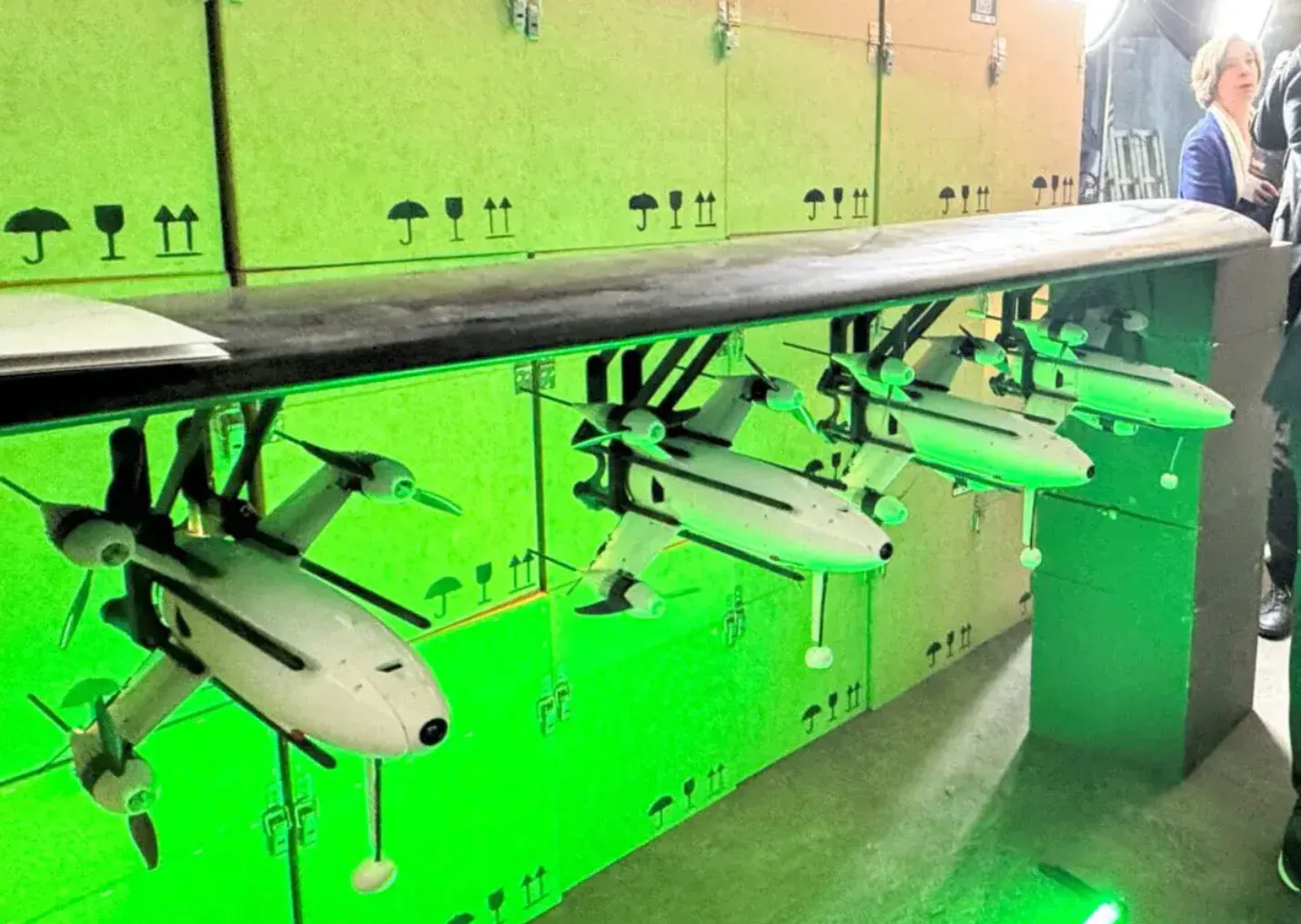
Concept of a possible FP-1/FP-2 modification with eight SPYS interceptor drones. Image taken from the Drone Wars X account.
In the case of the FP-1/FP-2 modification, the concept involves placing four SPYS interceptor drones under each wing of the unmanned aerial vehicle—eight in total. The main advantage of this configuration is the ability to launch the interceptors from the air.
Under the concept, the FP-1/FP-2 could deliver the SPYS drones to the required area and altitude without using up the interceptors’ own resources flying from a ground launch point. Aviation expert Valeriy Romanenko explains that this approach would expand the area in which the interceptors can be used.
As for the concept under which the FP-1 and FP-2 could serve as carriers for interceptor drones and launch up to eight interceptors against jet-powered drones, it is generally interesting. Why? First, because it sharply increases the operational range of such drones. They do not need to expend fuel climbing and flying over a fairly long distance. Essentially, the airborne platform lifts them to a considerable altitude
Interception of the "Geran-5"
It should be noted that during the presentation of the SPYS interceptor in July, WIY Drones stated that it was capable of hitting targets moving at speeds of up to 600 km/h. To this end, the company worked, among other things, on a head-on interception algorithm. In September, the first confirmed use of SPYS against the Russian jet-powered strike drone "Geran-5" emerged.
Interception of the Russian jet-powered UAV "Geran-5" by a SPYS drone. Video: WIY Drones.
This Russian jet-powered UAV has become a new threat to Ukrainian cities: it is significantly faster than earlier modifications of the "Geran," making it more difficult to intercept. The "Geran-5" has a tubular fuselage and, in terms of its characteristics, already more closely resembles a cheap cruise missile than a classic long-range drone, said Fabian Hoffmann, a senior research fellow at the Norwegian Defence Research Establishment.
As a senior engineer at one of the defense companies told The Kyiv Independent on condition of anonymity, the "Geran-5" flies approximately 150 km/h faster than the jet-powered "Geran-4." This also changes the very logic of interception: instead of chasing the target from behind, the interceptor must be brought toward it head-on, which significantly complicates the task.
According to Ukrainian intelligence, the "Geran-5" can carry a warhead weighing approximately 90 kg. The Chinese turbojet engine for such a drone is estimated to cost approximately $40,000, while the entire aircraft costs about $115,000. By comparison, older piston-powered modifications could cost around $30,000.
At the same time, Russia is rapidly scaling up its use of jet-powered drones. Yurii Ihnat, head of the Communications Department of the Air Force Command, notes that on some days, jet-powered drones may account for up to two-thirds of all drones launched by Russia. Production volumes are also growing—the enemy is already capable of producing around 3,000 Geran-4 and Geran-5 drones per month.
The problem for Ukraine lies in the difficulty of intercepting them. President Volodymyr Zelenskyy said that Ukraine is currently shooting down around 57% of jet-powered attack drones, calling this figure “significantly lower than necessary.” That is why finding new means of countering such targets is now becoming one of the key tasks for Ukraine’s defense industry.
“We are already seeing information that at least five manufacturers have proposed their solutions for countering jet-powered attack drones. At least 50 more Ukrainian companies are developing solutions to counter such targets. But if we are talking specifically about mass deployment, we will probably not see it any earlier than another three to four months from now. After the development stage, time is needed to scale up production, train personnel and, among other things, select appropriate tactics for their use,”
However, even after effective countermeasures against jet-powered drones emerge, the technological race will not stop: Ukraine will find a way to shoot them down, while Russia, in response, will try to improve its weapons once again.
“This means that, likewise, once interceptors have been developed and the percentage of jet-powered drones shot down reaches approximately 90–95%, we will see the enemy very quickly try to improve its solution. We are talking about several months. We will see the next stage in terms of speed. In other words, it will no longer be 400–650 km/h, but probably 750–800, perhaps even 900 km/h, which is, in principle, comparable to the speed of conventional cruise missiles,”
In fact, this concerns the ongoing evolution of systems that have already been created: a platform initially developed for one task can perform new functions as the adversary changes. In conditions where new means of attack and countermeasures against them emerge at intervals of several months, the ability to rapidly modernize existing weapons is a key condition for not losing the technological race to the enemy.
“I believe that Fire Point is demonstrating a very sound approach in this case—not simply creating a separate drone for each task, but using existing platforms and seeking new ways to employ them. This makes it possible to adapt more quickly to changes in the battlefield situation,”