









Russia's budget deficit has already exceeded the annual target by half - Bloomberg
Kyiv • UNN
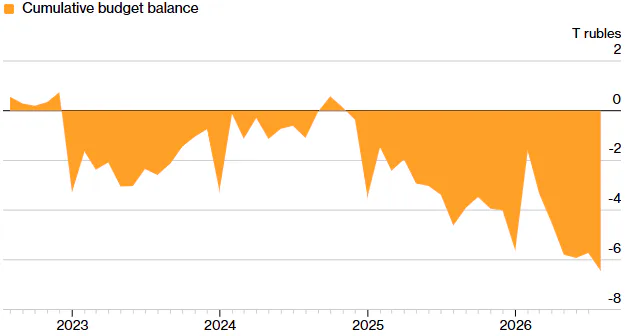
In July, Russia's federal budget deficit amounted to 724 billion rubles, and over seven months it reached 6.5 trillion rubles. War spending is rising despite the economic slowdown.

In July, the Russian federal budget deficit amounted to 724 billion rubles ($8.8 billion). Thus, the cumulative budget deficit for the first seven months of the year reached 6.5 trillion rubles, or 2.8% of gross domestic product. Bloomberg reports this, as reported by UNN.
Details
It is noted that this trend is driven by the continued growth in spending: the Russian government continues to make advance payments under state contracts—a practice that is usually concentrated in the first months of the budget period and then decreases as the year progresses.
Total spending reached 28.6 trillion rubles in the first seven months of the year, with spending on government procurement increasing by 39% to 8.4 trillion rubles. This exceeds 80% of the annual plan. ... Russia is increasing spending on the war against Ukraine, which has been ongoing for the fifth year, even as the economy has slowed sharply under pressure from high interest rates aimed at curbing inflation
It is noted that while Kyiv has increased the scale and range of drone strikes deep inside Russia, targeting industrial and other facilities, the Kremlin has intensified its air attacks on Ukrainian infrastructure. Earlier, Russian lawmakers approved amendments allowing the government to increase spending without revising fiscal legislation.
The budget is traditionally revised in the second half of the year, and Finance Minister Anton Siluanov has already stated that the annual deficit target of 1.6% of gross domestic product will be raised, despite expected oil revenues linked to the war between the United States and Israel and Iran
It will be recalled
According to the Foreign Intelligence Service of Ukraine, in 65 of Russia's 85 regions, real budget revenues at the end of 2025 turned out to be lower than before the start of the full-scale war—in 2021. At the same time, in 52 regions, inflation-adjusted expenditures exceeded the level of four years earlier. This became one of the factors behind the rapid growth of budget deficits.