










Cost as a Strategic Instrument: How Drones Are Changing the Economics of War
Kyiv • UNN
Kamikaze drones of various classes are changing the military economy, in which the cost of the means is weighed against the value of the target. The cost of a UAV depends on its missions, range, warhead weight, resistance to electronic warfare, and a number of other indicators.

Drone warfare has overturned the basic principle on which the military economy was previously built: victory goes not to the side with more expensive and sophisticated weapons, but to the side that more accurately calculates the ratio of “cost of the means – value of the target.” Cost is no longer a by-product of technology, but something shaped by parameters tailored to a specific task. What types of UAVs are used by the military and what affects their cost — read in the UNN article.
The focus will be primarily on kamikaze drones whose direct task is to strike a target. We deliberately do not consider categories of unmanned aircraft such as reconnaissance drones or signal repeaters — these are usually reusable systems. We also do not compare the prices of UAVs from different classes, but demonstrate that different tasks require different technological solutions. Yet these solutions are based on the same logic — inflicting maximum damage on the enemy at minimum economic cost.
A consumable that inflicts significant damage
FPV drones have become an asymmetric response to the enemy. As noted by the National Security and Defense Council, such drones emerged out of the need to replace artillery shells, which were in short supply. They are currently the most numerous type of drone, produced by more than 160 companies of various scales.
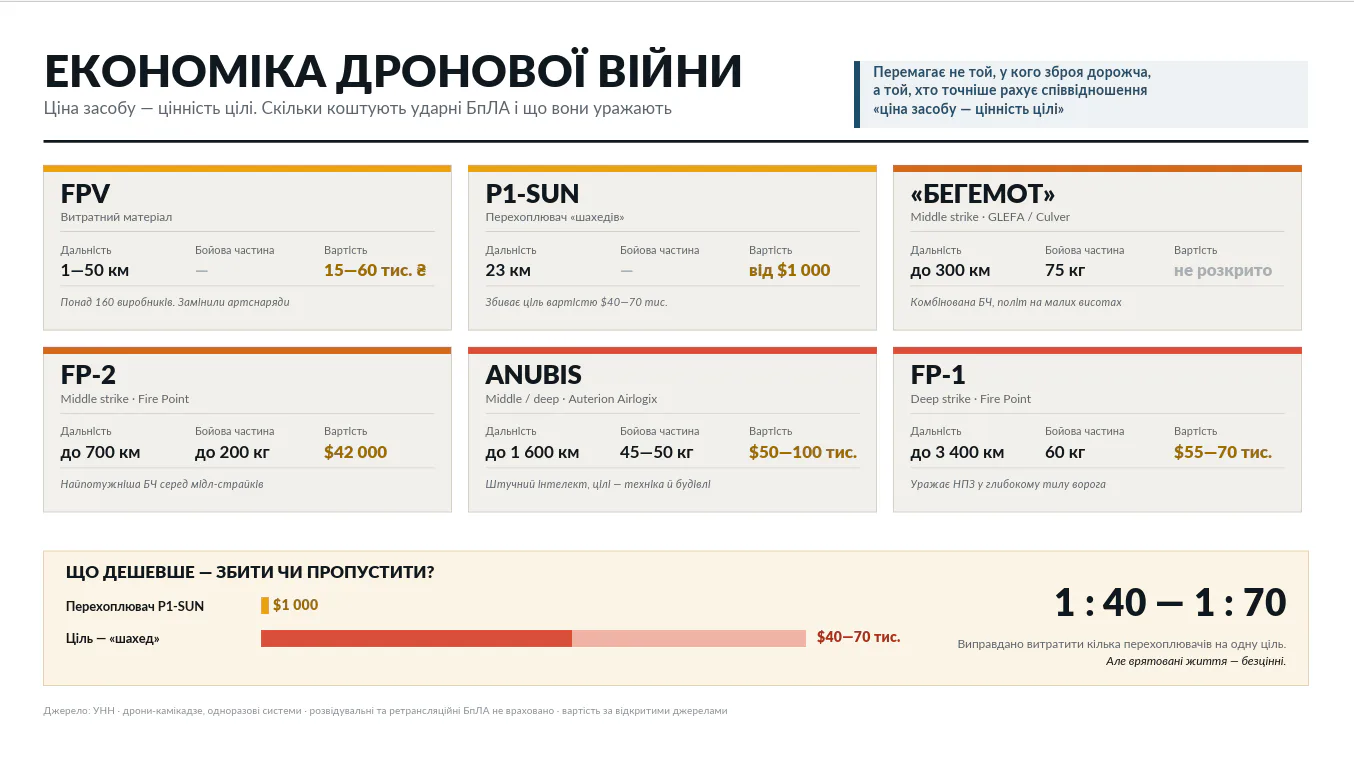
Essentially, such a drone is a consumable. Accordingly, manufacturers seek to minimize its cost — the smallest models cost from UAH 15,000–20,000, while larger ones cost UAH 30,000–60,000. At the same time, these drones made it possible to establish kill zones in sections of the frontline and prevent the movement of enemy heavy equipment and transport without significant losses on the enemy’s side.
The flight range of such drones depends on the type of communication and varies from 1 to 50 km. One of the main advantages of FPV drones is the ability to guide them precisely; that is why these drones harass not only enemy personnel but can also be used against enemy equipment, striking its weak points.
Interceptor drones
This type of drone has been widely used primarily against “Shaheds.” The best-known is the P1-Sun, or, as it is called, “Pis yun.” The stated cost of such a drone starts at $1,000. The drone has a plastic body and a short flight range of 23 km, but is capable of hitting “Shaheds,” whose cost ranges, according to various estimates, from $40,000 to $70,000. This makes it economically justified to use even several P1-Sun drones against a single enemy UAV. However, one should consider more than just the economic aspect — saved lives are priceless.
Deep and middle strike — a different level of targets
More powerful strike unmanned aircraft are intended to hit targets in the enemy’s rear. Depending on the strike range, such drones are generally divided into middle strike (medium-range) and deep strike (long-range). There are significantly fewer companies producing such drones than, for example, those manufacturing FPV drones, since these systems require greater investment and are more technologically complex to produce. However, in terms of their “life cycle,” these drones are also predominantly kamikaze drones.
An example of a UAV designed to strike targets at considerable distances is the Anubis drone, manufactured by the American-German-Ukrainian Auterion Airlogix Joint Venture GmbH. Depending on the version, this drone can be used at medium ranges or at distances of up to 1,600 km, making it a long-range UAV. According to open-source data, the cost of such an unmanned aircraft ranges from $50,000 to $100,000, depending on its configuration and flight range. Its artificial intelligence and a 45–50 kg warhead make it possible to use it not only against enemy equipment but also against buildings housing, for example, the enemy’s training centers.
Another middle-strike drone that our military began using relatively recently is the “Behemoth,” developed by GLEFA and Culver Aerospace. It is capable of striking targets at distances of up to 300 km, carrying a combined 75 kg warhead, and flying at low altitudes.
Formally, FP-2, manufactured by Fire Point, also belongs to this same medium-range strike class, but it is significantly more powerful, as it can carry a warhead of up to 200 kg and fly a distance of up to 700 km. As reported by former serviceman of the 59th Assault Brigade’s unmanned systems battalion Oleksandr Karpiuk, better known as Serh Marko, the cost of such a middle strike is $42,000.
A separate class of strike drones is the “deep strikes.” Here, designers have to seek a compromise between the weight of the warhead and the flight range. In addition, what is assessed here is not only the value of the target that the UAV is capable of striking, but also the cost of the alternative that would have to be used if such a drone were unavailable. This includes, in particular, the use of cruise missiles, which would be many times more expensive. Also, as Fire Point CEO and CTO Iryna Terekh explained, striking the target is only half the job — the ability to pass through air-defense echelons and electronic countermeasure systems is important.
"A great deal of work is also being carried out against electronic warfare systems — this is the most difficult part of the technological challenge we face. Delivering [the payload] and striking the target are, in fact, the easiest parts. Thanks to our work, we were able to break through several layers of Russian air defense in order to strike the target precisely," Iryna Terekh said, commenting on the strike on a Moscow oil refinery by an FP-1 long-range strike drone.
The updated FP-1 can cover a distance of up to 3,400 km with a 60 kg warhead. The cost of such a drone ranges from $55,000 to $70,000. At the same time, after passing through Russian air defenses, such unmanned systems successfully strike, among other targets, oil-processing units at Russian refineries, whose replacement and repair cost many times more than the strike system itself. This is without even mentioning the cumulative economic effect and the psychological pressure on the enemy, who ceases to feel safe thousands of kilometers from the front.
What determines the cost
In addition to the direct costs of materials and components, the cost of a UAV is significantly influenced by the tasks it is intended to perform. This, in turn, determines its flight range, warhead weight and other characteristics, including resistance to electronic warfare systems. These technical features affect the price of the product and make it impossible to compare the cost of drones from different classes, such as interceptors and long-range strike drones. Even drones of the same class may have technological features that make it impossible to standardize their cost; for example, strike drones may have different launch methods and may or may not have landing gear.
Ukrainian journalist and serviceman Anton Shvets also points out a number of other indicators that can significantly affect the final cost of the system.
In particular, he notes that carrying out missions may require modifications to be implemented literally “on the fly.” It should also be taken into account that a UAV that fails to fly for one technical reason or another may need to be replaced under warranty. The final cost is also affected by the product-supply model and the services provided by the manufacturer during delivery, including whether the manufacturer’s representative provides launch support. It also matters who bears the cost of delivering the product to the end user — the UAV operator.