










Chemical reactions indicating possible life on Saturn's moon found
Kyiv • UNN
Chemical reactions that may indicate the existence of life have been discovered in the interior of Enceladus, a moon of Saturn. According to the analysis of data from the Cassini probe, organic compounds that are precursors to life have been found.

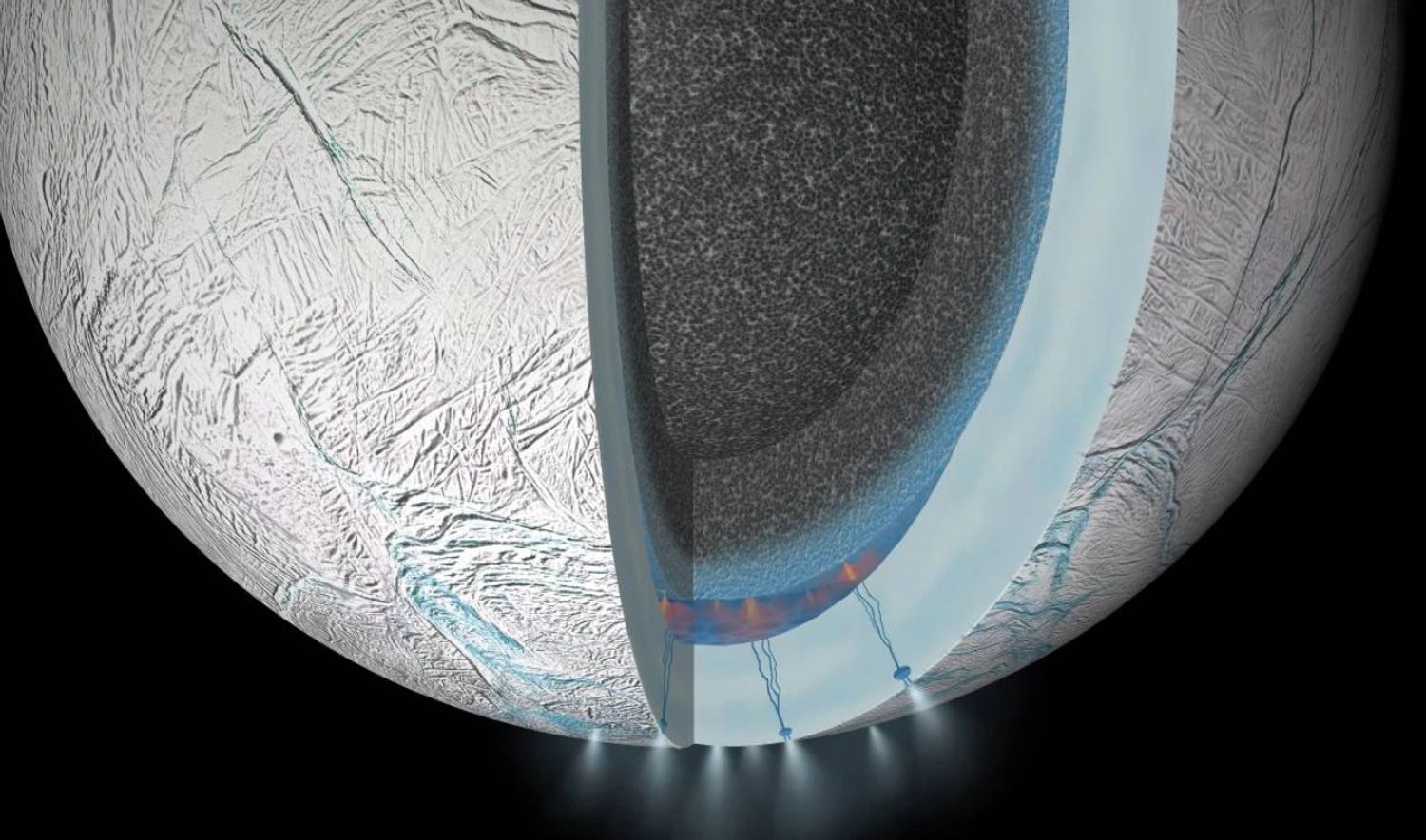
Deep within Enceladus, a moon of Saturn, lie vast oceans. Recently, chemical reactions were discovered in the celestial body, indicating the existence of life in the icy celestial body.
UNN reports with reference to the European Space Agency (ESA) and Nature Astronomy.
Details
Saturn's moon Enceladus continues to surprise researchers with extremely interesting findings. Recent discoveries have been particularly striking in the context of the search for life in our Solar System. According to the results of data analysis from the Cassini probe, which was launched in 1997 and studied Saturn and its moons for a number of years, particles of organic compounds were found. It is noted that these may be precursors of the substance from which life originates.
There are now increasing claims that Saturn's moon Enceladus meets the requirements of a habitable environment. This is already confirmed by the discovery of liquid water, energy sources, and a certain set of chemical elements and complex organic molecules.
Regarding whether life ever existed on Enceladus, there is no proven evidence yet. But the latest discovery brings us closer to the idea that Saturn's moon is an extremely successful example for the relevant theory, regardless of whether life existed in its waters before.
Reference
Enceladus is known as one of the 274 bodies currently detected in Saturn's gravitational field. It is not distinguished by its size, as the celestial body has a diameter of about 500 kilometers. This makes Enceladus the sixth largest moon of the planet.
Among its properties, Enceladus is known for geysers at its south pole. These sources are capable of ejecting water vapor and ice fragments.
Plumes of ejected material can reach almost 10,000 kilometers in length, which is more than the distance from Mexico to Patagonia. It is also known that some of this material rises into space
Most chemical analyses of ice from Enceladus were long performed on particles that settled in Saturn's E ring. However, in 2008, thanks to the Cassini probe, it was possible to directly sample freshly ejected fragments from a cryovolcano. These confirmed the presence of previously detected organic molecules.
Recall
Astronomers have discovered 128 new moons orbiting Saturn. This cemented its leadership in the list of Solar System planets with the most moons.
Blue Origin prepares New Glenn rocket for first NASA mission to Mars09.10.25, 09:19 • 6286 views