









The Webb Telescope recorded for the first time a star that "swallows" a planet: an unexpected finale
Kyiv • UNN
For the first time, the Webb Telescope recorded a planet the size of Jupiter falling into a star. Previously, it was believed that planets are absorbed by the expansion of the star.

NASA's telescope exposed a cosmic misunderstanding, conducting an "autopsy" of a dead planet. What looked like the classic end of a planet turned out to be actions under a different unexpected scenario.
UNN reports with reference to Gizmodo.
Details
Astronomers observed the history of a star located in the Milky Way galaxy, approximately 12,000 light-years from Earth, and a Jupiter-sized planet orbiting very close to the star. Initially, it was believed that the objects were acting according to the "canon" of science: a distant star becomes a red giant, inflates, and a dead planet is swallowed by it. But researchers did not expect that the planet itself plunged directly into "its" sun.
Reference
Observations of the objects began in 2020 at an observatory in San Diego, California, USA.
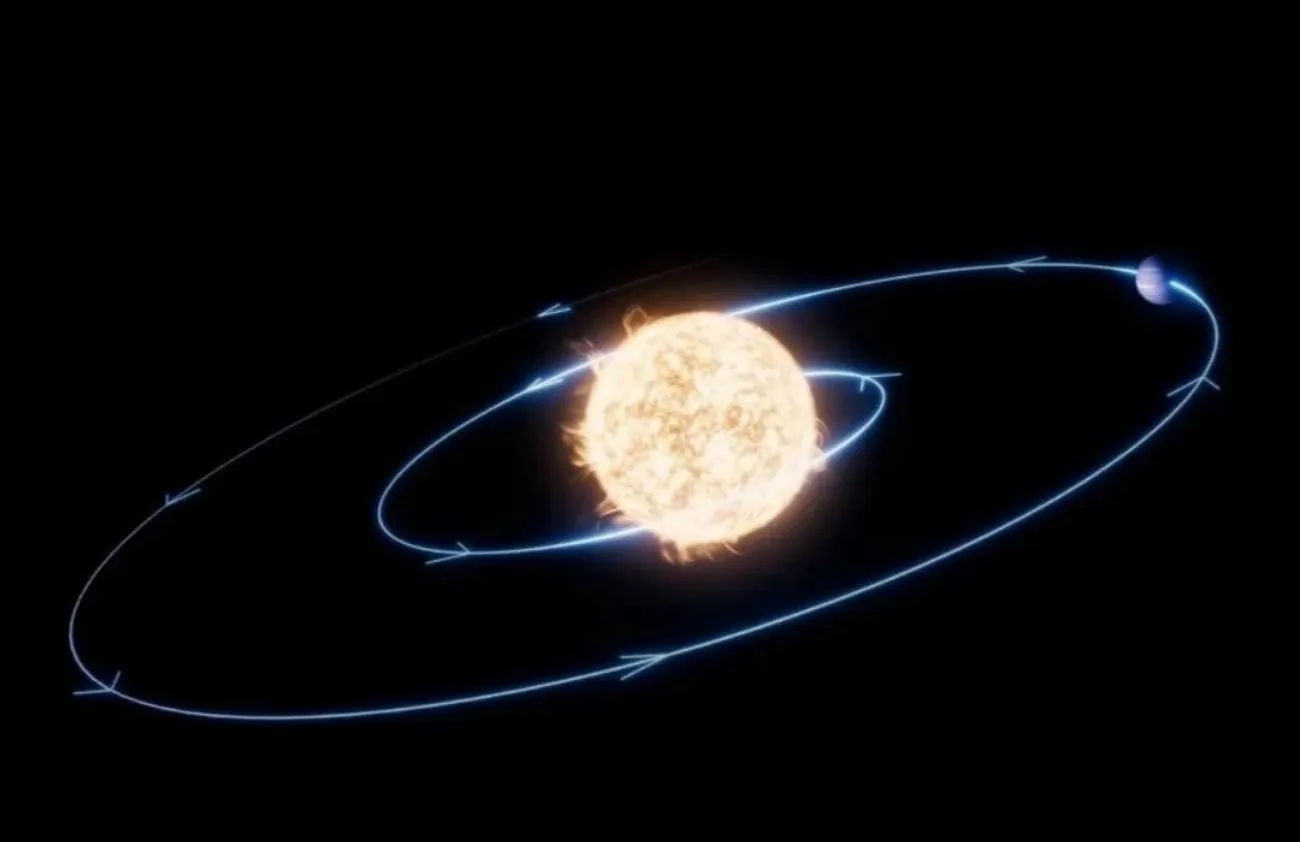
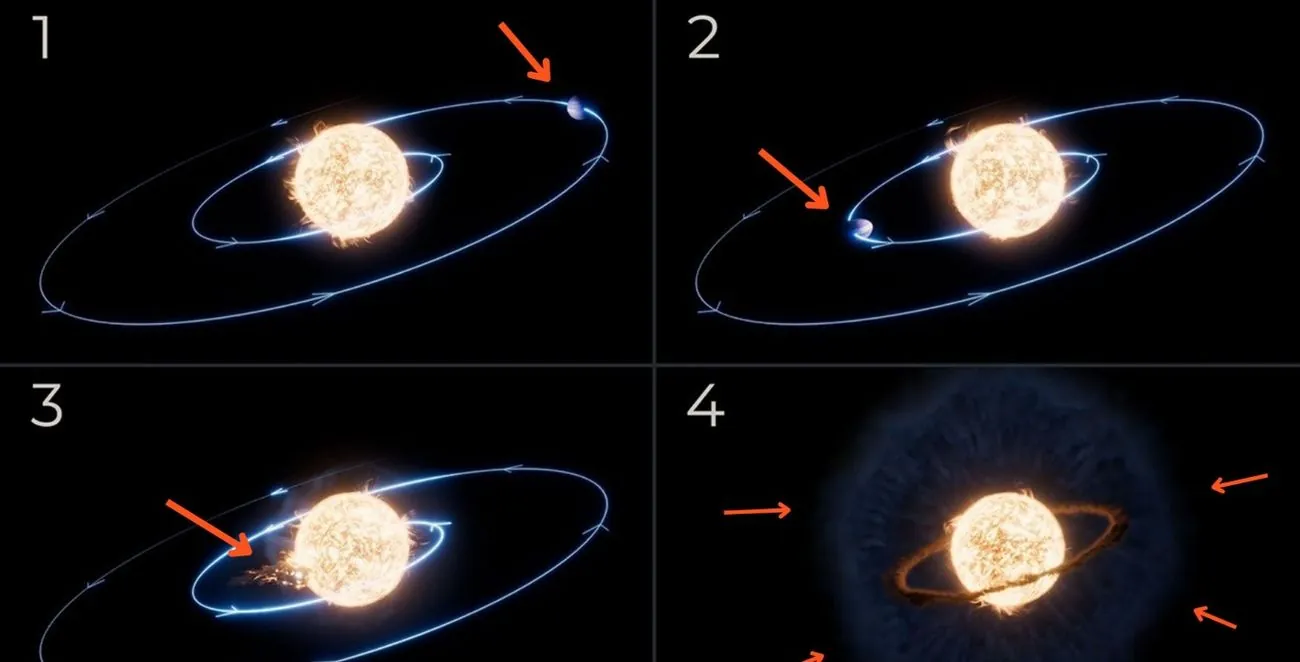
The studied planet orbited too close to its main star – even closer than Mercury to the Sun. For millions of years, gravity pulled the space object deeper and deeper until it finally reached the star's atmosphere. The planet's substance began to spread around the star, like cosmic slime on a hot surface.
An unusual "flash of light" was recorded. The astronomical event was named ZTF SLRN-2020. In a study published in 2023, the authors concluded that the star simply turned into a red giant, absorbing its closest planet.
But subsequent observations have already turned out to be the result of work with the NASA's James Webb Telescope.
To peer deep into the dusty environment of a star with the bulky name ZTF SLRN-2020, the telescope used highly sensitive devices - the Mid-Infrared Instrument (MIRI) and the Near-Infrared Spectrograph. Researchers discovered something that did not resemble the expected image of an expanding star at all.
The star turned out to be surprisingly quiet... There was no inflated shell, no turbulent giant star engulfing a poor planet in a thermal frenzy,
Conclusions obtained with the James Webb Telescope
The sudden brightness that first attracted astronomers' attention to the event was probably the last cry of a dying planet.
Its material, which lay on the surface of the star, caused a bright flash - a cosmic burst at the moment of disappearance.
The studied planet was even closer to the star than Mercury to our Sun. And thus, millions of years after millions of years - eventually the planet reached the point of no return: contact with the outer atmosphere of the star.
This is a completely new event, and we didn't know exactly what to expect when we pointed the telescope in this direction,
Thus, scientists have made a new discovery in the study of the death of planetary systems.
For the first time, scientists were able to observe how a planet slowly (spiraling) falls down to its star.
Previously, it was believed that such planets are absorbed by the sudden expansion of the star - a process that from the outside looks like a giant explosion.
But the Webb telescope showed something that is sure to make astronomers rethink their approach - including in the study of the Solar System.
James Webb telescope starts studying exoplanet with signs of life28.04.24, 01:32 • 85313 views