










The Russian trace in the decision of the suspended head of the State Aviation Service Bilchuk: why the official investigation went beyond the standard procedure
Kyiv • UNN
The official investigation into the temporarily suspended head of the State Aviation Service, Oleksandr Bilchuk, is taking significantly longer than standard. The Cabinet of Ministers is thoroughly examining the facts of the transfer of repair documentation for Mi-8MT(MTV) helicopters to a company associated with the Russian military-industrial complex, which may indicate serious offenses.

The official investigation into Oleksandr Bilchuk, the temporarily suspended head of the State Aviation Service of Ukraine, will last until November 10. The Cabinet of Ministers has been meticulously studying all facts and documentation regarding his decision to transfer repair documentation for Mi-8MT(MTV) helicopters to a company associated with the Russian defense-industrial complex for more than two months, UNN writes.
The company AAL Group Ltd, registered in an offshore jurisdiction, has a direct connection with "Rostec" and, thanks to Oleksandr Bilchuk, may gain access to sensitive information regarding the condition of Ukrainian Mi-8MT(MTV) helicopters. Usually, such official investigations last up to a month. However, as retired judge Oleksandr Sytnyk noted in a comment to UNN, in cases where their terms are extended, it may indicate the detection of serious offenses.
If the Cabinet of Ministers continues the official investigation, it may indicate serious signs of offenses and that more time is needed for the investigation itself. Perhaps additional time is needed to check other documents. When the commission conducting the official investigation has studied all possible documents and facts, it provides recommendations for further decisions.
The Cabinet of Ministers took overtime to check Oleksandr Bilchuk's decision, which may show signs of a serious offense. After all, as UNN previously wrote, the company raises concerns not only in Ukraine but also in the United States. In 2024, the US Armed Forces Transportation Command USTRANSCOM vetoed any cooperation with the company, deeming it unsuitable.
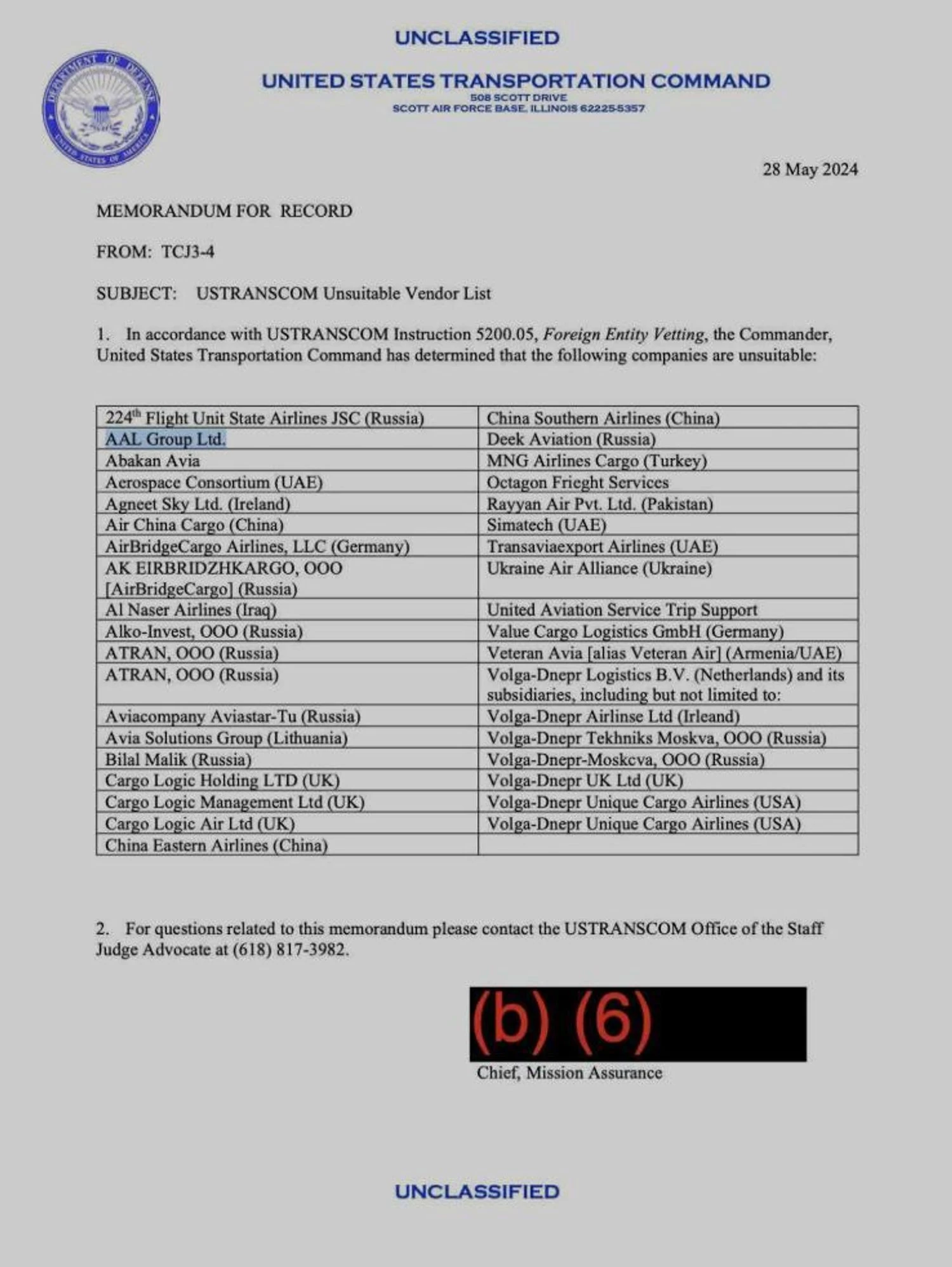
Thus, Oleksandr Bilchuk's decision is, in fact, anti-state and requires thorough verification by law enforcement officers. As lawyer Oleh Shram noted, Bilchuk's decision creates risks for Ukraine's national security that go beyond an administrative error.
If representatives of the aggressor country have indeed gained access to sensitive information, then this is a matter of signs of crimes against the foundations of national security. An official investigation can serve as a basis for initiating criminal proceedings. Or criminal proceedings can be parallel to the official investigation.
A corrupt component is possible in the reasons for Bilchuk's decision. As political scientist Serhiy Shabovta noted in an exclusive comment to UNN, officials might not have been interested in a sufficient level of checking the company for a Russian trace or any other threat; instead, there might have been a monetary lure or any other benefit in signing the contract. Thanks to which dangerous cooperation became possible.
I understand that this (signing dangerous contracts with companies with a Russian trace - ed.) is an absolutely natural, unfortunately, result for our officials and businessmen who are involved in such contracts. Because this is a limited circle of people who, first of all, do not consider beneficial conditions for the state, do not calculate possible security moments - they are focused only on getting money.
The adoption of such a dubious decision becomes even more ambiguous after reviewing the declarations of Oleksandr Bilchuk, who headed the State Aviation Service of Ukraine for nine years.
Bilchuk's financial history shows stable growth, which is difficult to explain solely by his official salary. An analysis of the official's declarations forms a rather atypical picture for a family where the husband is a civil servant and the wife is a lecturer at the Kyiv Professional College of Tourism and Hotel Management.
Already at the start of his leadership of the State Aviation Service, in 2016, the family owned significant assets: over UAH 200,000, USD 83,000, and about EUR 5,000 in cash savings, two apartments (29.3 m² and 92.1 m²), a garage (38.5 m²), and two cars – a Volkswagen Tiguan (2011 model year) and a Honda Jazz (2010 model year). At market prices of those years, the cost of such cars was at least USD 23,000 and USD 15,000, respectively. Thus, even the initial level of material support for the family significantly exceeded the typical for civil servant and lecturer positions.
Subsequently, the family's financial flows were supported by Bilchuk's salary - on average at the level of UAH 100,000 and his wife's income - about UAH 17,000 per month.
However, it is real estate transactions that raise the main questions. In 2018, the family sold a smaller apartment of 29.3 m² for UAH 694,843 (~USD 25,000), and already in 2020, they purchased a larger one - 47.4 m² for UAH 1.35 million (~USD 50,000). Thus, for the new purchase, it was necessary to add approximately USD 25,000 from savings.
In 2021, Bilchuk declared the transfer of UAH 2 million in cash (~USD 73,000) to his son. In the same year, an object of unfinished construction appeared in the declaration - an apartment of 65 m², the owner of which was listed as his son Andriy, but in the declarations for 2022-2024, it is not mentioned.
The acquisition of cars is no less indicative. In 2019, the Honda Jazz was replaced by a Honda HR-V for UAH 756,000 (~USD 26,400), and the Volkswagen Tiguan was sold for UAH 285,000 (~USD 28,600). However, in 2024, the most strange deal takes place: Bilchuk buys an Infiniti Q50 2019 model year for only UAH 200,000 (~USD 5,000), although, according to AUTO.RIA, the minimum market value of such a car was USD 15,000-16,000.
Finding such a car for a third of the market price is a stroke of luck that even the luckiest buyer could hardly hope for. Such a discrepancy in value raises reasonable doubts about the real price of the deal.
At the same time, despite expenses for housing, the transfer of large sums to his son, and regular updates of the car fleet, the declared foreign currency savings of the Bilchuk family only grew. Such financial stability against the background of public service looks more like a phenomenon that requires separate attention from the NACP and a thorough check of the sources of funds.