









Relic dragon tree is threatened with extinction due to climate change and goats
Kyiv • UNN
On the island of Socotra, in Yemen, the dragon tree is threatened with extinction due to climate change and goats. These trees are an important element of the ecosystem, their disappearance will lead to catastrophic consequences.

One of the most unusual trees on the planet - the dragon tree - has become an object of increased protection on the island of Socotra, which is an administrative part of Yemen. The relict plant, shrouded in legends, is threatened with extinction due to climate change and goats. This is reported by UNN with reference to the Associated Press.
Details
On a wind-swept plateau high above the Arabian Sea, Sena Keibani tends to a seedling that barely reaches her ankle. The young plant, protected by a makeshift fence of wood and wire, is a species of dragon tree (another name is cinnabar-red dracaena or lat. Dracaena cinnabari) - a species found only on the Yemeni island of Socotra. The dragon tree is now struggling to survive amid increasing threats related to climate change.
Seeing trees die is like losing one of your children
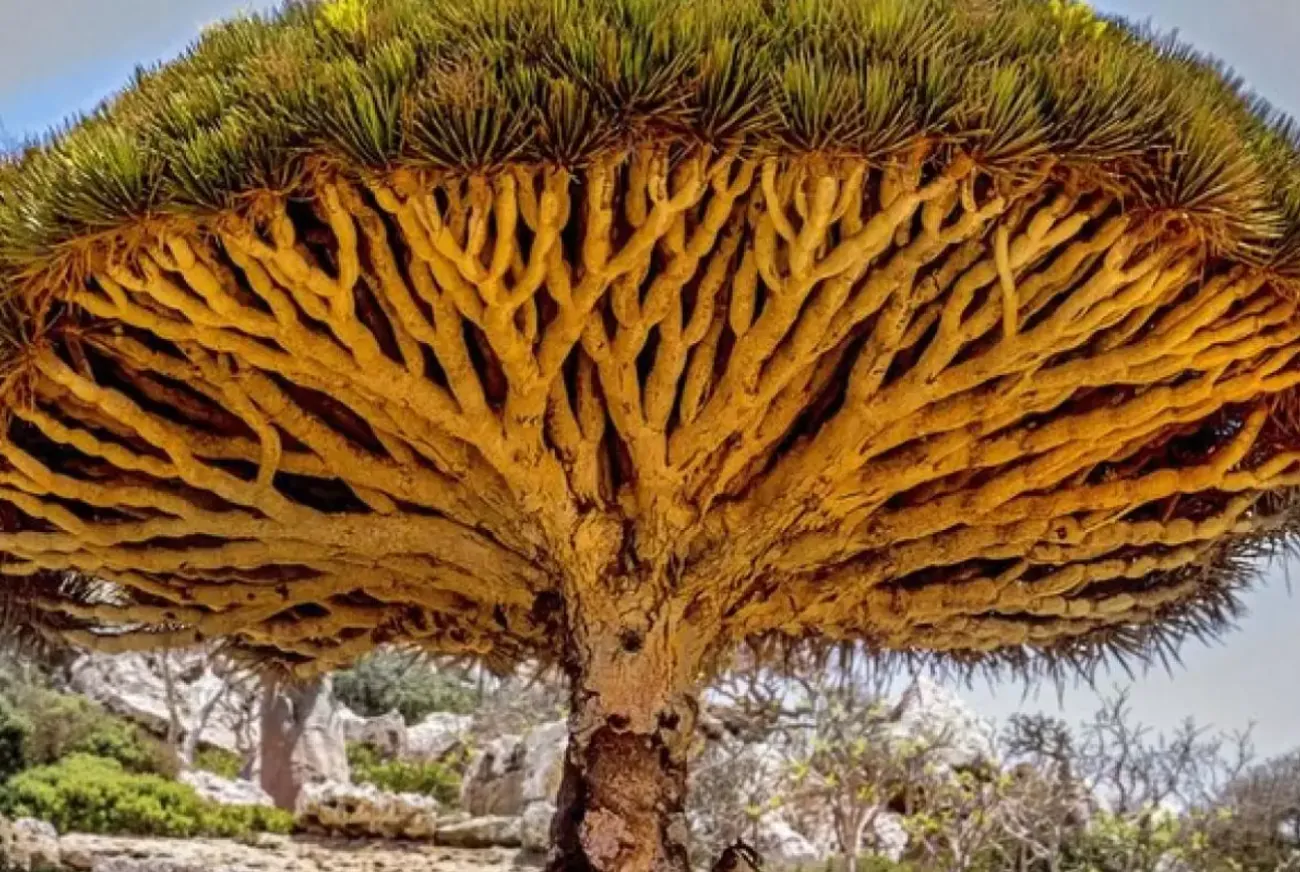
Known for their mushroom-shaped crowns and blood-red sap that flows through their wood, these trees once grew in large numbers on the planet. But increasingly strong cyclones, grazing by invasive goats and constant unrest in Yemen - one of the world's poorest countries, engulfed in a decade-long civil war - have pushed the unique ecosystem to the brink of survival.
Socotra, often compared to the Galapagos Islands, drifts in isolation about 240 kilometers from the Horn of Africa. Biological riches, including 825 plant species, more than a third of which are found nowhere else on Earth, have earned it UNESCO World Heritage status. Among them are bottle trees, whose swollen trunks protrude from the rocks like sculptures, and frankincense, whose gnarled branches twist to the sky.
But it is the dragon tree that has long captured the imagination of scientists and travelers due to its fantastic shape and unusual biology. Every year, the island receives about 5,000 tourists, many of whom are attracted by the surreal sight of "dragon blood" forests.
Visitors are required to hire local guides and stay in campsites run by Socotri families. This rule ensures that tourist dollars are distributed locally.
With the income we get from tourism, we live better than those who live on the mainland
But this tree is not just a botanical curiosity: it is a pillar of the Socotra ecosystem, which ensures the life of other species with its existence. Umbrella canopies trap fog and rain, directing them into the soil, allowing neighboring plants to thrive in the arid climate.
When you lose trees, you lose everything - the soil, the water, the entire ecosystem
Scientists, such as Van Damme, warn that without intervention, these trees could disappear within a few centuries, and with them many other species.
We, as humans, have managed to destroy a huge amount of nature on most of the world's islands. Socotra is a place where we can really do something. But if we don't, it will be our fault
Addition
Dragon tree, dracaena draco or dragon tree (Dracaena draco) is a subtropical tree-like plant of the genus dracaena. Tree up to 10 m tall with a thick trunk. Its crown resembles an inside-out umbrella with thick branches. In ancient times, the juice was used for medicinal purposes and for varnish that could be applied to metal surfaces.