










Money, health and the meaning of life: Ukrainians explained why they feel happy during the war
Kyiv • UNN
According to the Kyiv International Institute of Sociology (KIIS), 71% of Ukrainians consider themselves happy, returning to the level of 2021. Money, health and the meaning of life have the strongest impact on happiness.

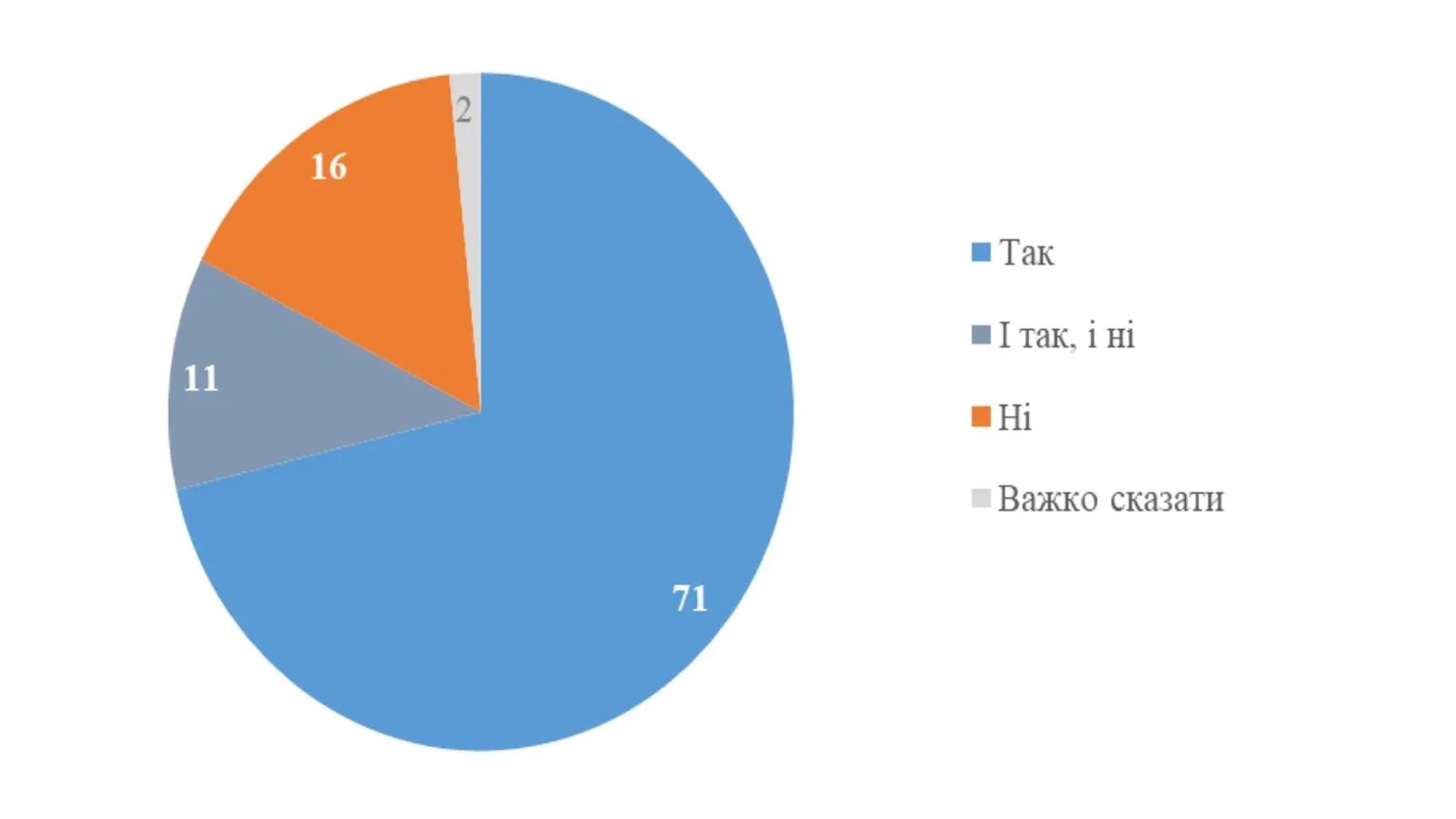
Despite more than four years of full-scale war, the majority of Ukrainians continue to assess their lives positively: 71% of those surveyed say they consider themselves happy, while 16% describe themselves as unhappy. This is according to the results of a new study by the Kyiv International Institute of Sociology, reports UNN.
According to the information obtained by sociologists, the happiness indicator has returned to the level recorded at the end of 2021, before Russia's full-scale invasion.
Details
Breaking down these 71% further, 31% of Ukrainians directly answered that they consider themselves happy. Another 40% chose the more reserved option — "rather yes than no." At the same time, 11% of respondents were unable to make a definite choice and answered "both yes and no." Some 16% of Ukrainians consider themselves unhappy or rather unhappy. Of these, 9% answered "rather no than yes," while another 7% simply answered "no."
However, the KIIS immediately cautions that these figures do not at all mean that life has become easier for Ukrainians. The war continues, and people face danger, loss, financial difficulties, stress and uncertainty every day.
Why the happiness level recovered after falling in 2024
KIIS has been asking Ukrainians about happiness for more than 20 years, making it possible to see how public sentiment has changed.
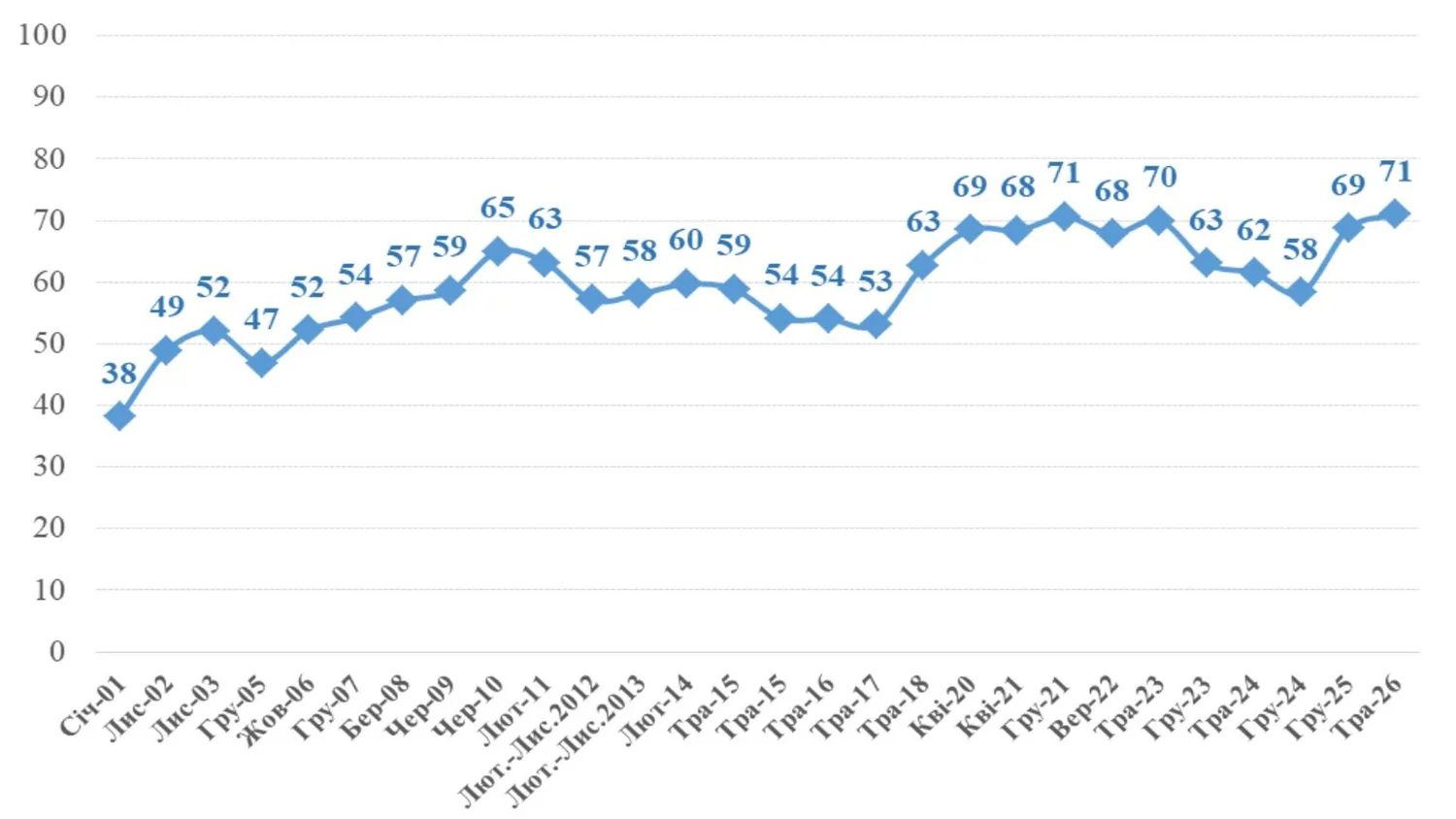
In 2001, only 38% of Ukrainians considered themselves happy. By 2010, this figure had risen to 65%.
On the eve of the major war, in December 2021, around 70–71% of Ukrainians described themselves as happy. Approximately 15% did not consider themselves happy at that time.
After the full-scale invasion began, there was no sharp decline. In September 2022, 68% of respondents considered themselves happy, and in May 2023 — 70%. However, the figure then began to fall.
In May 2024, 61% of Ukrainians described themselves as happy, while in December of the same year the figure had fallen to 58%. After that, the situation changed again. In December 2025, the share of happy people rose to 69%, and in 2026 — to 71%. In other words, over a year and a half, the indicator increased by 13 percentage points and effectively returned to its prewar level. But there is an important nuance here.
The number of people who consider themselves unhappy has barely changed. In December 2024, they accounted for approximately 16%, and in 2026 — the same 16%. Instead, there was a sharp decline in the number of people who were uncertain between a positive and negative assessment of their lives. In December 2024, 25% of respondents chose the answer "both yes and no," while in 2026, only 11% did so. In other words, a significant portion of Ukrainians moved not from unhappiness to happiness, but from uncertainty and conflicting feelings to a more positive attitude toward their own lives.
Age, money and health: who is more likely to consider themselves happy
The survey results also revealed a fairly clear pattern: the sense of happiness is strongly influenced by age, financial circumstances and health.
Among Ukrainians under the age of 40, 75% consider themselves happy. Among people aged 70 and older, the figure is already around 60%.
KIIS notes that in Ukraine, the level of happiness gradually declines with age.
Interestingly, many studies in the United States and European countries show a different pattern: the level of subjective well-being there often falls until approximately age 45–50 and then begins to rise again.
An equally noticeable connection can be seen between happiness and income. Among people with very low incomes, 48% describe themselves as happy. Among the most affluent, the figure is already 91%.
A similar situation exists with health. Among those who assess their health as poor or very poor, approximately half of respondents consider themselves happy. Among people with the most favorable self-assessments of their health, the happiness level reaches 91%.
At the same time, health and well-being are also closely connected. Among the poorest respondents, only 8% say they are in good health. Among the most affluent, the figure is already 51%.
A sense of purpose in life also matters
Another interesting point identified by sociologists is the connection between a sense of happiness and an understanding of the meaning of one's own life. Among those who say they do not know what the meaning of their life is, 41% consider themselves happy. Among those who believe they know the answer to this question, the figure is already 79%.
KIIS notes that even before the full-scale war began, studies showed that happiness was linked not only to money or health, but also to education, family and intimate relationships, a sense of stability, and confidence in the future.
Why Ukrainians are once again more likely to describe themselves as happy
KIIS President Volodymyr Paniotto draws attention to a rather paradoxical situation that sociologists began recording shortly after the start of the full-scale war. Objectively, the lives of millions of people became dramatically more difficult: some lost their homes, others their jobs or incomes, many families were separated, and danger became part of everyday life. At the same time, however, some subjective indicators not only did not collapse but occasionally even increased.
According to Paniotto, the reason is that happiness depends not only on how much a person has, but also on what they expect from life and whom they compare themselves with. During wartime, these criteria change substantially. What might have seemed like a major problem in peacetime now often takes a back seat. Instead, basic things become far more important: that loved ones are alive, that there is somewhere to live, that one has a job, the opportunity to see relatives, and the ability to maintain a familiar rhythm of life.
KIIS believes that one possible explanation for the current rise in happiness is psychological adaptation to the prolonged war. Over several years, people have restored many everyday practices: they work, study, maintain personal contacts, attend cultural events, and make plans even amid constant danger. The war has not become less difficult as a result, but people's expectations and the criteria by which they assess their own lives have changed.
Another possible factor is attitudes toward the country's future. In previous KIIS studies, researchers found a fairly clear correlation: the more optimistically people assessed Ukraine's future, the more often they described themselves as happy. However, the current survey did not include a separate question about optimism regarding the future, so sociologists cannot directly prove this connection.
Another possible explanation is the feeling that Ukraine has more opportunities to influence the course of the war.
KIIS mentions the expansion of Ukraine's ability to carry out long-range strikes against military and other important facilities on the territory of Russia, as well as successful high-profile operations. Sociologists suggest that such events may reduce feelings of helplessness and, conversely, strengthen the sense that Ukraine is capable not only of withstanding attacks but also of actively influencing the situation itself.
However, KIIS emphasizes that this is only one hypothesis, which this particular survey did not test.
Context
KIIS sociologists conducted the survey from May 7 to June 3, 2026, using telephone interviews. They surveyed 2,007 adult citizens of Ukraine who, at the time of the study, were living in territory controlled by the government. The sample also included internally displaced persons from temporarily occupied territories.
At the same time, the survey did not include people who remain in temporarily occupied territories, or Ukrainian citizens who left the country after February 24, 2022.