









XB-1 supersonic aircraft breaks the sound barrier: how did they manage to avoid a devastating sonic boom?
Kyiv • UNN
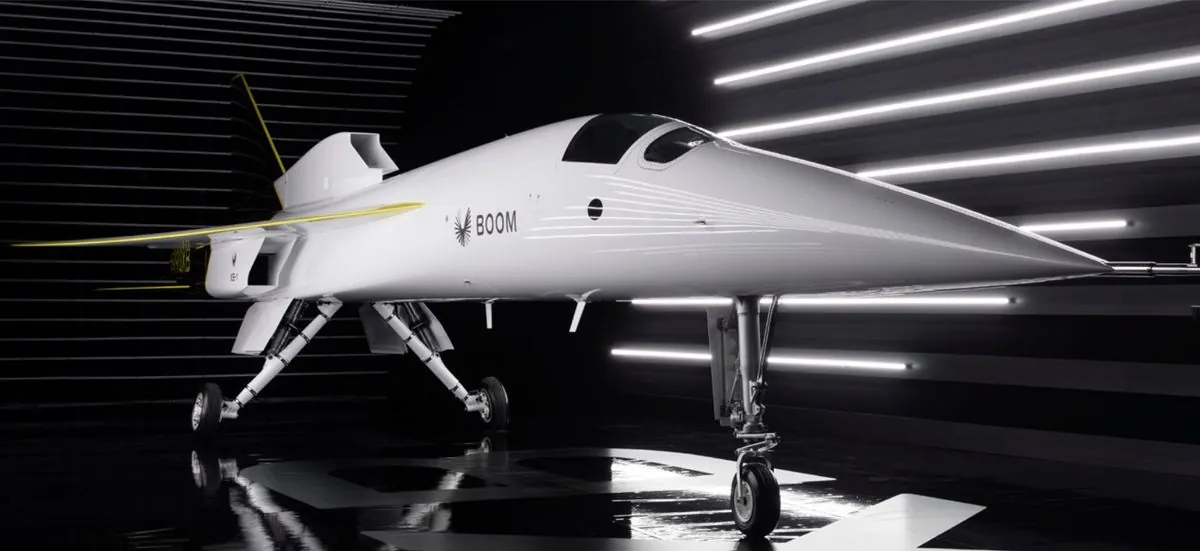
The Boom Supersonic XB-1 experimental airplane has successfully completed a supersonic flight at Mach 1.1 without a sonic boom. The company used the Mach cutoff phenomenon at an altitude of more than 10 km.

Supersonic travel may be within reach: Boom Supersonic's experimental aircraft, became the first manned civilian aircraft to break the sound barrier since the Concorde, which was discontinued in 2003.
Transmits to UNN with a link to NewScientist.
When the experimental XB-1 aircraft broke the sound barrier three times during its first supersonic flight on January 28, it did not emit a sonic boom that could be heard from the ground, according to the American company Boom Supersonic.
Important achievement: by exceeding the sound barrier, the XB-1 managed to avoid a devastating sonic boom. The XB-1 took advantage of a physical phenomenon called Mach cutoff.
When an airplane breaks through the atmosphere at high speed, it changes the air pressure around it, creating sound waves. And when supersonic flight exceeds the speed of sound - Mach 1, or about 1,224 kilometers per hour - these sound waves combine to form a shock wave that propagates away from the flight path. Such a wave creates extremely loud noise, shaking buildings and even breaking glass.
The sonic booms above ground are so destructive that they contributed to the decommissioning of the legendary Concorde commercial airliner in 2003 and prompted many countries to ban commercial supersonic aircraft.
When the XB-1 took off for its 12th test flight, the task was clear: to accelerate to Mach 1.1 (about 1,350 km/h), officially breaking the sound barrier (Mach 1.0).
The acceleration was gradual until the aircraft reached an altitude of more than 10 km, after which it accelerated to Mach 1.122. After 11 minutes and 35 seconds of flight, the XB-1 broke the sound barrier, remaining at supersonic speed for about four minutes.
What happened
There was a phenomenon called "Mach cutoff" - when shock waves propagate from supersonic to subsonic regions in a stratified atmosphere.
At high altitudes, sound travels more slowly, so an airplane that breaks the sound barrier at these altitudes will create a boom that will not reach the ground. If the boom moves downward, the increasing speed of sound will deflect it, pushing its shock waves upward.
The trick is that temperature and wind also affect the speed of sound, so the ideal altitude and speed for a supersonic aircraft will depend on atmospheric conditions.
"The real challenge is to get very accurate atmospheric forecasts for temperature and wind - hence calculating a practical Mach speed is quite simple," explained Bernd Liebhardt from the German Aerospace Center in Germany.
Boom Supersonic says that during the XB-1's latest and final test flight, on February 10, it also reached supersonic speed without a boom.
Now the company is using the experience of test flights to help its future commercial airliner, called Overture, achieve the same success.
Recall
Former US intelligence director John Ratcliffe spoke about Russia's attempts to compete with the US in the field of hypersonic technology. He noted that Russia's Texas-sized economy forces it to choose narrow areas of competition.