


73% of companies want to find out within an hour that they have been mentioned in the media — study
Kyiv • UNN
79% of communications professionals consider real-time media monitoring critically important. At 14% of companies, negative reports had spread before a response could be made.

The European Business Association (EBA) Marketing and Communications Committee conducted a survey among communications professionals from EBA member companies on real-time media monitoring practices. The survey found that most of them want to learn about important media mentions of their companies within an hour. However, due to the lack of a real-time alert system, negative materials have time to spread through reprints before the first response in 14% of companies, UNN reports.
Details
"Three quarters of communications professionals from EBA member companies expect to learn about an important mention within an hour, while one in three received information about a negative publication not from the monitoring system," the study says.
Speed is a requirement, not a preference: 79% of respondents consider real-time media monitoring critically important for the company's day-to-day operations. 45% expect to learn about an important publication within 15 minutes of its appearance, and 73% within an hour. Three out of four respondents consult monitoring results at least daily, while 41% do so continuously throughout the working day.
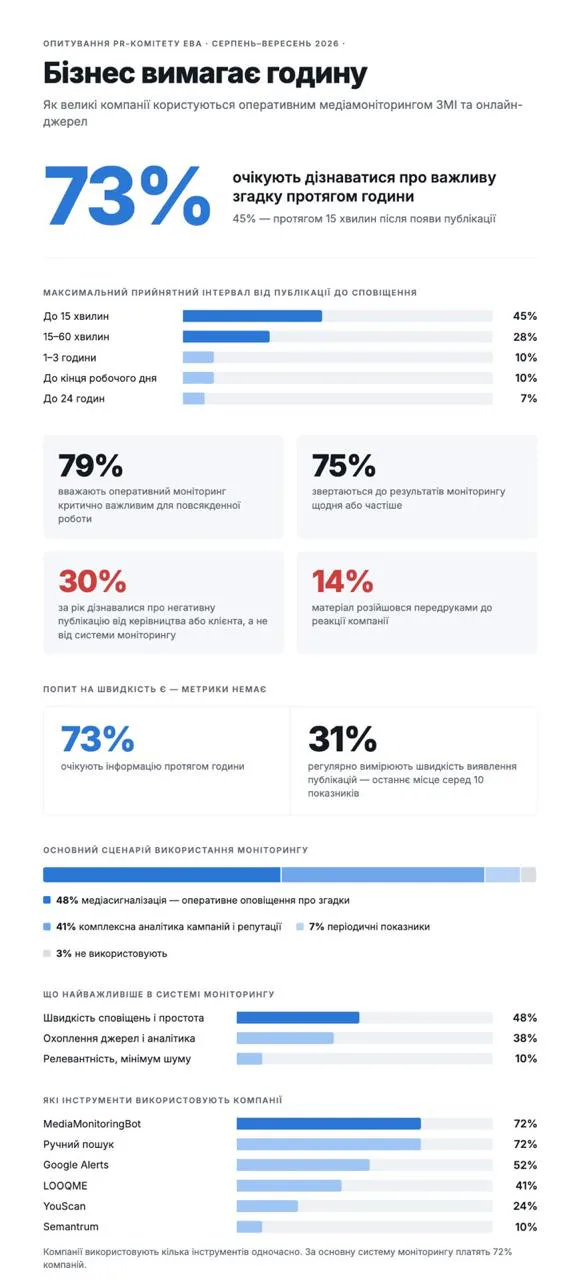
The cost of delay: over the past 12 months, 30% of survey participants learned about a negative publication from management, a client, or a partner rather than from the monitoring system. At 14% of companies, the material had already spread through reprints before they responded.
Media alerts as the primary use case: half of those surveyed use monitoring primarily as a real-time alert system for mentions of companies, brands, or executives in new publications. 41% use it for a comprehensive assessment of PR campaigns, reputation, and competitors, and only 7% for analyzing periodic metrics.
"Priorities when choosing a monitoring system were distributed accordingly: 48% place the speed of alerts and ease of use first, 38% source coverage and analytical capabilities, and 10% the relevance of results," the study says.
There is demand for speed, but no metric: although the vast majority of respondents expect to receive information within an hour, only 31% regularly measure the speed at which important publications are detected—ranking last among the ten metrics analyzed by companies. The most common metrics are the number of publications and mentions (97%), sentiment (83%), and the share of information presence compared with competitors (72%).
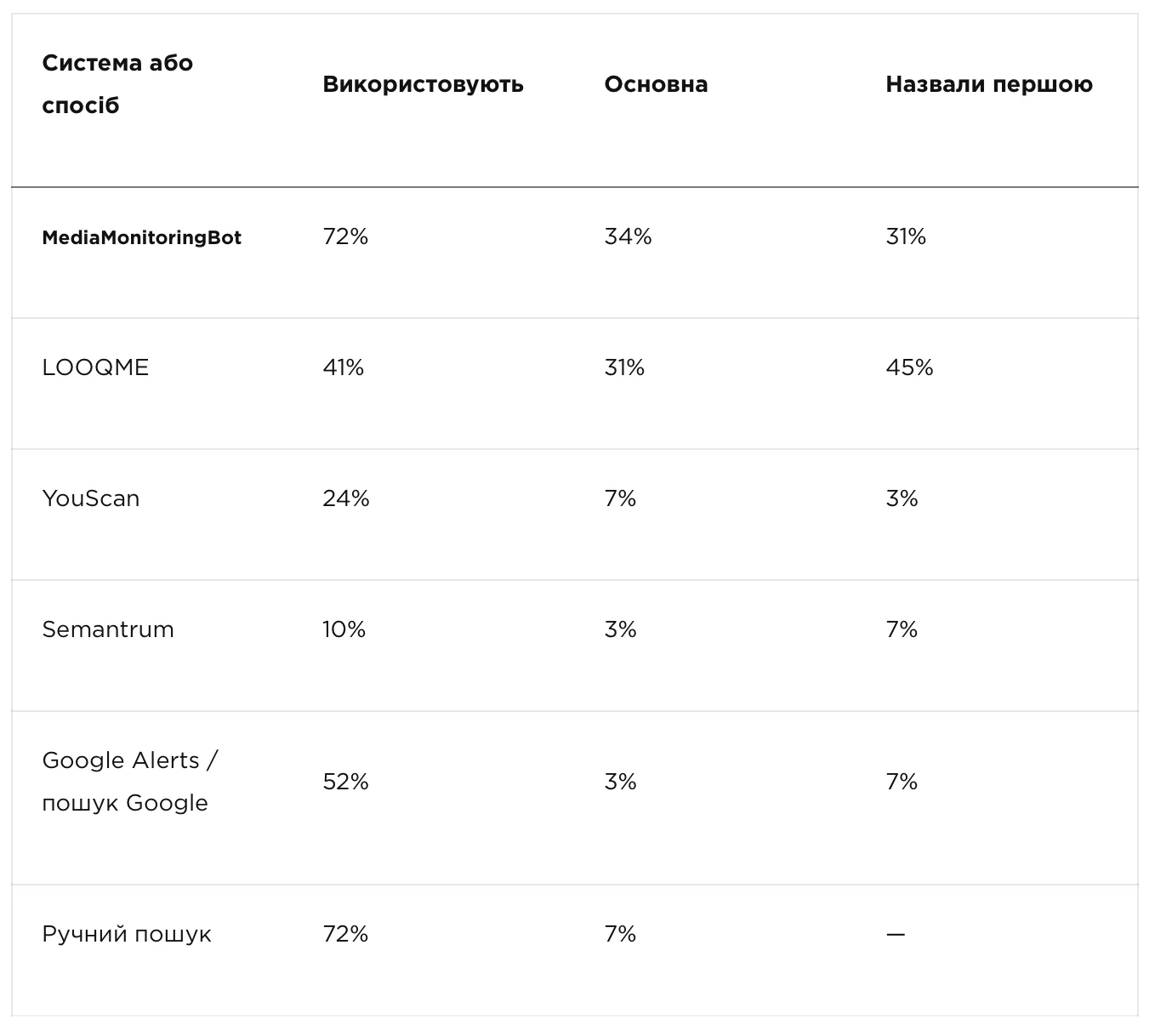
Tools: the most widely used specialized real-time media monitoring system among the companies surveyed is MediaMonitoringBot, used by 72% of respondents. LOOQME is used by 41%, YouScan by 24%, and Semantrum by 10%. At the same time, 72% of companies also use manual searches, while 52% use Google Alerts. A total of 72% of companies pay for their primary monitoring system.
In terms of unaided awareness, LOOQME was mentioned most often in first place (45%), followed by MediaMonitoringBot (31%). Another 7% of respondents named a "monitoring Telegram bot" without specifying a brand.
"Real-time media monitoring is not merely a tool for tracking mentions, but an important component of managing a business's reputation and communications risks. The results of our survey demonstrate a certain paradox: companies expect maximum speed in receiving information, but far from all of them measure this speed or assess its impact on communications effectiveness. Managing reputation based on daily data, analytics, and timely decisions is a sign of the maturity of a business's communications function," said Natalia Ulynets, Chair of the EBA Marketing and Communications Committee.