










"Semester ends": Ministry of Education clarifies nuances of student assessment in schools for parents
Kyiv • UNN
The Ministry of Education and Science has published a guide for parents to help them understand the nuances of student assessment in schools. The document explains formative and summative assessment, as well as the structure of the NUS achievement certificate.

The semester in schools is coming to an end, and against the backdrop of summing up and grading, the Ministry of Education and Science has published a guide that will help parents better understand the nuances of evaluating children, writes UNN.
Details
In order to understand what a child has achieved: what they know, what they can do, teachers, as indicated, use the following types of assessment: formative and summative.
Formative assessment is detailed textual or oral feedback that the teacher provides directly to the child and directly or indirectly to the parents. First and foremost, it is assessment for learning.
Summative assessment is an assessment of the result (within a topic, semester, year). To determine how well a child has achieved learning goals at a certain stage (within a part of the program, semester, or year), summative assessment is used. It is usually conducted in the form of summative (independent or control) works, tests, summative projects, etc. Everything depends on the specifics of the subject and the teacher who chooses the methods of such assessment.
Just like formative assessment, summative assessment provides information about what results the child has achieved: what skills and at what level they are developed, what knowledge they possess to apply these skills.
To get more information about a child's learning outcomes, the NUS achievement certificate (unlike a report card) records grades by groups of results.
As an example, the Ministry of Education and Science provides a certificate for the subject "Ukrainian Language", where there are four grades that give a more detailed picture of the child's ability to perceive texts, communicate orally and in writing, analyze what they have read, etc.
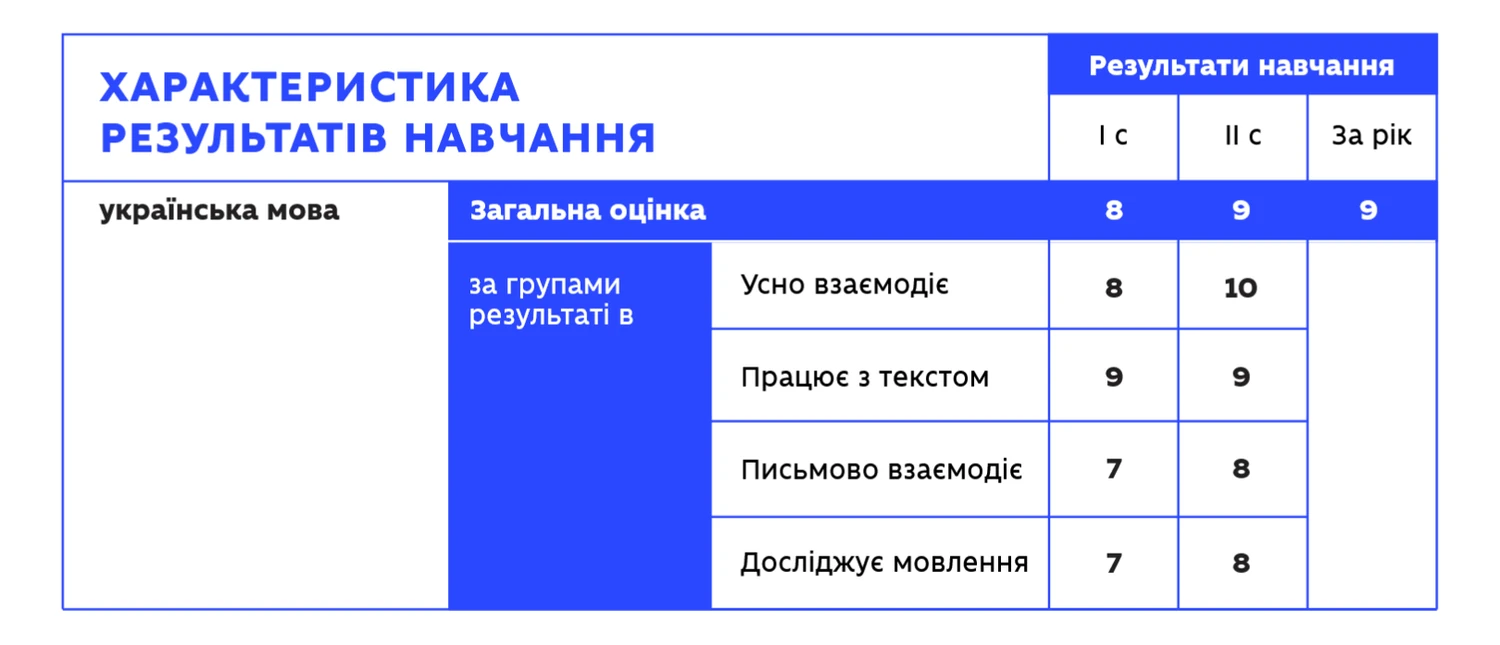
"Let's compare: if a report card simply has an 8 in Ukrainian language, it gives no information about how well the child can write texts independently, or how developed their skills are in analyzing and critically reading texts," the Ministry of Education and Science explained.
The achievement certificate consists of two parts: not only the characteristics of learning outcomes, but also the characteristics of learning activities.
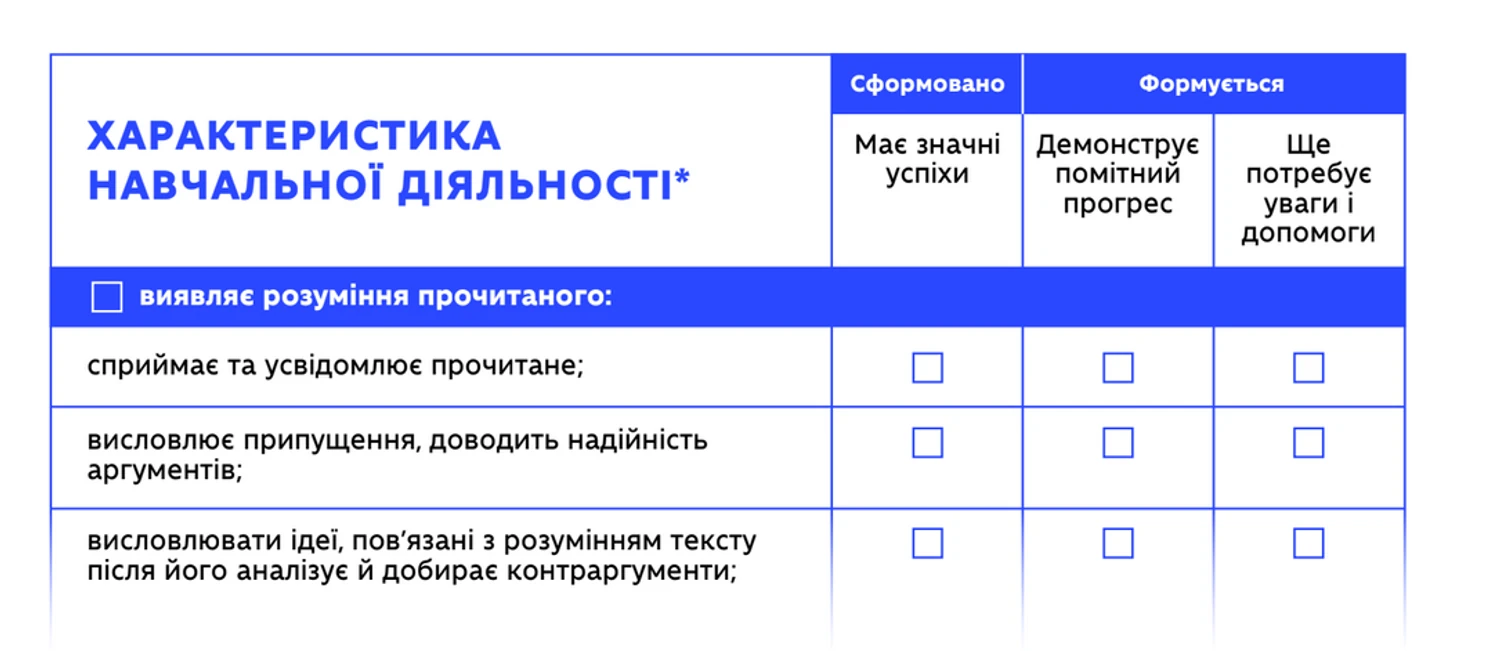
The characteristics of learning activities relate to the formation of cross-cutting skills in the child, which are developed in all lessons, during the study of all subjects and integrated courses. From this part of the certificate, you can find out how well the child cooperates with others, shows initiative during learning, whether they are able to constructively manage emotions, and much more.
How to read the certificate
The Ministry of Education explained how to read the certificate:
- result groups are rows in the table. They show what skills your child is working on developing within the subject (for example, working with texts, solving problems, analyzing information, etc.);
- each cell in the row is a result for one semester. You can see how progress changes throughout the year;
- the last cell in each row is the annual grade, which summarizes all results for the year;
- the semester grade is the arithmetic mean of the grades for each group of results;
- the annual grade is the arithmetic mean of the two semester grades;
- the overall grade is the arithmetic mean of the grades for the three learning outcomes.
The achievement certificate provides a detailed understanding of a child's academic progress. The teacher fills out the document twice a year.