










Rare humpback whale rescued from fishing net in the Baltic Sea
Kyiv • UNN
Near the Polish city of Międzyzdroje, animal welfare activists freed a 7-meter humpback whale that had become entangled in fishing nets. The rescue operation was successful thanks to the calm behavior of the animal and the coordinated work of the services.

Humpback whales are extremely rare in the Baltic Sea. A recent journey of a marine mammal near the German and Polish borders ended in a fishing net. But representatives of an animal welfare organization and border guards came to the rescue.
UNN reports with reference to PAP and Spiegel.
A rare case of a humpback whale swimming into the Baltic Sea ended up in a fishing net - but, fortunately, animal rights activists quickly came to the rescue.
The photograph of the huge marine mammal was published on social media on Wednesday by the director of the Marine Search and Rescue Service, Sebastian Kluska.
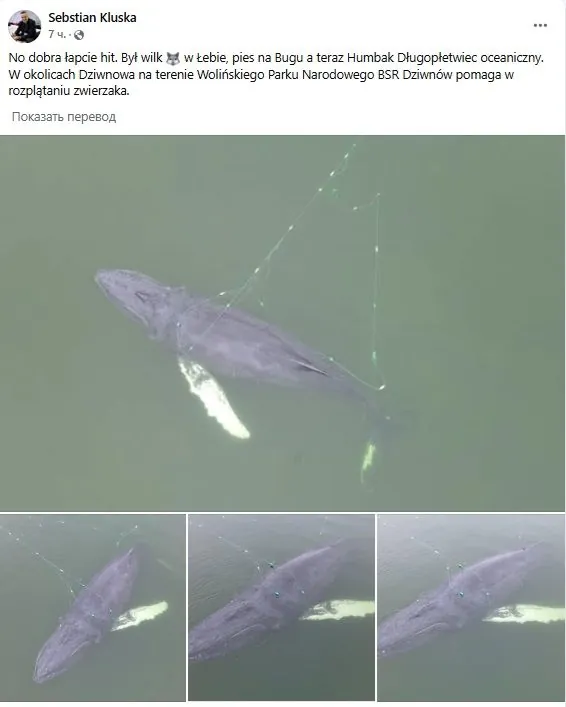
According to media reports, the young cetacean, about 7 meters long, got entangled in nets near a fishing base in Międzyzdroje (a city in northwestern Poland, on Wolin Island on the Baltic Sea).
How the whale rescue operations took place
The marine mammal was spotted on Wednesday morning. The rescue operation involved the Marine Search and Rescue Service, the Maritime Office in Szczecin, WOPR, PSP, the Border Guard, and employees of the Wolin National Park.
Rescuers approached the trapped animal very closely in a small boat.
The whale behaved relatively calmly
After we firmly attached it to a large motorboat, it freed itself from part of the rope. As soon as it started kicking, it managed to break free and started swimming. But it was still in the net. – explained Piotr Goliona from WOPR Międzyzdroje to PAP.
When the rescuers tried to remove the nets for the second time, the whale probably realized that they were coming to its aid - "something similar to cooperation" could be observed in the animal, the rescuers note.
Reference
The humpback whale (Megaptera novaeangliae) is a species of baleen whale. Its weight can exceed 40 tons, and its body length reaches 17 m (males) and 19 m (females). The name humpback whale is associated with its huge pectoral fins, which can reach 4 m in length. In the North Atlantic, the main food of the humpback whale is krill (planktonic crustacean) and small fish species.
From the history of the appearance of humpback whales in the waters of the Baltic Sea
Regarding previous cases of the marine mammal's appearance: in 2006, a humpback whale over 10 meters long was spotted in the Gulf of Gdańsk, feeding on a school of sprats. This species of whale was also seen off the coast of Poland in the 1970s.
Whales are very rare in the waters of the Baltic Sea, as the sea is relatively small and offers little food for animals of this size. In recent years, single individuals of minke whales and sei whales have been observed, and other whale species have also appeared,
According to environmentalists, the humpback whale, which was successfully freed from the fishing net, will now be monitored. Animal rights activists hope that it will find its way back to the North Sea.
Rare turtle rescued 8000 kilometers from its home14.11.24, 15:51 • 103194 views