


Dust found high in Earth's atmosphere has revealed the secrets of water at the edge of the Solar System
Kyiv • UNN
Twelve particles from the Kuiper Belt containing traces of heavy water were found in the stratosphere. Its proportion is 15% higher than the terrestrial level.

A dozen dust particles that had wandered in from the distant Kuiper Belt beyond Neptune were discovered in Earth's stratosphere. And it turned out that they preserve the secrets of a special type of "heavy" water, which, as it turns out, is surprisingly widespread in the outer Solar System. UNN writes about this, citing Space.com.
Details
When a group of scientists analyzed 12 dust particles captured by NASA's ER-2 stratospheric research aircraft, they found signs of interaction with a form of water containing heavy oxygen isotopes.
This is important because, to better understand how the planets formed, scientists seek to understand how different materials were distributed in the early Solar System 4.5 billion years ago. If a reservoir of heavy water exists in the depths of the Solar System, understanding how this water got there and remained there will make it possible to create models describing planetary growth.
These 12 dust particles originally formed in the Kuiper Belt, but a phenomenon known as Poynting–Robertson drag—when dust particles absorb heat from the Sun and then re-emit it as thermal infrared radiation in all directions, slowing the dust particles and causing their orbits to drift toward the Sun—set them on that path. These particular 12 dust particles were lucky: Earth intercepted them, and their small size, mass, and speed meant that they survived atmospheric entry. Had the ER-2 aircraft not captured them, they could quite possibly have drifted down to Earth, the publication writes.
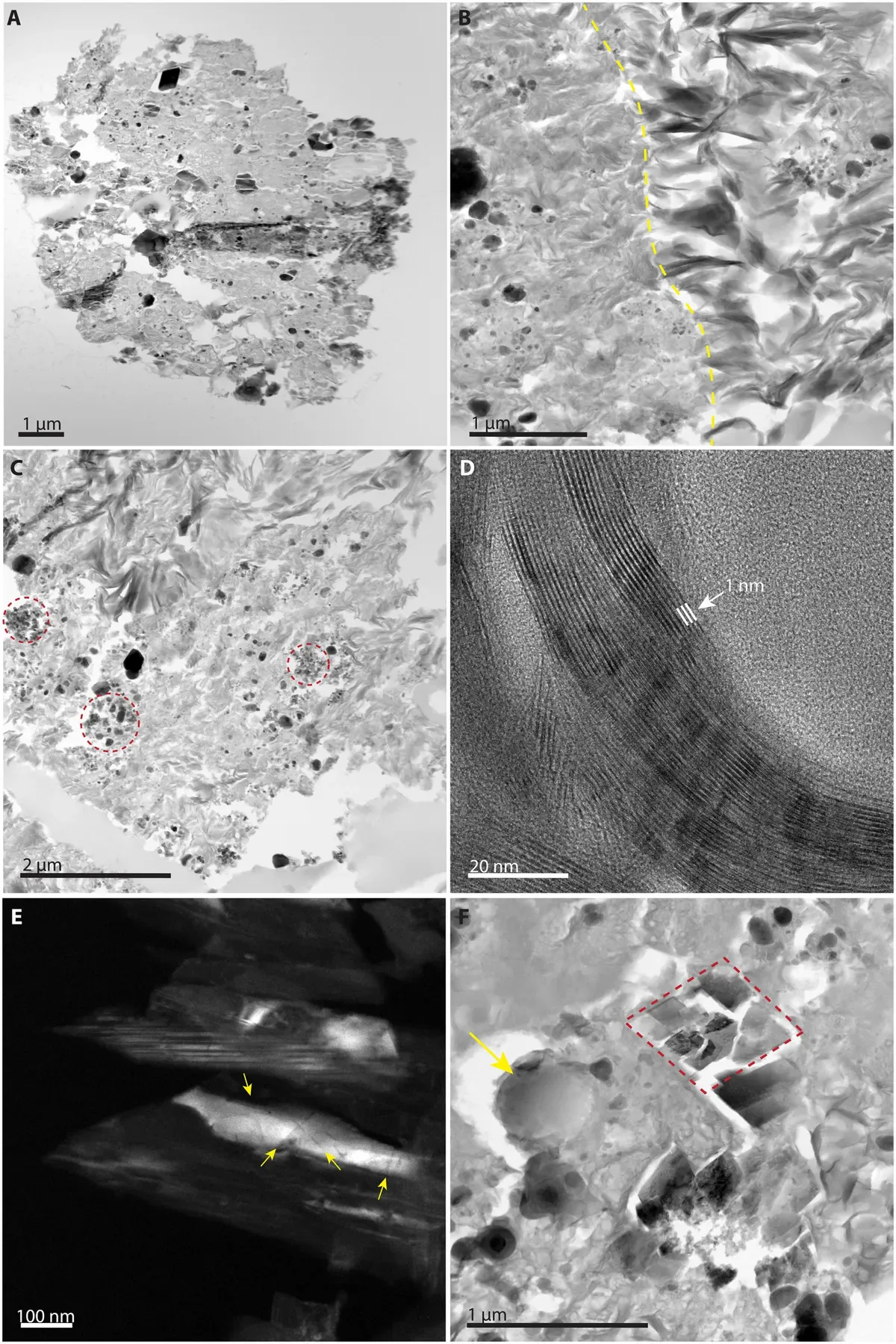
A team of scientists led by Lindsay Keller's team at NASA used advanced electron microscopy at the agency's Johnson Space Center, followed by an ion microprobe at the University of California, Los Angeles, to study hydrated minerals inside the tiny dust particles, which are less than a millimeter in size. The particles were identified as originating from the Kuiper Belt based on the pattern of traces, or "scars," left on them by energetic solar particles—a diagnostic characteristic of Kuiper Belt dust.
Using these instruments, Keller's team discovered hydrated clay minerals that formed when water enriched in heavy oxygen interacted with silicate minerals enriched in iron, nickel, and sulfide at low temperatures. These dust particles formed 4.5 billion years ago, when the planets were forming from material in the circumstellar disk of gas and dust around the young Sun. According to their models, Keller's team was able to establish an upper limit on the amount of heavy-oxygen water in the Kuiper Belt, calculating that the ratio of oxygen-18 to oxygen-16 is 15% higher than in Earth's oceans.
What makes this discovery even more intriguing is that there was probably a boundary between the inner Solar System and the Kuiper Belt. Most of the material in the planet-forming disk was well mixed, as can be seen in the composition of meteorites originating from different sources. However, most meteorites do not contain much heavy oxygen. Something must have prevented heavy oxygen from moving inward and becoming part of the planetary bodies located closer to the Sun.
"Limited mixing between these reservoirs of the outer Solar System suggests that the heavy-water reservoir in the outer Solar System was isolated from the inner regions, most likely by Saturn or in combination with the ice giants," researchers from Keller's team write in their scientific paper.
This once again illustrates the complexity of the chemistry within the planet-forming disk that created the Solar System, including Earth. When trying to understand the development of Solar System chemistry, it is also necessary to take the planets themselves and their role in shaping that chemistry into account, resulting in the Solar System we see today.
The analysis of the dust particles was published on November 11 in the journal Science Advances.