










Could help in pharmaceuticals: the 2026 Nobel Prize in Chemistry was awarded for discoveries related to homochirality
Kyiv • UNN
Henri Kagan and Kensō Soai received the prize for discovering nonlinear effects and autocatalysis. Their work explained the emergence of homochirality.

The 2026 Nobel Prize in Chemistry was awarded to two scientists "for the discovery of nonlinear effects and autocatalysis in asymmetric organic synthesis." The Nobel Committee announced this on October 7, UNN reports.
The Royal Swedish Academy of Sciences decided to award the 2026 Nobel Prize in Chemistry to Henri B. Kagan and Kensō Soai "for the discovery of nonlinear effects and autocatalysis in asymmetric organic synthesis"
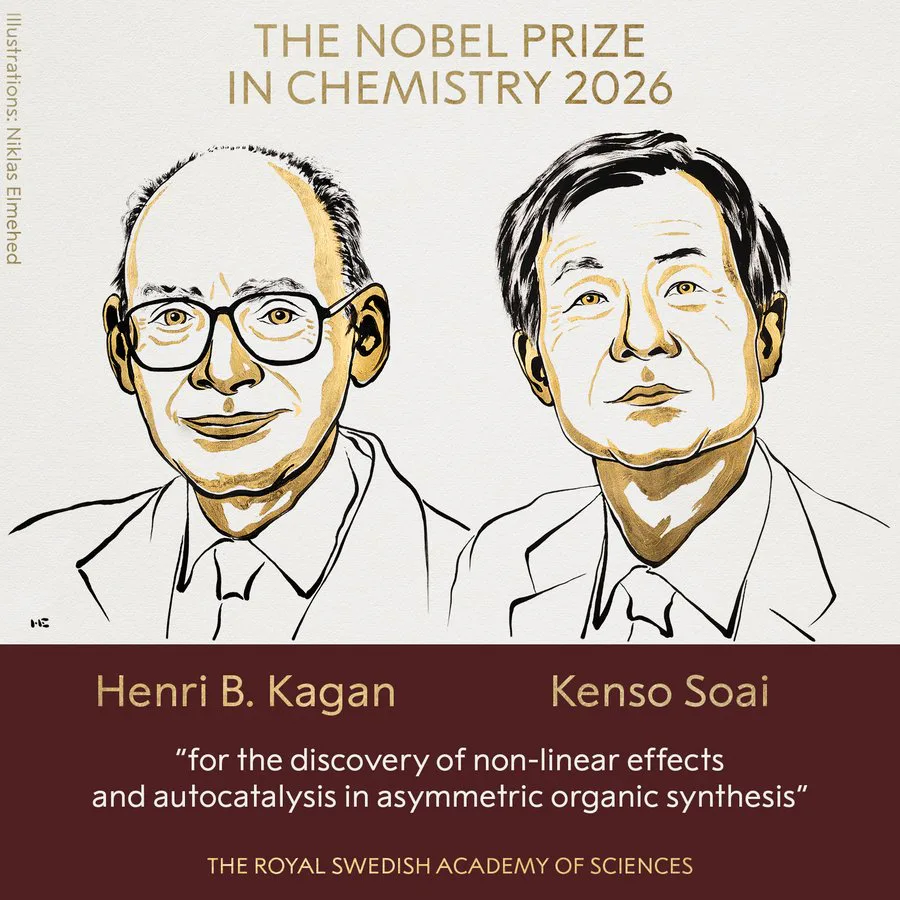
As noted, some molecules, such as amino acids, exist in two forms that are mirror images of each other. However, living organisms contain only one of these mirror images. How such chemical asymmetry could arise remained a mystery to chemists for a long time. Henri B. Kagan and Kensō Soai were awarded the 2026 Nobel Prize in Chemistry for discovering the solution to this mystery.
"The 2026 Nobel Prize in Chemistry is awarded for discoveries that have enabled chemists to control chemical reactions leading to homochirality," the statement said.
For a long time, chemists, as reported, wondered how homochirality could arise. When they began experimenting with chemical reactions that can produce two mirror-image molecules, they always obtained equal proportions of both in their test tubes. However, chemists sought to create only one of these mirror images because when developing molecules that interact with living organisms—for example, in pharmaceuticals—only one mirror image will have the desired effect.
"Thanks to laureates Henri Kagan and Kensō Soai, we now know how homochirality can arise. Their discoveries have been crucial for chemists developing reactions to produce pharmaceuticals," the committee said.