










Assessment of basic school students simplified: one grade per semester
Kyiv • UNN
The Ministry of Education and Science has approved new approaches to assessing students in grades 5–9, simplifying the recording of results in the gradebook. Now, one grade per subject is given for each semester, without the mandatory indication of result groups.

Ukraine has simplified assessment procedures in basic school, the Ministry of Education and Science reported on Tuesday, UNN writes.
Details
"The MES has approved approaches to assessing students in grades 5–9," the statement says.
According to Order No. 1427, "the competency-based approach to assessment and teachers’ academic freedom in planning assessment procedures remain in force. Instead, the mechanism for recording learning outcomes in the register has been simplified."
"The workload on teachers today is enormous. We heard the comments from male and female educators regarding the complexity of recording assessment results and simplified the keeping of class registers: it is no longer necessary to indicate groups of results, and one grade for the subject is given per semester. Teachers who find this indexing convenient as a working tool may continue to use it. The time previously spent compiling tables can now be allocated to working with children. The State Standard, the competency-based approach, and the expected learning outcomes remain the basis of assessment. The NUS reform continues, and we will continue reviewing procedures that do not work for the child," said Minister of Education and Science Andrii Butenko.

What remains
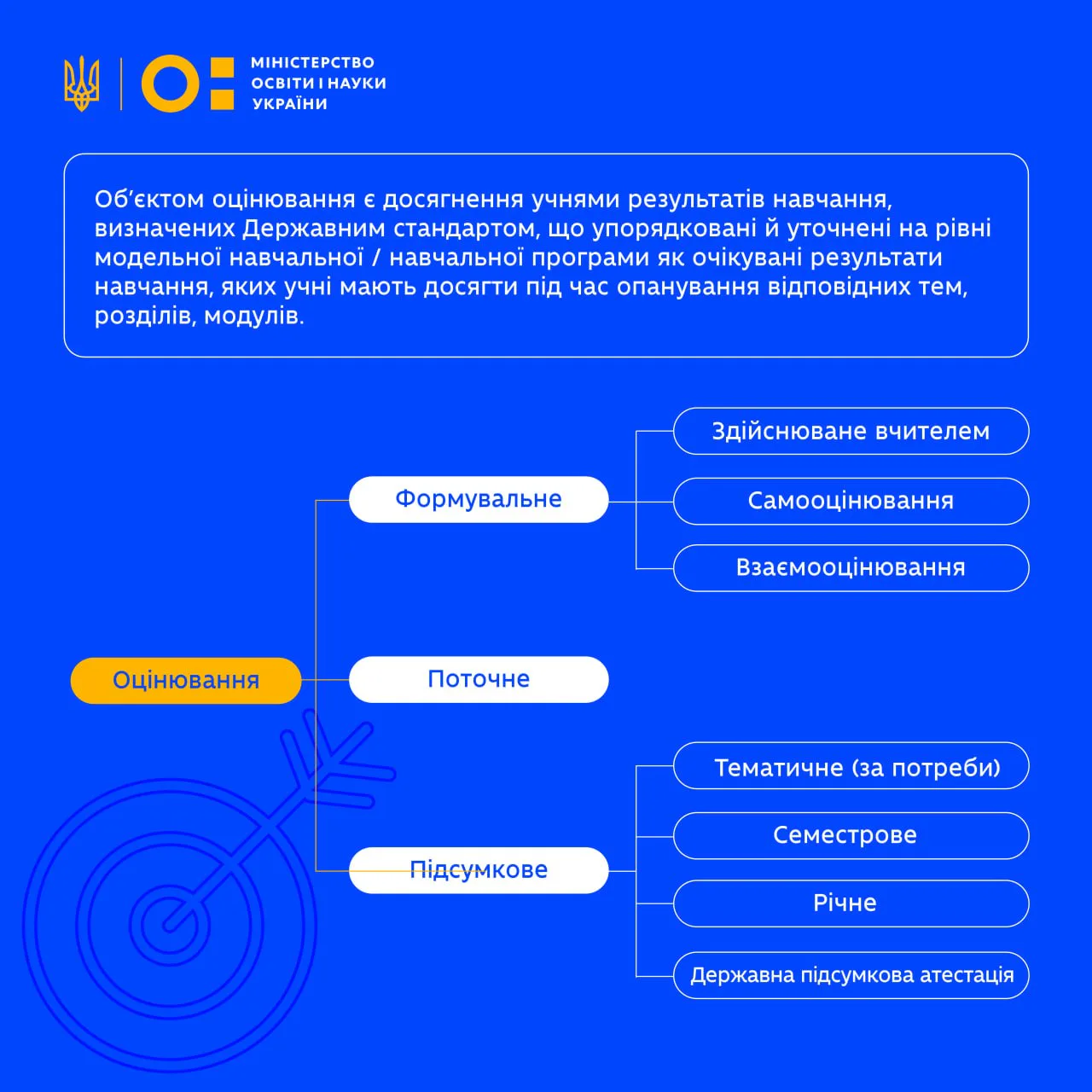
The basis of assessment remains: the teacher assesses students’ achievement of the learning outcomes defined by the State Standard and specified in model curricula and educational programs. These are the expected outcomes that students should achieve while mastering the relevant topics, sections, or modules.
The expected learning outcomes defined by the program for a semester or academic year form the basis for planning the educational process and assessing students, including assigning semester and annual grades.
Within the scope of their academic freedom, teachers independently choose the tools for assessing learning outcomes.
What is changing
The changes include:
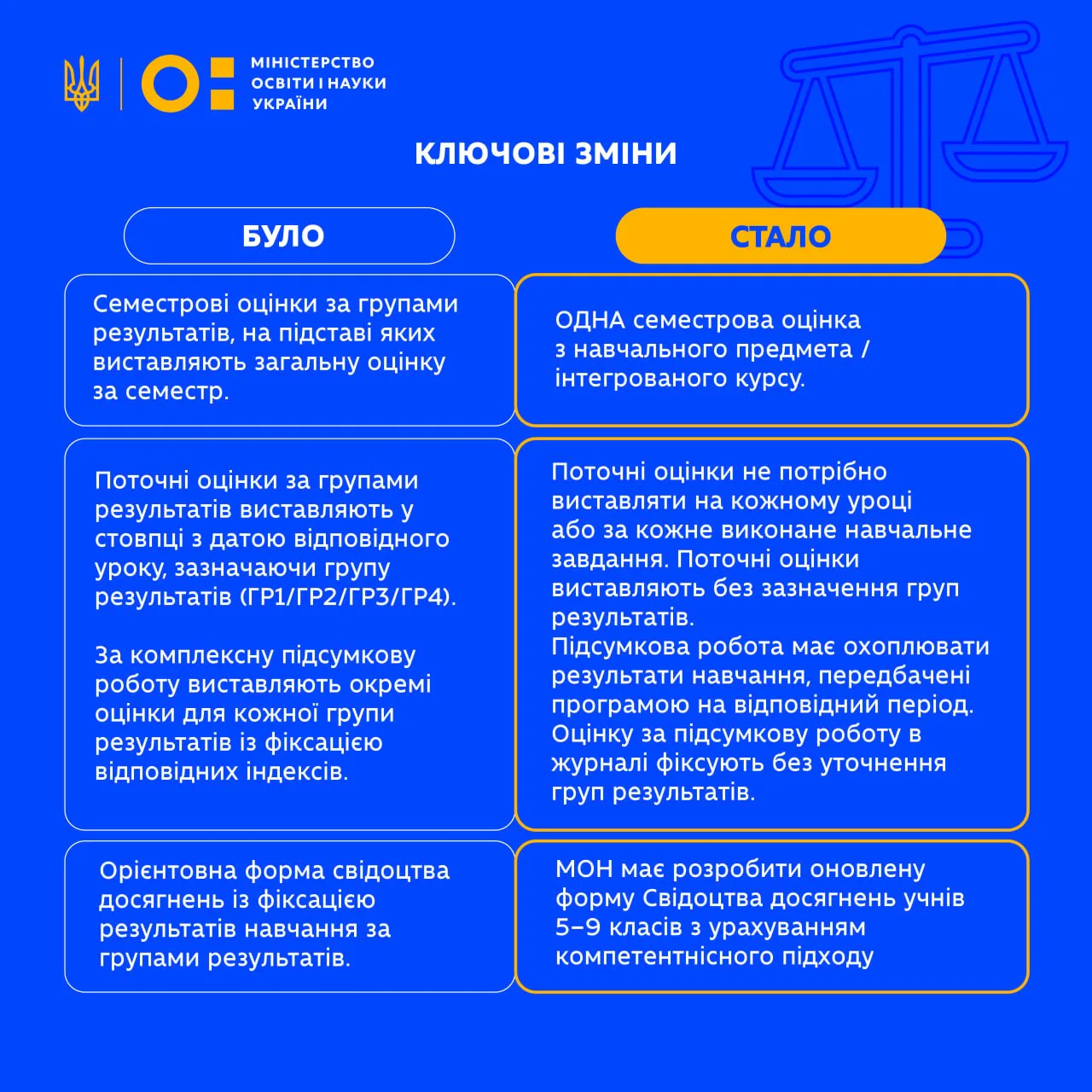
- grades will be recorded in the class register without mandatory indication of groups of results — GR1, GR2, GR3, or GR4. At the same time, teachers may use indexing as an additional working tool;
- at the end of the semester, one grade will be given for the academic subject or integrated course. Separate semester grades for each group of results are no longer mandatory;
- The MES will develop an updated form of the Certificate of Achievements for students in grades 5–9, taking into account the competency-based approach.
Formative assessment
The purpose of formative assessment is to provide students with feedback, identify their learning needs, and, where necessary, adjust the educational process. Its results are not taken into account during summative assessment.
The teacher independently chooses the formative assessment scale — verbal, level-based, or points-based. The results may be recorded in a convenient manner: in notes, observation journals, and so on. This is a teacher’s working tool and does not need to be оформed as a separate report.
Ongoing assessment
Ongoing assessment makes it possible to determine the intermediate level of students’ achievement of the expected learning outcomes within a topic, module, or section. The teacher independently determines how many grades to give and when, as well as selecting appropriate methods and tools.
The ongoing grade is given in points for completed work or a learning task in accordance with the established criteria. It affects the summative grade and is recorded in the class register without mandatory marks or indexes for groups of results.
Ongoing grades do not need to be given in every lesson or for every completed task.
Summative assessment
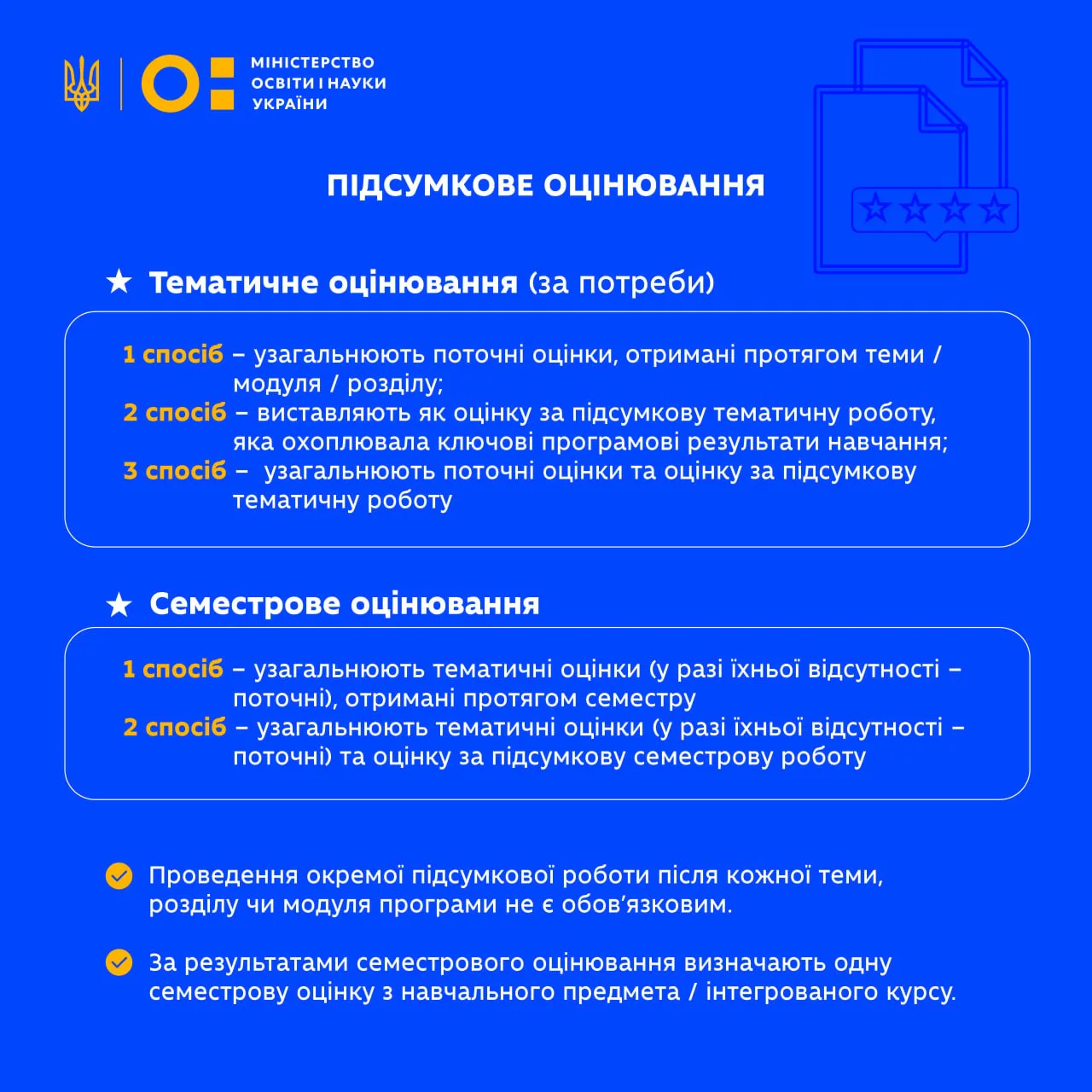
Thematic assessment is conducted when necessary. A thematic grade can be determined in one of three ways:
- by summarizing the ongoing grades received while studying a topic, module, or section;
- by assigning a grade for a final thematic assignment covering the key learning outcomes предусмотрed by the program;
- by summarizing the ongoing grades and the grade for the final thematic assignment.
It is not mandatory to conduct a separate final assignment after each topic, section, or module.
Semester grade
The semester grade is determined based on thematic grades, and in their absence, on current grades. At the teacher’s discretion, a final semester assessment may also be conducted. It must cover the learning outcomes предусмотрed by the curriculum for the relevant period. The grade for such an assessment is recorded in the register without specifying the groups of outcomes.
At the end of the semester, one grade is given for the subject or integrated course.
School autonomy and the teacher’s academic freedom
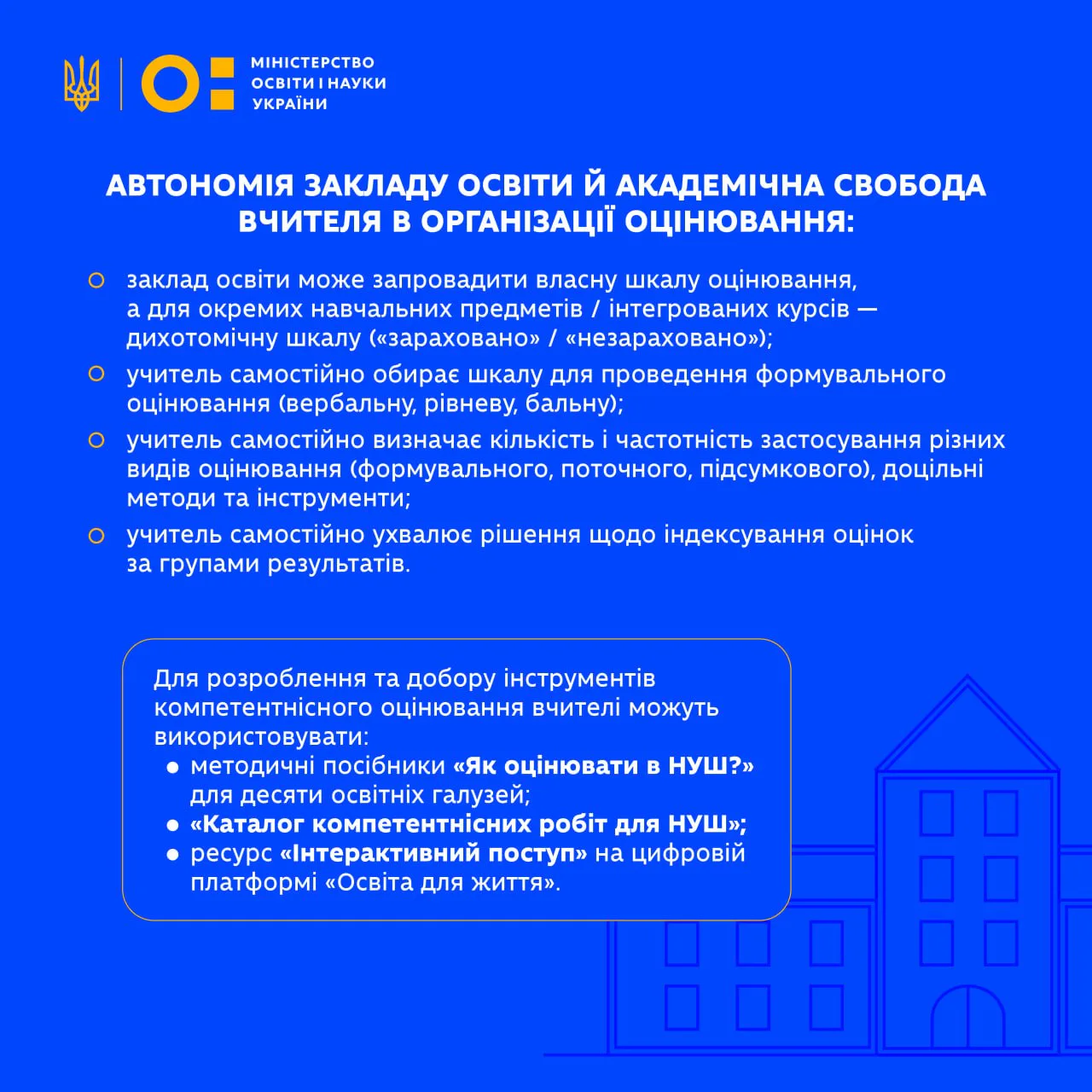
An educational institution may introduce its own assessment scale, and for individual subjects and integrated courses, a dichotomous scale of "pass / fail".
The teacher independently:
- chooses the formative assessment scale;
- determines the number and frequency of different types of assessment;
- selects methods and tools in accordance with the learning objectives;
- decides whether to use indexing of grades by groups of outcomes as an additional working tool.
"The Ministry of Education and Science will also present, by October 1, an updated form of the Certificate of Achievements for students in grades 5–9, taking into account the competency-based approach," the ministry stated.