









What will happen to food prices in Ukraine and how much will people have to pay for essentials?
Kyiv • UNN
Vegetables may rise in price by 12%, while bread and meat will increase in price due to the rise in fuel costs to $120 per barrel and a seasonal shortage of supplies.

Experts believe that there will be no sharp, one-time jump in all prices, but vegetables, bread, and some dairy and meat products will continue to rise in price, and this process will manifest unevenly in different regions.
In March 2026, the Ukrainian food market entered a period of increased price pressure amid accelerating inflation, seasonal reduction in vegetable supply, more expensive logistics, and rising energy costs. The most vulnerable categories remain vegetables, bread, and some dairy and meat products.
UNN, together with experts, analyzed what will happen to prices for popular food products in the coming weeks.
How food prices changed in Ukraine as of March 2026: official statistics
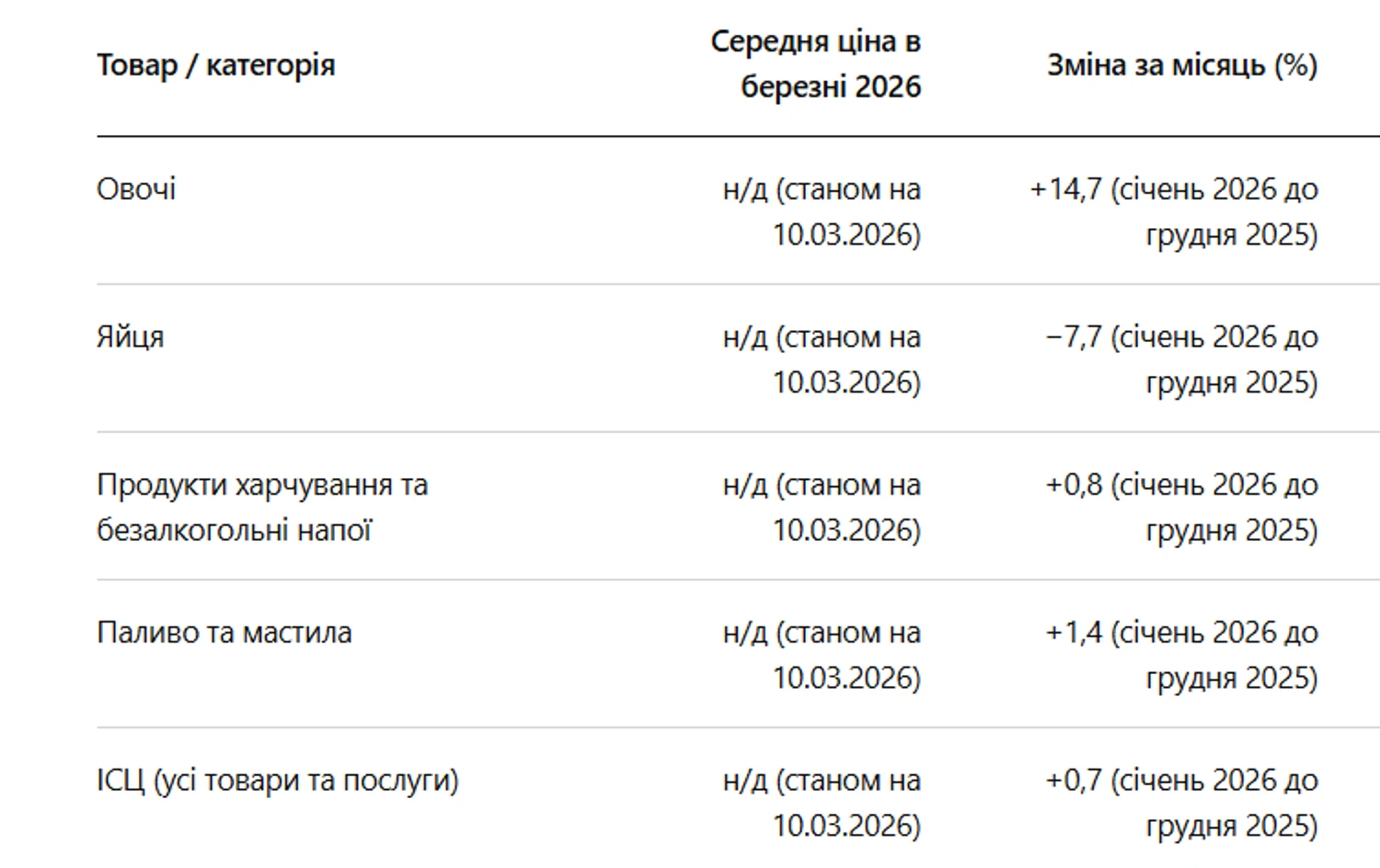
According to official data published by the State Statistics Service of Ukraine, in January 2026, inflation amounted to 0.7% compared to the previous month, and food products and non-alcoholic beverages rose in price by 0.8%. In particular, the largest increase was recorded in the "Vegetables" category: they added 14.7% to the price. But eggs rose in price somewhat more moderately: the price increased by only 7.7%.
We emphasize that as of now, only data from the State Statistics Service for January and February of the current year can be used, as information on prices in March will be available in the last days of the month - early April.
Thus, using the available data from the agency, we see that February inflation accelerated to 1.0% m/m, and the annual rate to 7.6%.
As a result, in March, prices start with an increased monthly inflation rate, which usually enhances the food market's sensitivity to seasonal and logistical shocks.
"Oil fever" in the Middle East: will it affect food prices in Ukraine
Ivan Us, chief consultant at the National Institute for Strategic Studies, explains in an exclusive comment to UNN: fuel is included in the costs of delivery, generator operation, production processes, and logistics. However, the scale of the impact depends on market competition, the cost structure of a particular product, regional logistics, and seasonal factors.
The expert draws attention primarily to the global factor. According to him, the fuel market reacted very sharply to the military-political escalation in the Middle East.
In the morning, prices were already almost $120 per barrel. For comparison, a month ago the price was $60 per barrel. This automatically creates additional pressure on retail prices, because fuel is a universal cost price.
Rising fuel prices affect not only car refueling. For the food market, this is primarily a matter of delivery. Almost every product in the store goes through a transport chain: from the manufacturer or importer to the warehouse, from the warehouse to the point of sale.
Any product needs to be delivered to the store. And to deliver it, you need to take a car and fill it with fuel, and the corresponding price goes up.
That is why the increase in the cost of petroleum products is almost inevitably partially transferred to the final price for the buyer. According to the economist, the question is no longer whether there will be growth, but its scale.
There is no doubt that there will be growth. But how much, that's what we need to look at first.
At the same time, in his opinion, a complete automatic transfer of costs to the consumer is not a guaranteed scenario for the Ukrainian food market. At least, not this March.
If one chain sharply raises prices, and others limit growth, it may lose part of the market. Therefore, each retailer is forced to balance between the need to compensate for costs and the need to retain the buyer.
Expert explained why diesel prices actually rose09.03.26, 14:19 • 3902 views
Another UNN interlocutor, Deputy Head of the All-Ukrainian Agrarian Council Denys Marchuk, holds a somewhat different opinion. The expert is convinced that the current rise in fuel prices is not strong enough to instantly cause a sharp increase in the price of all products.
A price increase of 3, 5, 6 hryvnias for fuel will not be so strongly reflected in the price of food products.
He explains this trend from the perspective of the cost structure. The share of fuel costs in different categories of goods varies, and for many products, it is not dominant.
According to Marchuk, a more tangible price effect would occur if the jump in the fuel market reached 50-60%. Then consumers would quickly feel a more significant increase in the price of bread and vegetables in their own wallets.
Instead, the direct effect of rising gasoline, gas, and diesel prices is now complemented by another, more important factor of price pressure — energy.
The energy factor remains key in forming (the final, - ed.) price of ... food.
How weather, seasonality, and demand shape the final price of food
March in the food segment often falls during a period when stocks of borscht ingredients and other stored vegetables physically decrease,
the share of losses in storage facilities increases, and the cost of storage (energy, maintenance, sorting) rises. All this cannot but affect the final cost of popular food products for the consumer.
In addition, one should not forget about the currency factor. It will be especially significant now for the imported share of products, seeds, plant protection products, packaging, and certain types of fuel. According to NBU data on the average official exchange rate for the period, the average US dollar exchange rate rose from UAH 41.6271 in October 2025 to UAH 43.1324 in February 2026; for the euro — from UAH 48.4633 to UAH 51.0235, respectively.
In practical terms, this means that with an unchanged currency price of imported components, their hryvnia equivalent in February was higher, and therefore in March, this pressure may persist in the prices of goods with imported components or a high dependence on imported materials.
Vegetables, bread, milk: which products will be hit by price increases now
According to Denys Marchuk, Deputy Head of the All-Ukrainian Agrarian Council, vegetables will significantly increase in price in the near future, as their price is pressured by seasonal factors. After winter, the supply of quality products decreases, while demand remains. Against this background, prices receive an additional impetus for growth.
Vegetables can actually become more expensive by an average of about 10-12% until we see open-field vegetables.
The expert also expects further price increases for bread. He reminds that the bakery market has been showing a stable monthly price increase of 1-2% for a long time. The main reasons remain unchanged: energy carriers, logistics, and labor costs. Due to staff shortages, manufacturers are forced to raise wages, which also increases the cost price.
As for meat and dairy products, here, according to the economist, pre-holiday demand will also play a role. After Lent and before Easter, this segment traditionally reacts with price increases. Marchuk estimates a possible increase within 3-5%.
Why food prices are rising unevenly for Ukrainians
According to expert Ivan Us, who spoke with UNN journalists, the main factor that creates a difference in the final prices of goods both on supermarket shelves and in small store windows is regional differences.
The cost of delivery depends on the distance between supply bases, distribution centers, and specific retail outlets. The longer and more complex the logistics, the higher the pressure on the price. Therefore, in regions where a greater distance needs to be covered for supply, significantly higher costs will be passed on to prices.
This means that price increases may be more noticeable not only in remote areas but also where logistics are generally more expensive or less efficient.
In addition, the competitive environment will also affect price formation. If there are many players in a certain segment, retailers will more often restrain prices at the expense of their own margin. If competition is weaker, costs may be passed on to the buyer faster.
Ivan Us directly points to this dependence:
"Where there is greater competition, these costs will not be passed on so strongly, while in segments with less competition, opportunities for price increases will be wider," the expert explains.
The current situation indicates that the Ukrainian food market is entering a period of localized but quite widespread price pressure. Fuel is not the only reason for the price increase, but it exacerbates existing problems - expensive energy, seasonal supply reduction, pressure on logistics, and personnel costs.
For the consumer, this means that there may not be a sharp, one-time jump in all prices, but certain categories of products will continue to rise in price. Vegetables, bread, and some meat and dairy products remain the most vulnerable. For the market, the key issue will be not only the level of costs but also the ability of retail chains to maintain a balance between profitability and competition.