










The Ukrainian "Coral" can shoot down ballistic missiles – Defense Express explained the interception principle
Kyiv • UNN
The updated “Coral” has retained its ability to counter ballistic targets. Defense Express believes that the missile will destroy them by detonating nearby.

The Ukrainian Coral surface-to-air missile developed by the Luch State Design Bureau has retained its stated capability to engage ballistic targets; however, its operating principle likely differs from the kinetic interception used by the PAC-3 MSE. Defense Express reports this in an analysis of the updated version of the missile presented at the MSPO 2026 exhibition, UNN writes.
Details
"Coral" was first publicly shown back in 2021. Since then, the missile has changed substantially: its weight has increased from 300 to 450 kg, its length from 4.33 to 4.8 meters, and its maximum diameter from 260 to 300 mm.
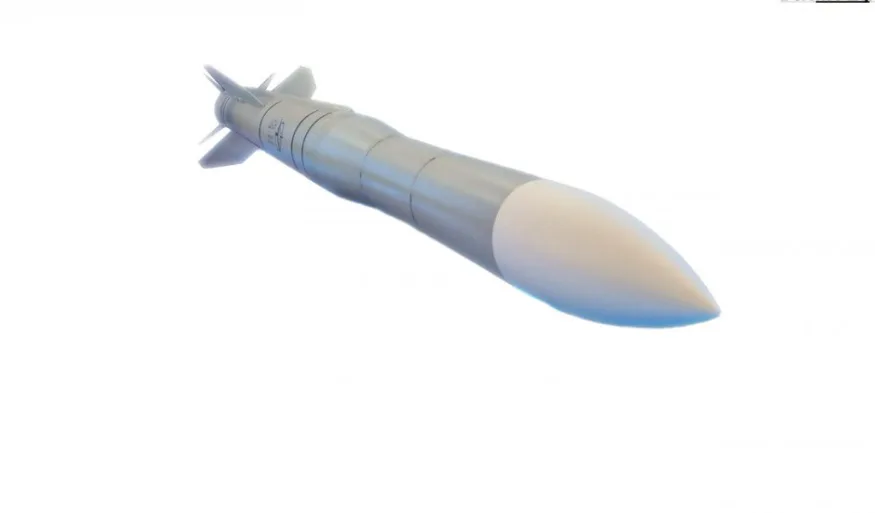
Previously, the Coral was said to have an engagement range of up to 30 km and an altitude of up to 10 km. These parameters are not listed in the new specifications; however, Defense Express assumes that they may also have increased following the missile's enlargement.
Not a direct hit, but detonation near the target
The new version of the missile does not have a belt of gas-dynamic lateral-control thrusters, which enables sharp maneuvers under high g-loads. This technology is used, in particular, in missiles capable of destroying ballistic targets through a direct kinetic hit.
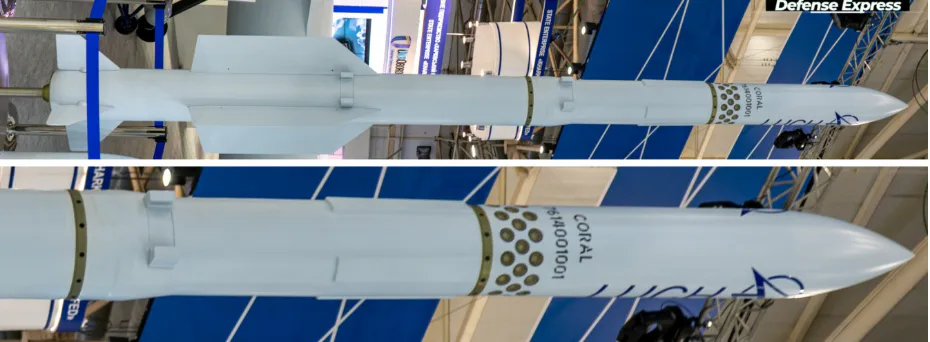
For this reason, Defense Express analysts believe that, in terms of its missile-defense operating principle, the Coral is closer to the PAC-2 GEM-T. In other words, it may engage a ballistic missile by detonating its warhead near the target and showering it with fragments, rather than through a direct collision, as with the PAC-3 MSE.
At the same time, the Coral is considerably lighter than the PAC-2 GEM-T, which weighs about 900 kg. In terms of dimensions and design concept, the Ukrainian missile may be closer to the prospective PAC-3 ACE, which also has an active radar homing seeker but does not provide for kinetic interception.
Defense Express notes that such a simplified design may have another advantage—potentially simpler and more mass-scale production compared with more complex missile-defense interceptors such as the PAC-3 MSE.