










PHC identifies measures to help protect against hantavirus
Kyiv • UNN
Hantavirus, transmitted by rodents, is recorded annually in Ukraine. The Andes strain can spread between humans. It is crucial to avoid contact.

In Ukraine, cases of hantavirus infection are recorded every year - but this is a hantavirus transmitted exclusively from rodents to humans, whereas the peculiarity of the Andes strain, which is being discussed following an outbreak on a cruise ship, is human-to-human transmission. To stay safe, it is necessary to avoid contact and minimize such exposure, reported Mykola Hanich, spokesperson for the Ministry of Health's Public Health Center, during a telethon on May 10, according to UNN.
What is hantavirus
"Hantaviruses are a whole group of viruses for which rodents are the natural reservoir. That is, it is a group of viruses spread worldwide that varies depending on the location, the type of rodents, the species, and so on," noted the spokesperson for the Public Health Center.
According to him, hantaviruses cause two main diseases:
- hemorrhagic fever with renal syndrome. According to the PHC spokesperson, this is common in Europe and Asia: "In fact, this is the classic variant for Ukraine";
- hantavirus pulmonary syndrome, which is registered mainly in the countries of the Western Hemisphere, in South America. "And this group of viruses includes a variety such as Andes." According to the PHC spokesperson, "this is a unique species because, unlike other hantaviruses, it can indeed be transmitted from person to person under conditions of close, prolonged contact between an infected and a healthy person."
"In Ukraine, dozens of cases of hantavirus infection are recorded every year. But this hantavirus is transmitted exclusively from rodents to humans," Hanich noted.
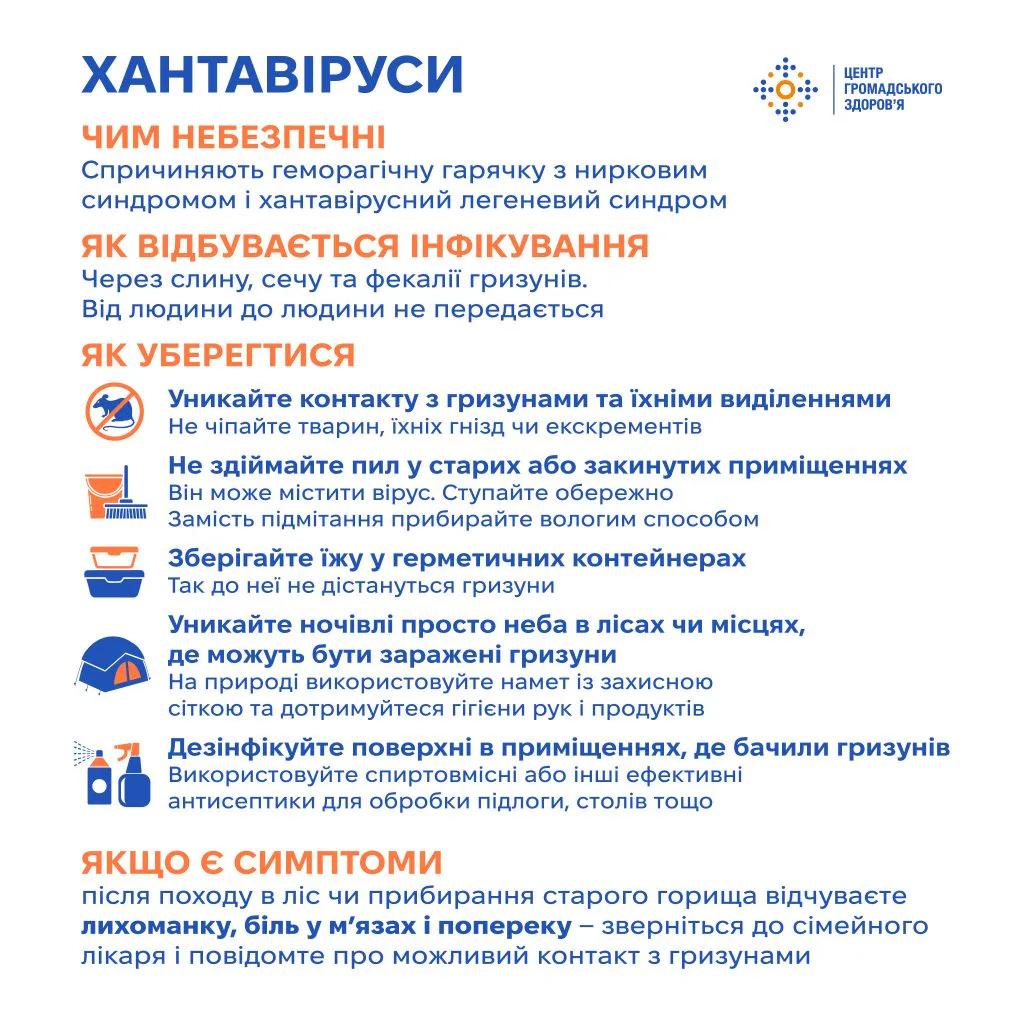
How to stay safe
"One must be careful, one must avoid such possible contact, because this virus is transmitted and can be spread through rodent secretions that may be contained in dust. They can be on surfaces, they can be in food if it was not protected," said the PHC spokesperson.
According to him, this can apply to ordinary households where there may be rodents or mice, but it can also apply to field mice and rats - "that is, they can carry this virus if you know there could be potential contact."
"That is, it could be, for example, an old building, some technical room, a shed, or even if you noticed rodents in the house, it is advisable not to sweep the floor or raise dust into the air; it is better to perform wet cleaning. And if you know that rodents could have been on surfaces, it is better to clean them with antiseptics," the PHC spokesperson indicated.
"Under no circumstances should you touch them with your hands. And hands, in fact, must be washed. You can use ordinary latex or rubber gloves to avoid contact during cleaning," he added.
"In fact, these are the main methods to prevent infection with this virus: avoid contact and minimize such exposure," Hanich indicated.