Physicists create world's smallest pixel
Kyiv • UNN
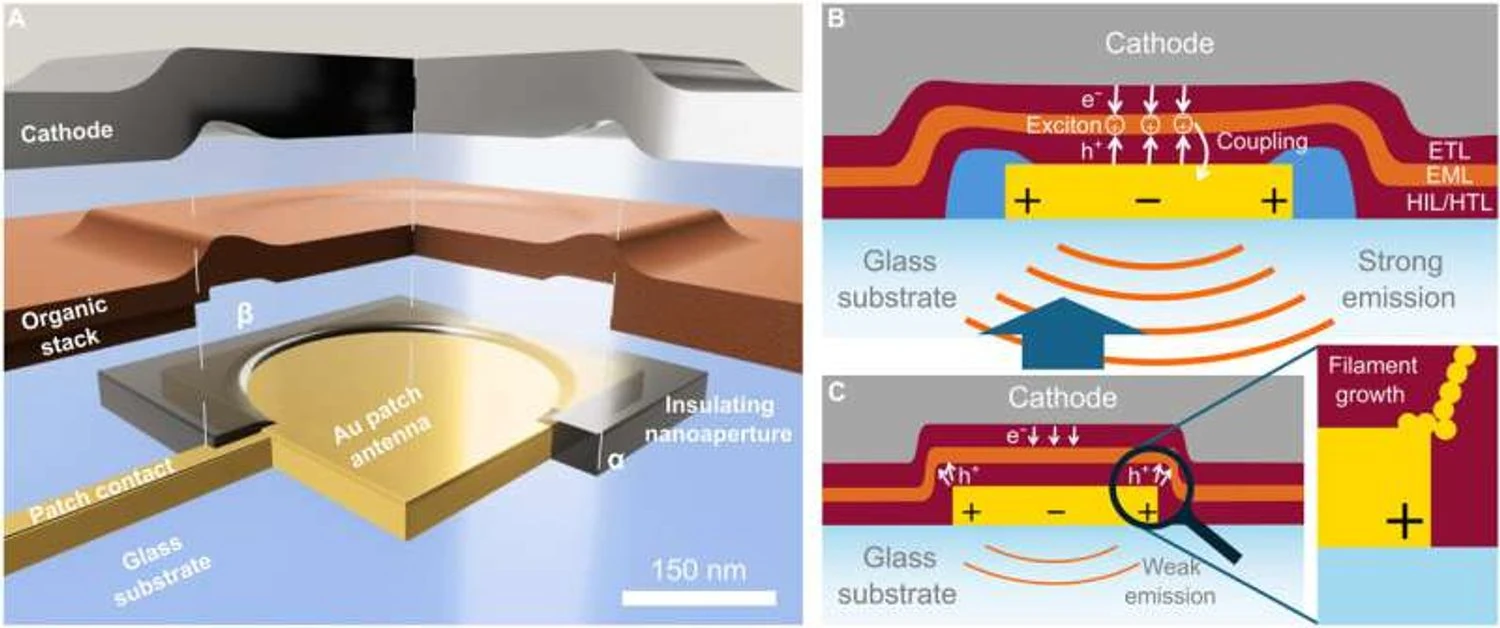
Physicists from Julius-Maximilian University of Würzburg have developed the world's smallest pixel using optical antennas. This orange pixel, measuring 300 by 300 nanometers, has the same brightness as a conventional OLED pixel measuring 5 by 5 micrometers.

Physicists have created the world's smallest pixel to date, UNN reports with reference to Phys.org.
Details
Smart glasses that display information directly in the field of view are considered a key technology of the future, but so far their application has often failed due to the bulkiness of the design. However, classical optics preclude the creation of efficient light-emitting pixels if their size is reduced to the wavelength of the emitted light.
Physicists from Julius-Maximilian University in Würzburg (JMU) have made a decisive step towards creating miniature displays with high brightness and, using optical antennas, have created the smallest pixel in the world to date.
The research group led by Professors Jens Pflaum and Bert Hecht was responsible for this work. The results of their work were published in the journal Science Advances.
Using a metal contact that allows current to be injected into an organic light-emitting diode, simultaneously amplifying and emitting the generated light, we created an orange pixel in an area of only 300 by 300 nanometers. This pixel is as bright as a conventional 5 by 5 micrometer OLED pixel.
For clarity: a nanometer is one millionth of a millimeter. This means that a display or projector with a resolution of 1920 x 1080 pixels can easily fit on an area of just one square millimeter. This, for example, allows the display to be integrated into the frames of glasses, from where the generated light will be projected onto the lenses.