









Scientists have discovered the largest merger of two massive black holes in history
Kyiv • UNN
Scientists have detected ripples in spacetime from the collision of two black holes, each with a mass exceeding 100 Suns, which formed a new black hole with a mass of up to 265 Suns. This event, recorded by gravitational wave detectors, was the largest merger and forced physicists to reconsider models of giant object formation.

Scientists have discovered ripples in spacetime caused by a powerful collision of two massive black holes that spiraled and merged far beyond the Milky Way, UNN reports with reference to The Guardian.
Details
The black holes, each more than 100 times the mass of the Sun, had long begun to orbit each other and eventually collided, forming an even more massive black hole about 10 billion light-years from Earth.
This event was the largest black hole merger ever recorded by gravitational wave detectors, and it forced physicists to revise their models for the formation of these giant objects. The signal was registered when it hit Earth's detectors, sensitive enough to detect spacetime fluctuations thousands of times smaller than the width of a proton.
"These are the most powerful events we can observe in the Universe, but when the signals reach Earth, they turn out to be the weakest we can measure," said Professor Mark Hannam, head of the Cardiff University Gravitational Research Institute. "By the time these waves reach Earth, they are already minuscule."
Evidence of the black hole collision emerged on November 23, 2023, when two detectors located in Washington and Louisiana, USA, operated by the Laser Interferometer Gravitational-Wave Observatory (LIGO), simultaneously triggered.
A sudden "spasm" in spacetime caused the detectors to stretch and contract for a tenth of a second, a fleeting moment that captured the so-called "ringdown" phase, when the merged black holes formed a new one that "rang" before settling down.
Analysis of the signal showed that the colliding black holes had masses 103 and 137 times that of the Sun and rotated approximately 400,000 times faster than Earth, which is close to the theoretical limit for these objects.
"These are the largest black hole masses we have confidently measured with gravitational waves," said Hannam, a member of the LIGO scientific collaboration. "And they’re strange, because they are slap bang in the range of masses where, because of all kinds of weird things that happen, we don’t expect black holes to form."
Most black holes form when massive stars produce nuclear fuel and collapse at the end of their life cycle. Incredibly dense objects warp spacetime so strongly that they create an event horizon – a boundary beyond which even light cannot escape.
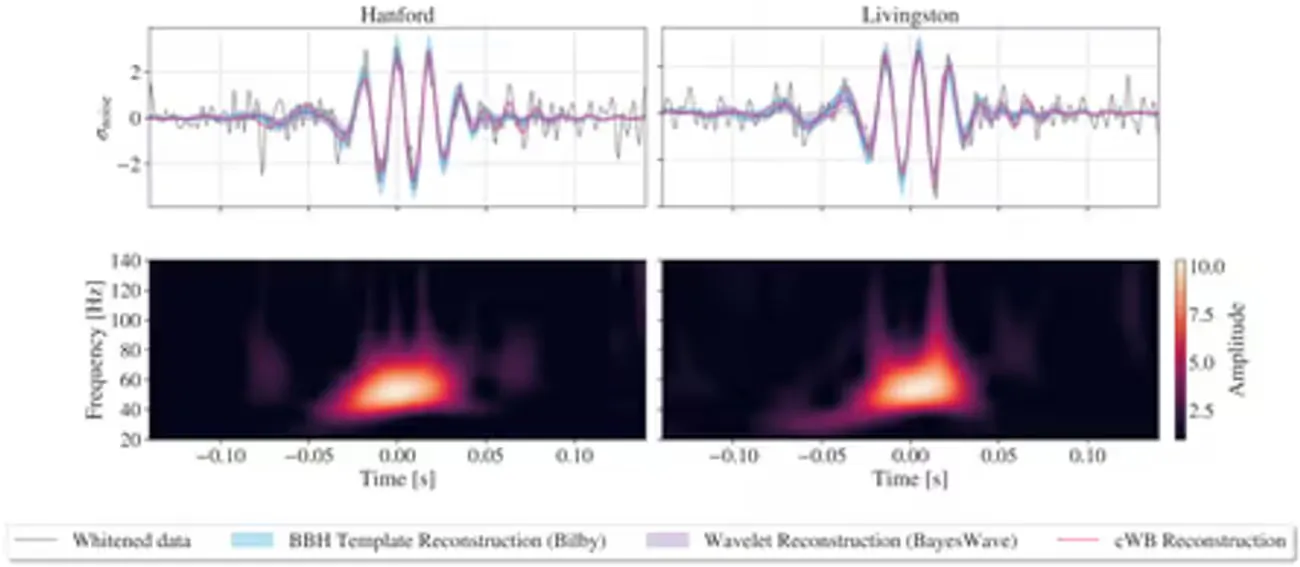
LIGO physicists suspect that the merged black holes themselves were products of earlier mergers. This explains how they became so massive and why they rotated so quickly, as merging black holes tend to impart rotation to the object they create. "We've seen hints of this before, but this is the most extreme example where this is likely happening," Hannam said.
Addition
Scientists have registered about 300 black hole mergers by the gravitational waves they create. Until now, the most powerful known merger resulted in the formation of a black hole with a mass of approximately 140 solar masses. The latest merger led to the formation of a black hole with a mass of up to 265 solar masses. Details will be presented on Monday at the GR-Amaldi conference in Glasgow.