










Deferment from mobilization starting September 1 — what new reservation rules will come into effect in Ukraine
Kyiv • UNN
Starting September 1, 2026, the salary requirement for reserved employees in Ukraine will increase to three minimum wages. Employees working concurrently and persons with another deferment will be counted at only one place of employment.

In Ukraine, another stage of the updated rules for reserving persons liable for military service will come into effect on September 1, 2026. This concerns changes provided for by Cabinet of Ministers Resolution No. 692 of May 30, 2026, and adjusted by subsequent government decisions. UNN examined how the new rules will be implemented and whom they will affect.
New reservation rules from September 1: what will change for employees and employers
The changes will primarily concern salary requirements for reserved employees, the accounting of employees working part-time and people who already have a deferment from mobilization on other grounds.
At the same time, some of the new rules began to apply as early as the summer. For example, the salary increase required for companies to be recognized as critically important is already applied when obtaining or confirming such status.
It should also be noted that the updates are taking place amid a review of the criteria under which enterprises, institutions and organizations are recognized as critically important for the economy and for ensuring the population's vital needs. The Cabinet of Ministers itself explains the reform as necessary to make the reservation process more accurate, reduce opportunities for manipulation and ensure a balance between the needs of the economy and the state's mobilization needs.
What exactly will change for Ukrainians from September 1
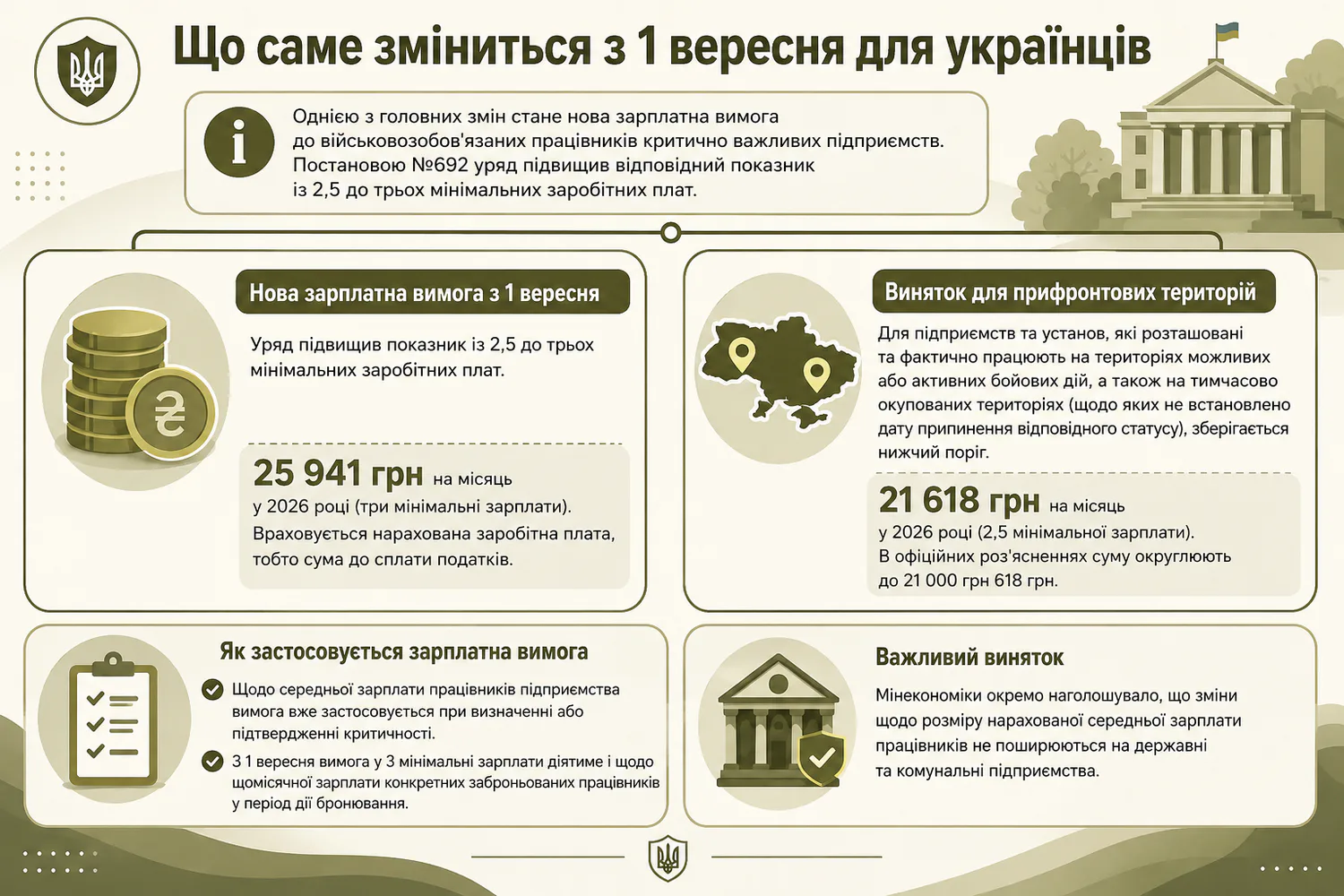
One of the main changes will be a new salary requirement for persons liable for military service employed by critically important enterprises. By Resolution No. 692, the government raised the relevant indicator from 2.5 to three minimum wages.
In 2026, this amounts to UAH 25,941 per month. It is important that the accrued salary is taken into account, that is, the amount before taxes are paid.
As we emphasized above, the average salary of the enterprise's employees is already taken into account when determining or confirming critical status, while from September 1 the corresponding "threshold" will also apply to the monthly salary of specific reserved employees during the period of the reservation. An exception was provided for critically important enterprises and institutions located and actually operating in areas of possible or active hostilities, as well as in temporarily occupied territories defined by law for which no date has been established for the termination of the relevant status. For them, the lower threshold of 2.5 minimum wages remains in effect, amounting to UAH 21,617.50 in 2026. In official explanations, the amount is rounded to UAH 21,618.
At the same time, the new salary rules have exceptions. In particular, the Ministry of Economy separately emphasized that changes concerning the amount of the employees' accrued average salary do not apply to state and municipal enterprises.
How employees working part-time and employees with another deferment will be counted
Another fundamental change concerns determining the total number of persons liable for military service, on which the volume of reservations available to an enterprise depends.
From September 1, employees liable for military service who already have a deferment from mobilization on other grounds provided for by Article 23 of the Law "On Mobilization Preparation and Mobilization," as well as employees who work part-time at another critically important enterprise or institution, will be counted in the total number of persons liable for military service at only one place of employment. Following the July adjustment of the rules, that place was defined as the enterprise where the man or woman had worked the longest.
It should be emphasized separately that the new rules do not establish a general ban on reserving employees who work part-time. The Ministry of Economy explicitly explains that a person liable for military service may be reserved by an enterprise where they work part-time if that enterprise takes them into account when determining its quota. The main principle is that the same person must not increase the basis for calculating reservations simultaneously for several employers.
What will happen to the status of critically important enterprises
Resolution No. 692 provided for a transitional period for enterprises that already had critically important status. Initially, it was established that decisions on critical status valid when the resolution entered into force would remain effective for the period for which they had been issued, but no later than September 1, 2026.
At the same time, central executive bodies, other authorized state bodies, and military administrations were tasked with reviewing their own sectoral and regional criticality criteria. The aim of this review is to ensure that the status is granted to enterprises whose activities genuinely have significant importance for the economy, the population’s livelihoods, or defense.
However, in July the government additionally adjusted the transitional mechanism. Enterprises that submitted the required documents regarding the average salary and the tax calculation within the established deadline are allowed to retain the previously issued decision recognizing them as critical for the period for which it was adopted. Therefore, September 1 does not mean that all enterprises that previously had the status will lose it.
Therefore, employees should be guided by the validity of the decision recognizing their specific employer as critical and by the validity of their own reservation. An employee does not need to submit documents independently to confirm criticality; this is handled by the enterprise. However, the Ministry of Economy recommends that employees check whether their military registration data is up to date and clarify the status of their reservation with their employer in advance.
Which enterprises can obtain critical enterprise status
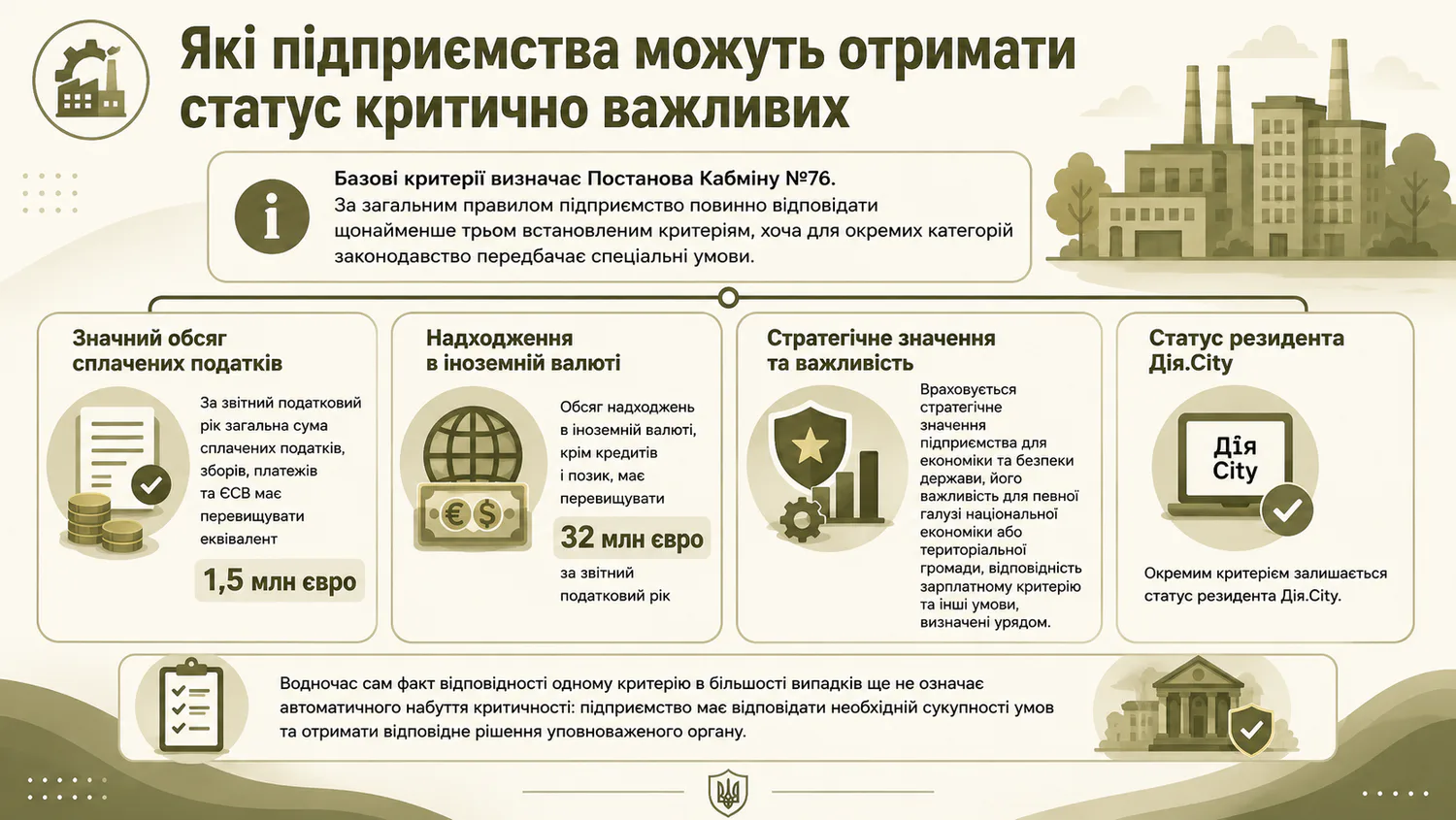
The basic criteria are defined by Cabinet of Ministers Resolution No. 76. As a general rule, an enterprise must meet at least three established criteria, although legislation provides special conditions for certain categories.
The criteria continue to include a significant amount of taxes, fees, payments, and the single social contribution paid. For the reporting tax year, their total amount must exceed the equivalent of EUR 1.5 million. Another criterion provides for foreign-currency receipts, excluding loans and borrowings, totaling more than EUR 32 million for the reporting tax year.
The enterprise’s strategic importance to the economy and security of the state, its importance for a particular sector of the national economy or territorial community, compliance with the salary criterion, and other conditions established by the government are also taken into account.
Resident status of Diia City remains a separate criterion. At the same time, merely meeting one criterion in most cases does not yet mean automatic acquisition of critical status: the enterprise must meet the required combination of conditions and obtain a corresponding decision from the authorized body.
How reservations through "Diia" work
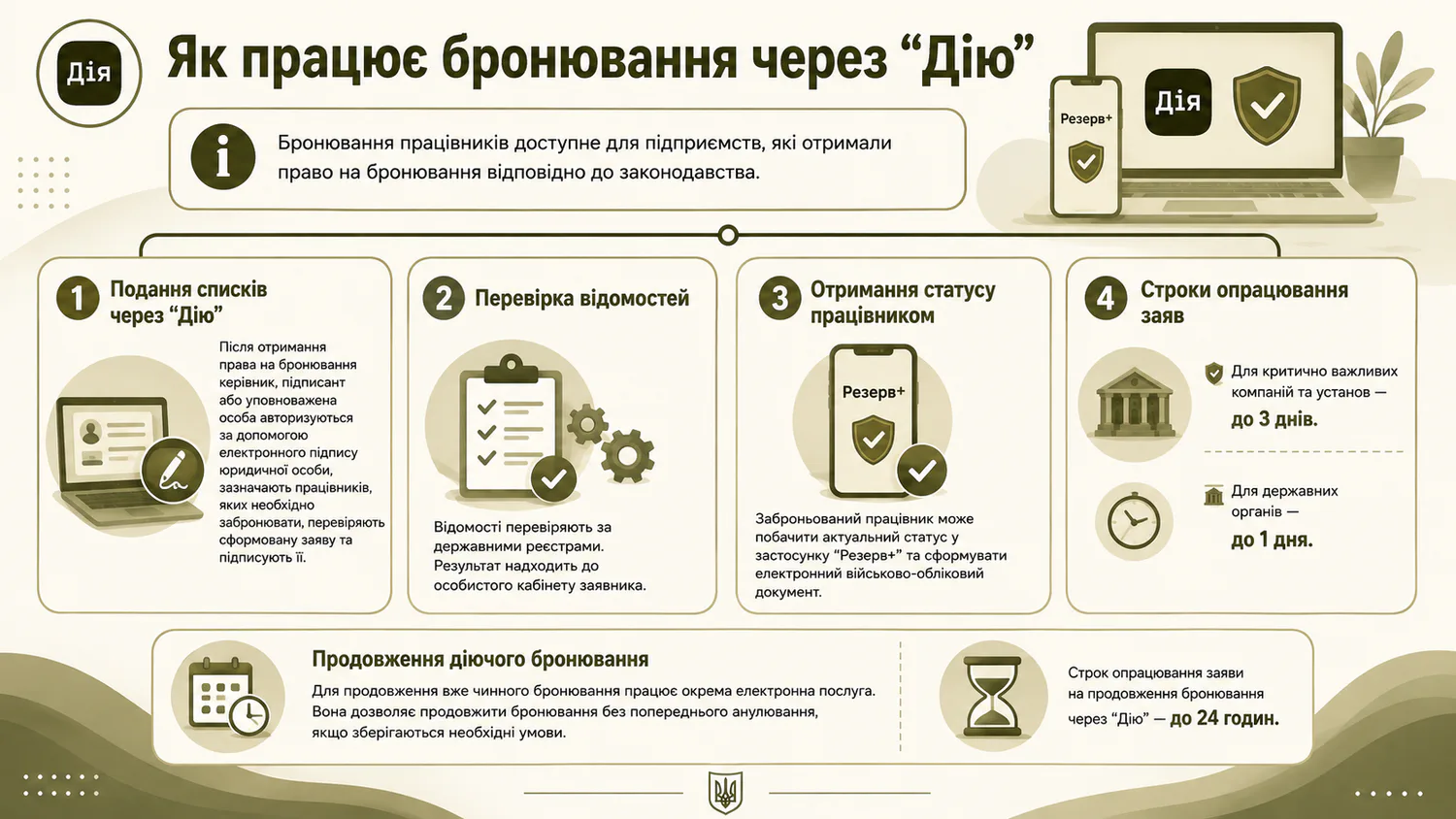
After an enterprise obtains the right to reserve employees, lists of conscripts liable for military service are submitted electronically through the "Diia" administrative services portal. The manager, signatory, or authorized person authenticates using the legal entity’s electronic signature, specifies the employees who need to be reserved, reviews the completed application, and signs it.
The information is then verified against state registers. The result is sent to the applicant’s personal account, while the reserved employee can view the current status in the "Reserve+" application and generate an electronic military registration document.
In addition, the "Reservation of Employees" service page on the "Diia" administrative services website states that processing takes up to three days for critically important companies and institutions, and up to one day for state bodies.
A separate electronic service is available to extend an existing reservation. It allows the reservation to be extended without prior cancellation if the necessary conditions remain in place. For this procedure, "Diia" specifies a processing time of up to 24 hours.
Who may be denied a reservation
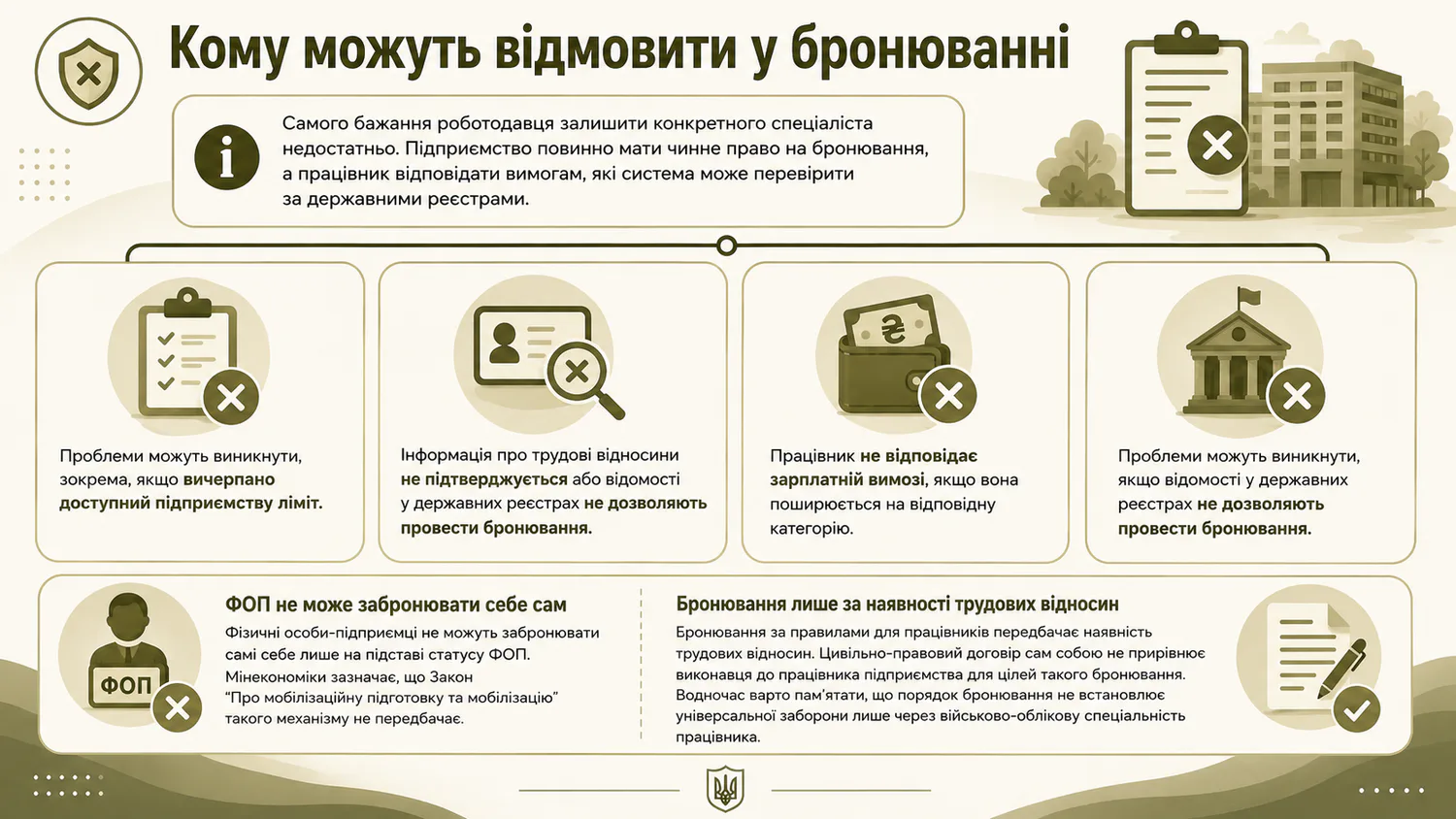
The employer’s desire to retain a particular specialist is not sufficient on its own. The enterprise must have a valid right to reserve employees, and the employee must meet the requirements that the system can verify through state registers.
Problems may arise, in particular, if the enterprise’s available quota has been exhausted, information about the employment relationship cannot be confirmed, the employee does not meet the salary requirement if it applies to the relevant category, or the information in state registers does not allow the reservation to be processed.
Individual entrepreneurs cannot reserve themselves solely on the basis of their individual entrepreneur status. The Ministry of Economy notes that the Law "On Mobilization Preparation and Mobilization" does not provide for such a mechanism.
Likewise, reservation under the rules for employees requires an employment relationship. A civil-law contract in itself does not equate a contractor with an employee of an enterprise for the purposes of such reservation. At the same time, it is worth remembering that the reservation procedure does not establish a universal ban solely because of an employee's military occupational specialty.
When reservation may be canceled
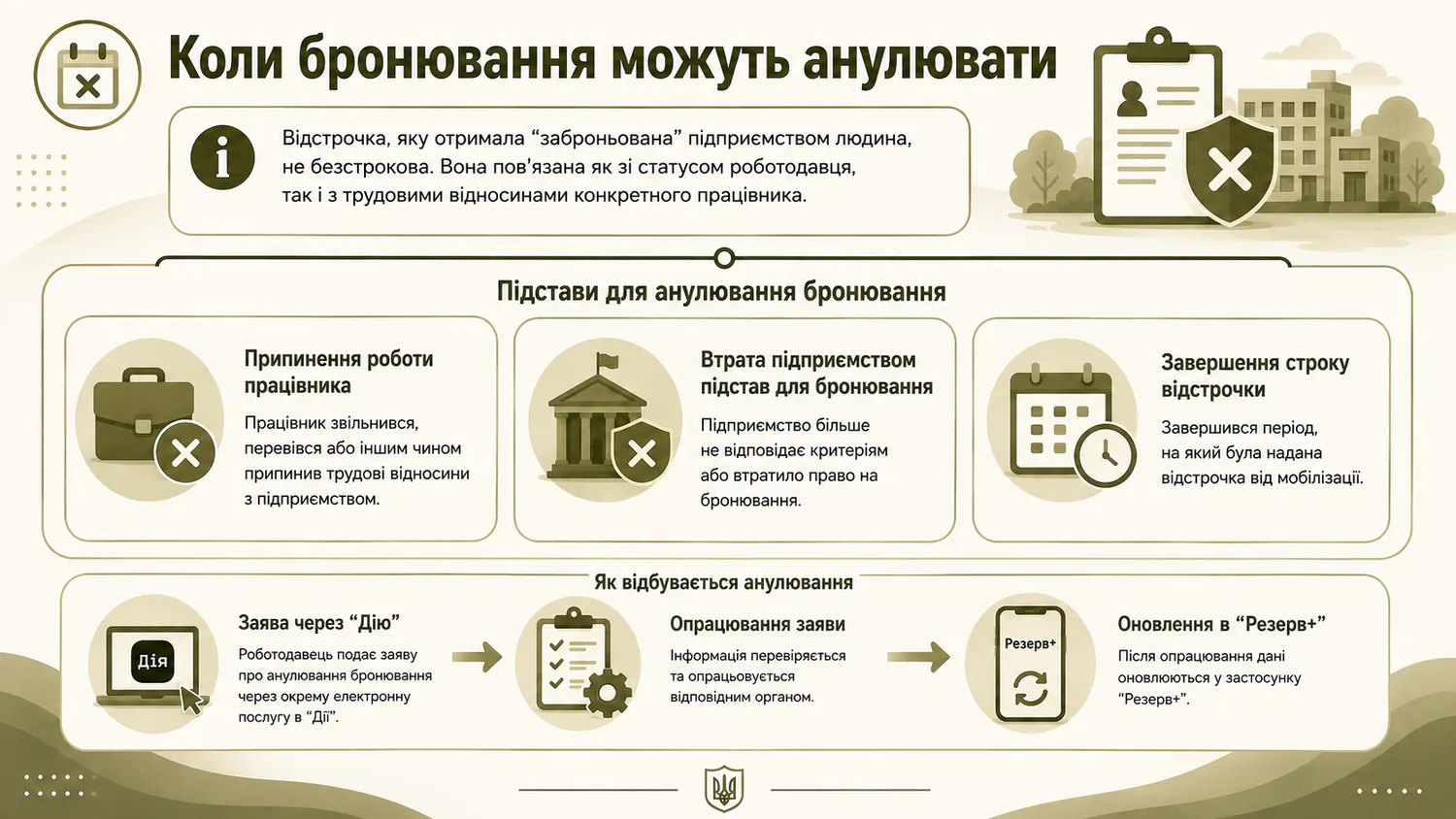
The deferment received by a person "reserved" by an enterprise is not indefinite. It is linked both to the employer's status and to the employment relationship with the particular employee.
The legislation provides grounds for canceling a reservation, including cases where an employee's work at the relevant enterprise ends, the enterprise loses the grounds for reservation, or the period for which the deferment was granted expires. A separate electronic service allows an employer to submit an application to cancel a reservation through "Diia." After processing, the information is also updated in "Reserve+".
What employers and employees need to do before September
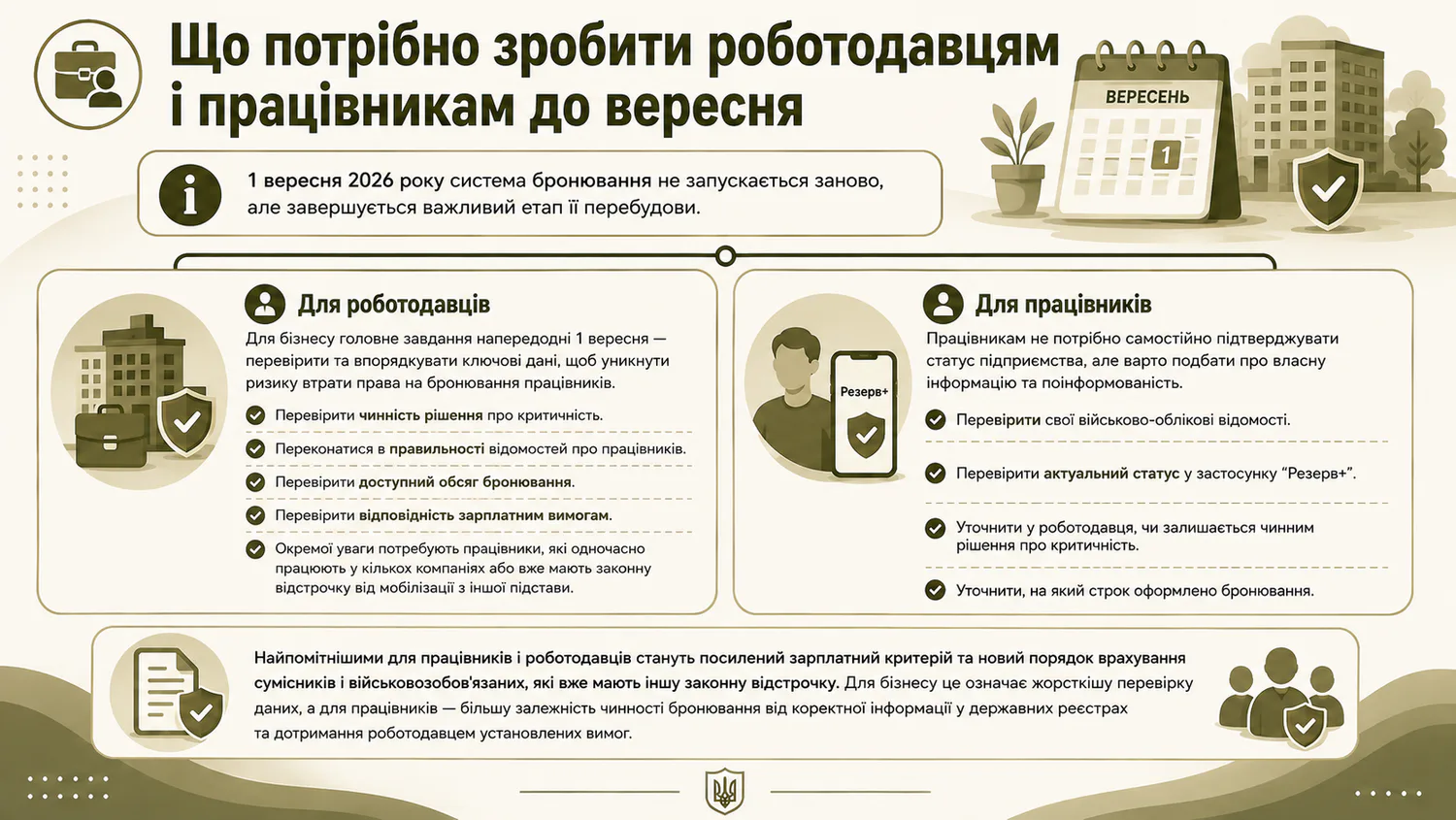
For businesses, the main task ahead of September 1 is to verify the validity of the decision recognizing them as critical, the accuracy of employee information, the available reservation capacity, and compliance with salary requirements. Particular attention should be paid to employees who work for several companies simultaneously or already have a lawful deferment from mobilization on another basis.
Employees, for their part, do not need to independently confirm the enterprise's status. However, it is advisable to check their military registration details and current status in "Reserve+," as well as clarify with their employer whether the decision recognizing the enterprise as critical remains valid and for what period the reservation has been оформed.
We emphasize once again that on September 1, 2026, the reservation system is not being launched anew, but an important stage in its restructuring is being completed. The most noticeable changes for employees and employers will be the strengthened salary criterion and the new procedure for taking into account employees who work concurrently and those liable for military service who already have another lawful deferment. For businesses, this means stricter data verification, while for employees it means a greater dependence of the reservation's validity on accurate information in state registers and the employer's compliance with the established requirements.
A reminder
Earlier, we wrote that defense enterprises must submit documents by August 10 to confirm their status as critical enterprises.