










Russia has created at least 10 secret bases for launching drones: a significant part of Europe is under threat
Kyiv • UNN
Journalists from The Telegraph have uncovered at least 10 secret Russian bases for launching drones near the borders with Ukraine and Belarus. The new long-range "Geran" drones can reach Warsaw, posing a potential threat to NATO countries.

Russia is rapidly expanding its network of secret bases for launching long-range attack drones. According to an investigation by The Telegraph, at least 10 such facilities are located near the borders with Belarus and Ukraine. Some of them are already being used to attack Ukraine. UNN reports.
Details
Journalists analyzed satellite imagery and leaked documents and identified at least 59 new launch rails. About 20 of them are longer, which may indicate the ability to launch the latest long-range drones.
Some bases are being established on the sites of former military facilities and airfields, while others are located in rural areas. More than 1,000 drones may be stored simultaneously at one of the facilities.
The new "Gerans" may threaten NATO countries
Russia is modernizing its attack drones, including by developing jet-powered versions capable of covering nearly 1,000 km. According to the publication, the "Geran-4" and "Geran-5" may carry up to 90 kg of payload and reach a speed that makes them difficult to intercept.
Seven of the 10 facilities identified by The Telegraph have already been used in recent attacks on Kyiv. The new infrastructure also poses a potential threat to NATO countries—in particular, the range of the new drones already makes it possible to consider Warsaw a potentially reachable target.
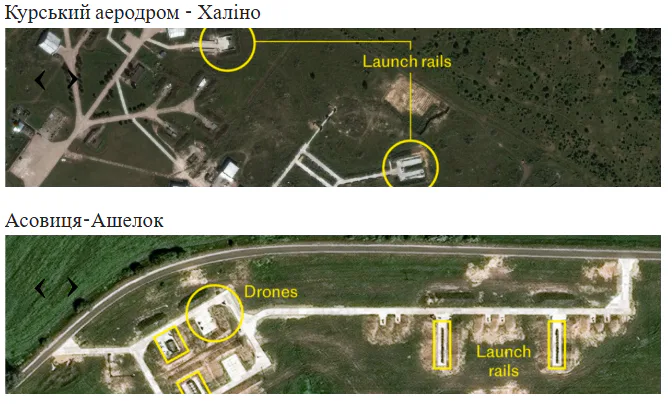
At the same time, The Telegraph emphasizes that there is no evidence of plans by Russia to attack Poland or other countries of the Alliance.
Drones have fundamentally changed the nature of modern warfare and have become a decisive factor on the battlefield
According to an estimate by DroneSec, the expansion of the network allows Moscow to launch more drones simultaneously and reduce their flight time to targets. This could significantly increase the scale of future Russian air attacks.