










Ukrainian attacks have disabled 42.74% of russian oil refining capacity
Kyiv • UNN
The General Staff of the Armed Forces of Ukraine reported that due to systematic strikes, 42.74% of russian oil refining capacities have been taken out of service. Over the year, industry losses reached 13.5 billion dollars, causing a fuel crisis in Russia.

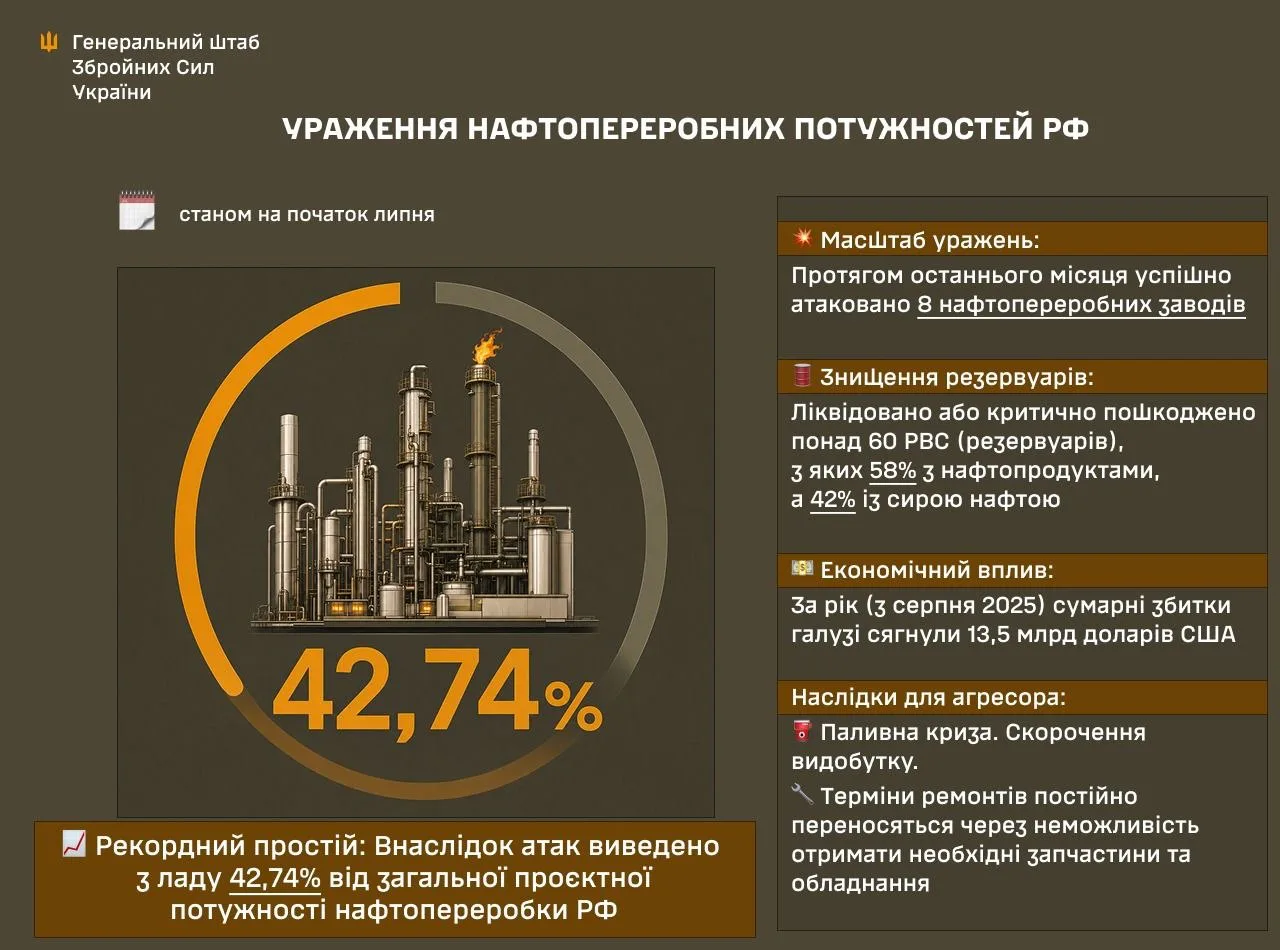
As a result of attacks by Ukrainian military, 42.74% of Russia's total design oil refining capacity has been taken out of service. This is stated in a report by the General Staff of the Armed Forces of Ukraine, as reported by UNN.
According to the General Staff, as of the beginning of July 2026, the campaign of systematic strikes by Ukrainian Defense Forces has achieved new indicators.
Record downtime: As a result of the attacks, 42.74% of Russia's total design oil refining capacity has been taken out of service.
Scale of damage: Over the past month, 8 oil refineries have been successfully attacked.
Destruction of tanks: Over 60 tanks (reservoirs) have been destroyed or critically damaged, of which 58% contained petroleum products and 42% contained crude oil.
Economic impact:
Over the year (since August 2025), the total losses to the industry have reached $13.5 billion US dollars.
Russia is gripped by a fuel crisis and oil production is declining. Repair timelines are constantly being postponed due to the inability to obtain necessary spare parts and equipment.
Deepstrike and middlestrike from Ukraine
In June 2026, Ukraine significantly increased the intensity of strikes on Russian territory, moving combat operations deep into the enemy's rear. According to the Ministry of Defense of Ukraine, in just one month, 11 Russian oil refineries, 7 fuel logistics facilities, 8 military-industrial complex enterprises, space communication centers, as well as military ships and ferries were hit.
An oil terminal was attacked in Saint Petersburg04.07.26, 09:22 • 9262 views
The geography of strikes covered territory from occupied Crimea and Krasnodar Krai to Western Siberia. Among the most important targets were the Antipinsky Oil Refinery in Tyumen Oblast, the Moscow Refinery, two of the largest plants of Bashneft in Ufa, the Orenburg Gas Processing Plant, as well as the TANECO and TAIF-NK refining complexes in Tatarstan.
The Titan-Barricades plant in Volgograd, which produces artillery systems, launchers, and components for missile systems, was also hit.
July was no exception. In the first days of the month, the SBS (Security Service of Ukraine) struck the Lukoil-Nizhegorodnefteorgsintez oil refinery in Kstovo (Nizhny Novgorod Oblast), which is one of the largest oil refining enterprises in Russia.
The affected enterprises supply fuel to the Russian army, while others produce components critically needed for the aviation and missile industries. Most of the strikes were carried out by Ukrainian military using FP-1 long-range strike drones and Flamingo missiles produced by the Ukrainian company Fire Point.
With the help of medium-range strike UAVs, Ukrainian military managed to effectively cut off occupied Crimea from mainland Ukraine, thereby seriously damaging the logistics of Russian troops in the south. Key bridges were destroyed, and facilities that supply the occupation forces with fuel are regularly hit.
Consequences for the Russian economy
The large-scale consequences of the Ukrainian attacks have led to the Kremlin no longer being able to fully deny the problem. According to Politico, Putin was forced to urgently hold a meeting with government officials due to the situation with fuel supply. The dictator had to publicly admit that Ukrainian strikes are creating problems for infrastructure, although he continued to insist that the deficit is supposedly not critical.
Journalists suggest that the key reason for the current problems was not just strikes on fuel tanks, but the targeted destruction of the most technologically complex elements of oil refineries – catalytic cracking units. These units ensure the production of gasoline and other light petroleum products. And due to sanctions, Russia cannot quickly replace or repair such equipment.
The state of Russia's public finances is also deteriorating. Military and classified expenditures are already approaching half of all budget outlays, while the liquid part of Russia's National Welfare Fund has shrunk from approximately 7% to 1.7% of GDP over four years of war. This means the Kremlin is increasingly financing the war through new debt and budget deficits.