










GUR confirmed "Lancet" debris during a Russian attack in the center of Kyiv and revealed details of its "filling"
Kyiv • UNN
Intelligence identified 62 foreign components in enemy UAVs and published their 3D models. According to its data, Russia uses Western AI modules to modernize weapons.

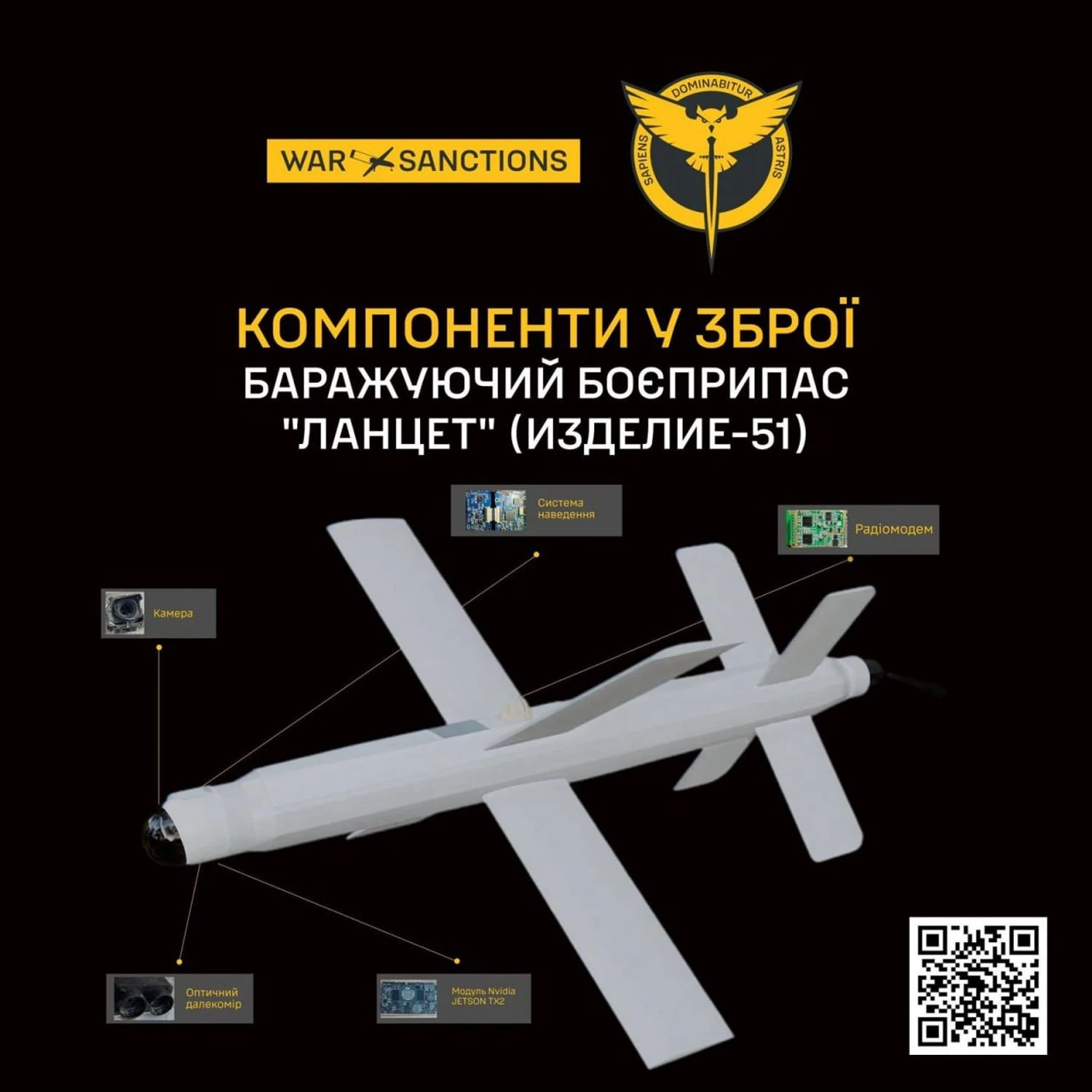
The Main Intelligence Directorate of the Ministry of Defense confirmed that the remains of a Russian drone shot down over Kyiv on March 16 were identified as a "Lancet," and released detailed information about the enemy's "Lancet" and "Scalpel" loitering munitions, UNN reports.
The Main Intelligence Directorate of the Ministry of Defense of Ukraine, in the "Components in Weapons" section of the War&Sanctions portal, published interactive 3D models, components, and electronic parts of Russian loitering munitions "Lancet" and "Scalpel," as well as data on the enterprises involved in their production.
"Lancet" (known as "izdelie-51") is one of the most widely used enemy attack UAVs produced by Zala Aero Group, associated with the "Kalashnikov" concern.
The remains of the UAV shot down over Kyiv on March 16 were identified as a "Lancet," which may indicate the enemy's modernization of this weapon, whose primary purpose was previously to strike vehicles, equipment, and firing positions at tactical and operational depths.
"Scalpel" is a lesser-known product developed by the "Vostok" design bureau, which is called the "younger brother" of the "Lancet" due to its X-shaped wing design, the intelligence agency noted.
Both UAVs, as reported, are guided by an operator in real-time, however, in the "Lancet," the enemy is trying to implement elements of autonomous guidance, including the use of artificial intelligence modules, particularly solutions based on Nvidia Jetson. Similar technologies were previously detected in other enemy UAVs – V2U, the Main Intelligence Directorate noted.
"In total, within the update, 62 electronic components were identified in the 'Lancet' and 'Scalpel.' Most of them are of foreign origin - primarily from the USA, as well as from Switzerland and China," the Main Intelligence Directorate reported.
The Main Intelligence Directorate emphasized: "Despite the sanctions, Russia retains access to critical technologies and continues to improve its own weapons. Even such technological products as modules for artificial intelligence solutions remain accessible to it."
The intelligence agency noted that "a similar module was also identified in the Iranian-made 'Geran-2' drone of the MS series, which is evidence of joint work between Russia and Iran on their modernization."
"The technologies used today against Ukraine pose a potential threat to other regions of the world as well," the Main Intelligence Directorate emphasized. And indicated that the publication of such data is intended to promote increased sanctions pressure and restrict the aggressor's access to modern technologies.
How will the US react to Iran's assistance from Russia and China?16.03.26, 15:54 • 77930 views