









Signals from the labor market: what changed at the end of the year and what decisions will define 2026 — Jooble
Kyiv • UNN
The Ukrainian labor market at the end of the year is sending new signals: how vacancies are transforming, what is changing in employer behavior, and what to expect in 2026.

At the end of the year, the labor market usually does not show sharp jumps — but it is during this period that it most accurately "speaks" through details. It's not about the number of ads, but about how they are formulated, what is emphasized in them, and what disappears. Analyzing fresh vacancies, experts are increasingly paying attention not to statistics, but to the content of the vacancies themselves, because it is precisely this that signals future changes in the field of work, reports UNN.
Signal one: "temporary formulations" are disappearing
One of the most noticeable shifts at the end of the year is the reduction in the number of ads with vague or cautious wording. While employers previously often left themselves "room for maneuver," they are now increasingly offering clearly defined roles.
Most often, the following elements disappear from job descriptions:
● mentions of short-term cooperation;
● phrases "for the period," "temporarily," "while there is a need";
● unclear areas of responsibility.
This indicates that businesses are planning hiring with an eye on the coming year, rather than as a reaction to the current situation.
Signal two: vacancies have become "longer in horizon"
This is not about the volume of text, but about the logic of the offer itself. At the end of the year, job advertisements increasingly mention development prospects, phased tasks, and expectations several months in advance.
For job seekers, this means a change in approach: finding a job no longer means "solving the problem here and now." More and more often, decisions are made based on whether this position can provide stability in 2026.
Signal three: the tone of communication is changing
Another important detail is the style of presenting vacancies. At the end of the year, announcements become less emotional and more pragmatic. Employers are less likely to "sell the atmosphere" and more often explain the terms of cooperation.
The focus remains on:
● work format and schedule;
● expected result;
● clear competence requirements;
● terms of interaction with the team.
This indicates the formation of a new agreement between the parties, where the main value is predictability.
Infographics: what candidates react to first
Year-end analytics allows us to identify the factors that most often influence the decision to choose a vacancy. This is not about bonuses, but about basic elements of trust.
Key selection factors:
● clear description of role and responsibilities — 31%
● predictability of employment — 29%
● work format (offline / hybrid / online) — 18%
● speed of communication with the employer — 12%
● reputation of the vacancy source — 10%
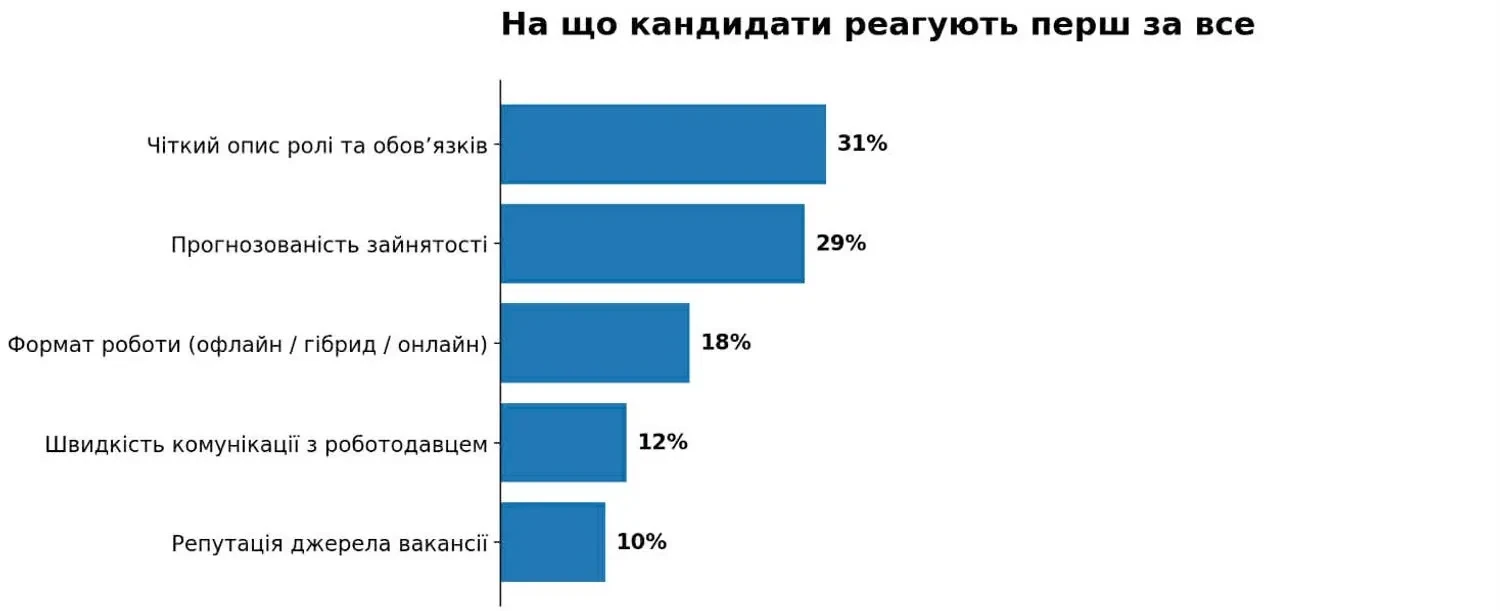
These indicators demonstrate that candidates are increasingly looking not for the "best offer," but for the most understandable one.
Why the role of platforms increased precisely at the end of the year
When vacancies become similar in terms, the decisive factor is the source of information. Platforms actually act as a filter between the market and the person looking for a job.

It is in this context that it is important that Jooble received the Ukrainian Business Award 2025 — an award that is perceived in Ukraine as an indicator of the stability and reputation of the service. For the labor market, this means an increase in trust in the job search infrastructure.
What these signals mean for 2026
The collected signals do not indicate a sharp change in the rules of the game. On the contrary, they indicate a gradual consolidation of a new norm.
Experts expect that in 2026:
● the number of spontaneous job changes will decrease;
● stable roles will be prioritized;
● the importance of employer reputation will increase;
● aggregator platforms will become the main entry point to the market.
Why this is important not only for job seekers
These processes affect not only those looking for a job. They form a new model of interaction between business, employees, and the economy as a whole. Work ceases to be a reaction to a crisis and increasingly becomes an element of planning.
Summary
At the end of the year, the labor market does not make loud statements — it sends signals. And those who can read them enter 2026 with a clearer understanding of the rules of the game. It is these signals that are shaping the new logic of employment in Ukraine today.