










Housing assistance via eVidnovlennia: who receives a certificate and who receives a voucher
Kyiv • UNN
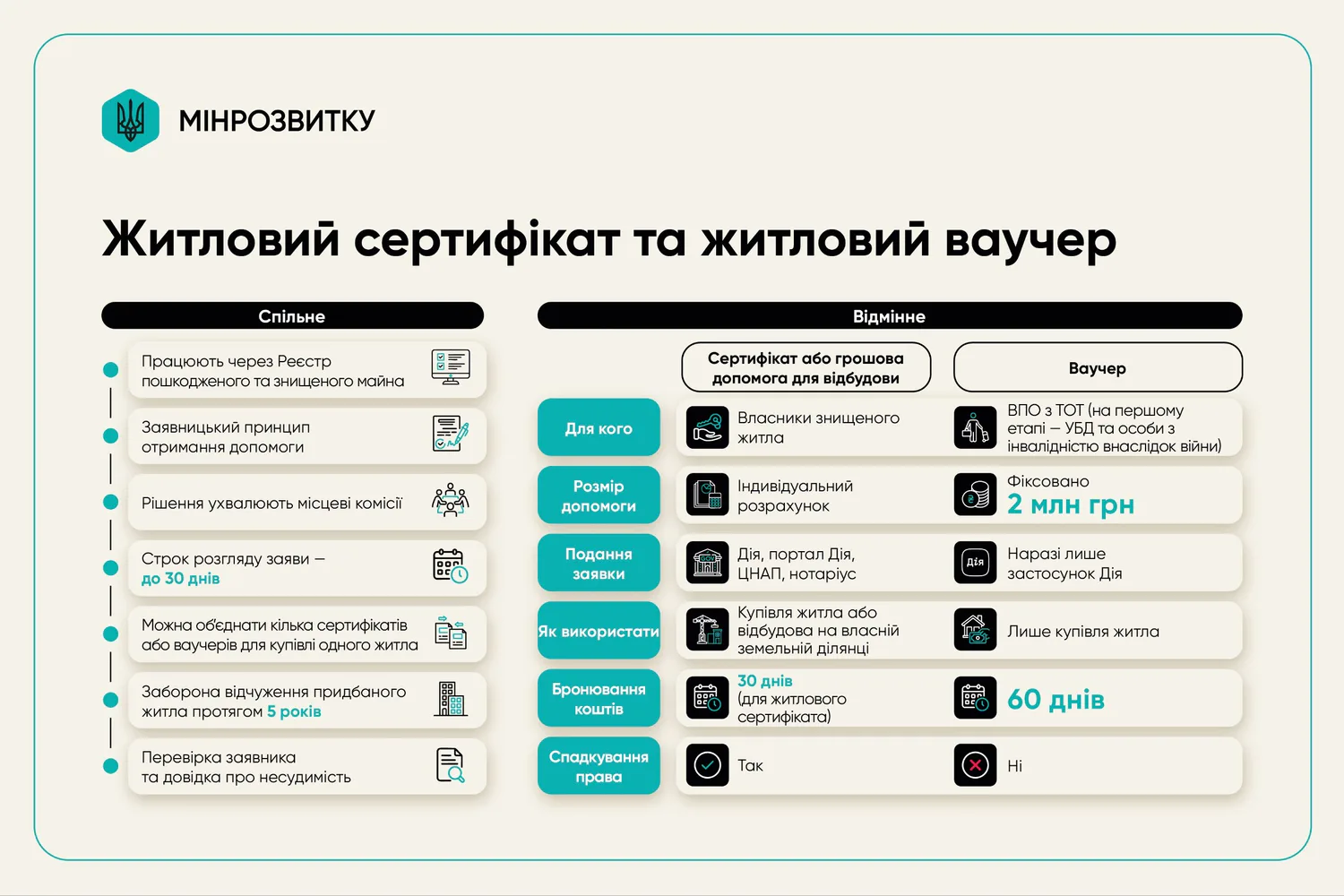
Certificates are issued for destroyed property, while vouchers are provided to displaced veterans from occupied territories. Both types of assistance allow for the purchase of new housing.

The state program eRecovery (yeVidnovlennia) provides several tools to assist Ukrainians who have lost their homes or cannot use them due to Russian aggression. These include a housing certificate, monetary compensation for rebuilding on one's own land plot, and a housing voucher.
These mechanisms share a common goal — to help people resolve their housing issues after losing their homes due to the war. At the same time, they are designed for different categories of recipients and carry different legal consequences.
UNN has looked into the differences between a housing certificate and a voucher, and the conditions under which Ukrainians can receive them.
Who can receive a housing certificate
A housing certificate is intended for owners of housing that was destroyed by the Russian military during missile and drone attacks or artillery shelling.
This refers to individuals who held ownership rights to a destroyed apartment, house, or other residential property and are applying for compensation to purchase a new home.
Within the eRecovery program, monetary compensation for rebuilding on one's own land plot is also available for such owners. This means state support can be used both for purchasing another home and for restoring damaged housing, provided the condition of the building allows for it.
Who can receive a housing voucher
The housing voucher was introduced as part of the "Housing for Internally Displaced Persons from Temporarily Occupied Territories" program. In the first stage, it is not available to all IDPs, but only to specific categories.
The voucher can be used by internally displaced persons from the TOT (temporarily occupied territories) who have the status of a combat veteran or a person with a disability resulting from the war.
An important difference: to receive a housing voucher, one does not need to terminate ownership rights to the housing remaining in the temporarily occupied territory. A person may lack physical access to such property but legally remains its owner.
What certificates and vouchers have in common
Both mechanisms operate based on the Register of Damaged and Destroyed Property. In both cases, assistance is provided after an individual submits an application. The next stage is the verification of their personal data and documents.
Applications are reviewed by local commissions established under local self-government bodies or military administrations. After verification, the commission's decision is approved by the authorized body.
The processing period for applications under both mechanisms is up to 30 calendar days. Background checks on the applicant and the submission of a certificate of no criminal record are also required.
How the funds can be used
Both the housing certificate and the housing voucher are intended for the purchase of housing. To purchase a single residential property, several housing certificates or several housing vouchers can be combined. The condition is that the funds for them must be reserved simultaneously.
If the money for the certificate or voucher has not yet been reserved, this should be taken into account during negotiations with the seller. The buyer should consider the program's financing schedule to avoid risks when concluding the deal.
If a person does not use the funds from the certificate or voucher within the established timeframe, they are returned to the state. After that, the money may be directed toward financing other applicants in the queue.
Restrictions after purchasing housing: what you need to know and consider
In both cases, a prohibition on alienation for a period of five years is placed on the purchased housing. This means that during this period, the owner cannot sell or otherwise alienate the property.
The same rule applies to housing rebuilt using monetary compensation funds. The restriction is necessary to ensure that state aid is used to resolve housing issues rather than for the resale of property.
Ownership rights and claims against the aggressor state
One of the main differences between a housing certificate and a housing voucher concerns ownership rights.
In the case of receiving compensation for destroyed housing, ownership rights to the destroyed property are terminated. Furthermore, the recipient assigns to the state the right of claim against the aggressor state for the amount of compensation received.
In the case of a housing voucher, termination of ownership rights to housing in the TOT is not required. At the same time, after purchasing housing, the recipient also assigns the right of claim against the aggressor state for the amount of assistance provided.
Can the right to housing assistance be inherited?
The right to compensation for destroyed housing can be inherited in accordance with the law.
For the housing voucher, no such possibility has been provided. This means that the right to receive a voucher is tied to a specific individual and their status.
What is the main difference between a housing certificate and a voucher?
A housing certificate and a housing voucher are not interchangeable tools. The certificate is aimed at owners of destroyed housing. The voucher is aimed at specific categories of IDPs from temporarily occupied territories.
Common features for both mechanisms include participation in the eRecovery program, an application-based procedure, review by local commissions, a processing period of up to 30 calendar days, applicant verification, the possibility of combining several certificates or several vouchers, and a five-year ban on the alienation of the purchased housing.
Reminder
Earlier, we wrote that owners of destroyed housing can receive compensation even if the house is located in a shelling zone. The "eRecovery" program allows for remote inspection of damaged objects using photos, videos, and satellite imagery.