










Himalayan Construction: India Scales Up Military Infrastructure to Deter China
Kyiv • UNN
India is investing hundreds of millions of dollars in a network of roads, tunnels, and airfields along its disputed border with China. This is a response to the bloody clashes of 2020, which exposed the Indian army's logistical vulnerabilities.

New Delhi is investing hundreds of millions of dollars in building a network of roads, tunnels, and airfields along the disputed border with China. The intensification of work began after the bloody clashes in 2020 in the Galwan Valley, which revealed critical logistical vulnerabilities of the Indian army. This is reported by WSJ, writes UNN.
Details
A key project is the Zojila Tunnel, costing over $750 million, located at an altitude of 3,500 meters. It is intended to provide year-round connectivity to the Ladakh region, which is usually cut off by snowfalls for six months. The Mudh-Nyoma airbase has also been opened, capable of receiving heavy C-130J transport aircraft, 30 kilometers from the Line of Actual Control.
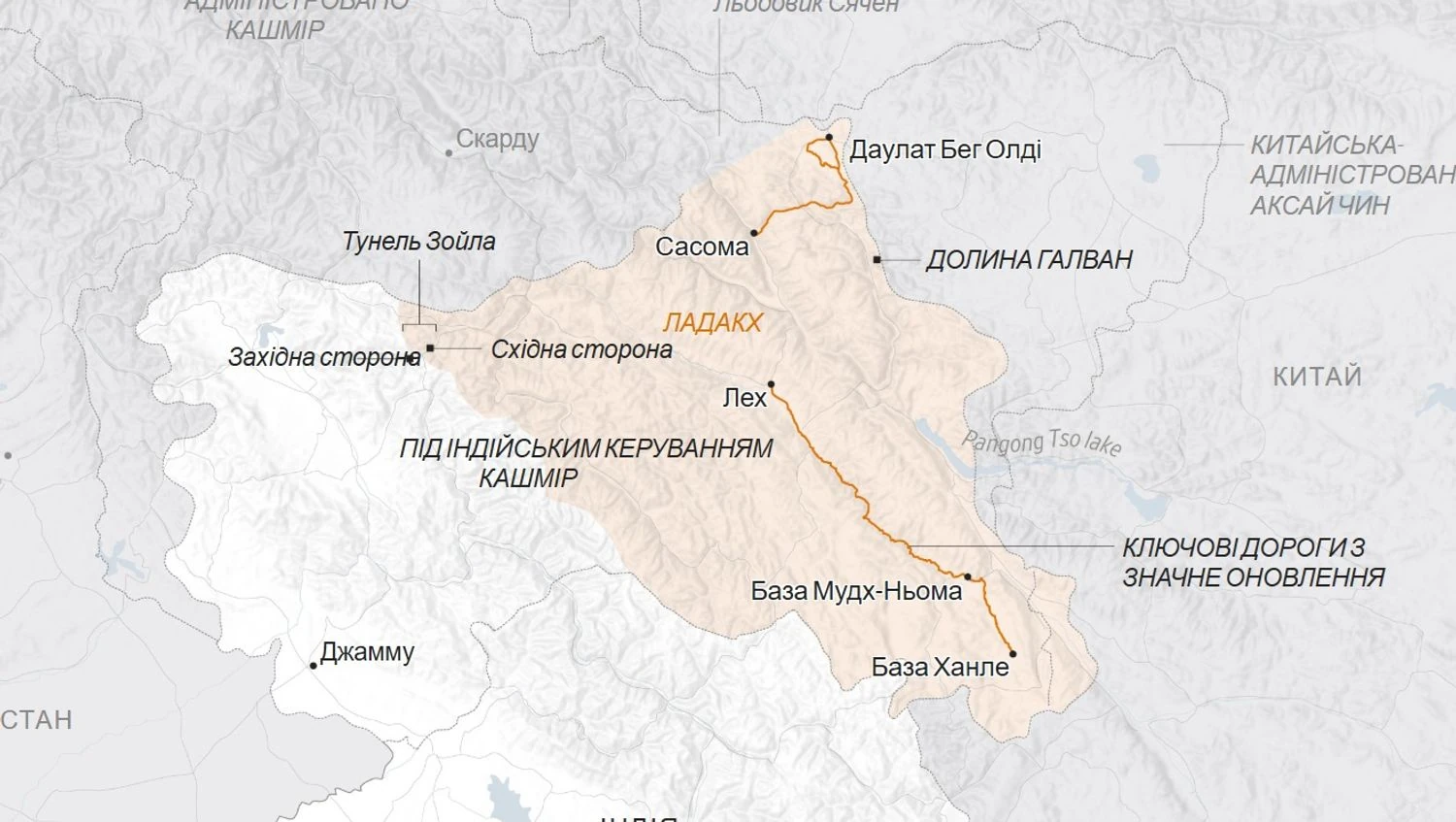
The budget of India's Border Roads Organization has increased from $280 million in 2020 to $810 million in 2025. During this period, the country's total military spending increased by almost 60%, reaching $80 billion.
Change in defense doctrine
For decades, India avoided building roads in the Himalayas, considering the impassable mountains a natural barrier. However, China's advantage in troop mobility forced New Delhi to reconsider its approach.
It was a striking change in thinking. We realized that we needed to change our approach entirely
Despite its efforts, India does not aim to fully catch up with Beijing in terms of infrastructure. Former Northern Command chief Lieutenant General Dipendra Singh Hooda emphasized the difficulty of supplying high-altitude posts: "It's a massive logistical exercise that is carried out regularly every year. It has to be carried to that post on someone's shoulder."
Risks of escalation
Analysts note that the expanded presence of both sides in previously unpatrolled areas increases the risk of new conflicts.
Both sides are moving into areas beyond those they usually patrol. Therefore, the likelihood of these two forces clashing with each other increases