










Scientists have discovered semi-heavy water ice around a young star similar to the Sun for the first time
Kyiv • UNN
Scientists have discovered semi-heavy water ice near a young star similar to the Sun for the first time. This confirms that some of the water in the Solar System may have formed before the Sun was born.

With the help of the James Webb Space Telescope, an international team of astronomers has for the first time discovered semi-heavy water ice around a young star similar to our Sun. This discovery confirms that some of the water in the Solar System may have formed before the Sun was born - in the deep cold clouds of interstellar space. UNN writes about this with reference to PHYS.
Semi-heavy water ice has been discovered for the first time around a young star similar to our Sun. This discovery was made by a team of international researchers led by astronomers from Leiden University (Netherlands) and the National Radio Astronomy Observatory in Virginia (USA). The finding confirms the hypothesis that some of the water that exists today in our Solar System may have originated before the Sun itself - in extremely cold interstellar environments.
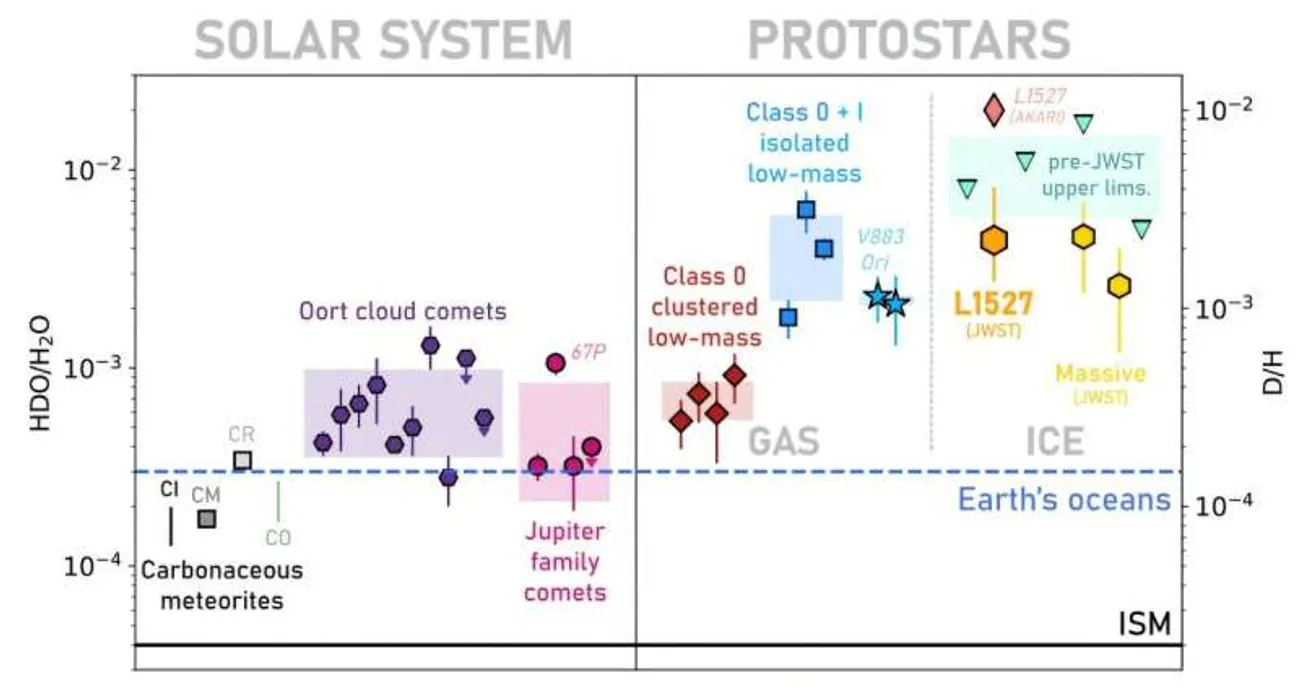
The study is published in The Astrophysical Journal Letters. Astronomers studied the composition of water by the deuteration coefficient - the ratio of ordinary water (H₂O) to water with one deuterium (heavy hydrogen) atom instead of one of the ordinary hydrogen atoms. This molecule has the formula HDO and is called semi-heavy water. Its detection indicates that water molecules were formed in extremely cold conditions, such as in dark interstellar clouds of dust and gas.
On Earth, as in some comets and satellites, one of several thousand water molecules is HDO. This is approximately ten times more than the composition of the Sun suggests, which has long led astronomers to assume an ancient, deformative origin for some of this water. However, to confirm this hypothesis, scientists needed to directly record this type of water ice in regions where stars are just forming.
And now it has been done. Astronomers have recorded a high content of HDO in the protostellar envelope - a cloud of gas and dust surrounding a star in its infancy. This was made possible by the James Webb Space Telescope, which allowed scientists to observe HDO in the solid phase for the first time, and not only in the form of gas, where the isotopic ratio is often distorted by chemical reactions.
Now, thanks to Webb's unprecedented sensitivity, we are seeing a wonderful clear signature of semi-heavy water ice directed towards the protostar.
We are talking about the star L1527 IRS, which is located in the constellation Taurus approximately 460 light-years from Earth. According to John Tobin of the National Radio Astronomy Observatory in Virginia, L1527 IRS "is in many ways similar to what we think our Sun was like when it began to form."
Interestingly, the coefficient of deuteration of water ice in this system coincides with the indicators for some comets and protoplanetary disks of other young stars. This indicates a common, stable origin of water in different parts of the universe.
This discovery adds to the growing body of evidence that most of the water ice makes its journey virtually unchanged from the earliest to the latest stages of star formation.
However, the coefficient of deuteration of water ice in L1527 IRS was slightly higher than the indicators for some comets and water on Earth. There may be various reasons for this - for example, some of the water on comets or in the oceans may have undergone changes in chemical composition after formation, or the initial dark cloud from which our Sun originated was different in composition than in the case of L1527.
To understand these differences, the team plans to expand the study. In particular, Slavitsinska and Tom Megeath from the University of Toledo (USA) are leading several programs involving the Webb telescope, which plan to study up to 30 protostars and dark clouds. Meanwhile, John Tobin continues observations with the Atacama Millimeter/Submillimeter Array, focusing on the search for HDO in gaseous form.
Scientists have shown stunning video of the aurora borealis on Jupiter13.05.25, 17:55 • 3934 views