










How to descale a kettle: effective home methods
Kyiv • UNN
Scale in a kettle forms due to calcium and magnesium salts in the water. For cleaning, it is recommended to use vinegar, citric acid or baking soda separately.

Limescale in a kettle is a common household problem, especially if the tap water has high hardness. White or yellowish deposits on the bottom and walls spoil the appearance of the utensil, affect the taste of water, increase heating time, and can shorten the service life of an electric kettle. It can be cleaned using home remedies or special household chemicals — the main thing is not to damage the material and to rinse the kettle thoroughly after the procedure.
How to do this safely, UNN has figured out.
Why limescale appears in a kettle
Limescale forms due to calcium and magnesium salts present in tap water. During heating, they precipitate and accumulate on internal surfaces. The harder the water and the more often it is boiled, the faster the deposit appears.
Most deposits collect at the bottom of the kettle and near the heating element. In electric models, a thick layer of limescale impairs heat transfer, so the appliance takes longer to heat water, consumes more electricity, and may fail sooner. Particles of the deposit can also end up in the cup.
Home remedies for cleaning limescale from a kettle
For regular maintenance, simple ingredients found in almost every kitchen are often sufficient: vinegar, citric acid, or baking soda. They help dissolve mineral deposits without household chemicals.
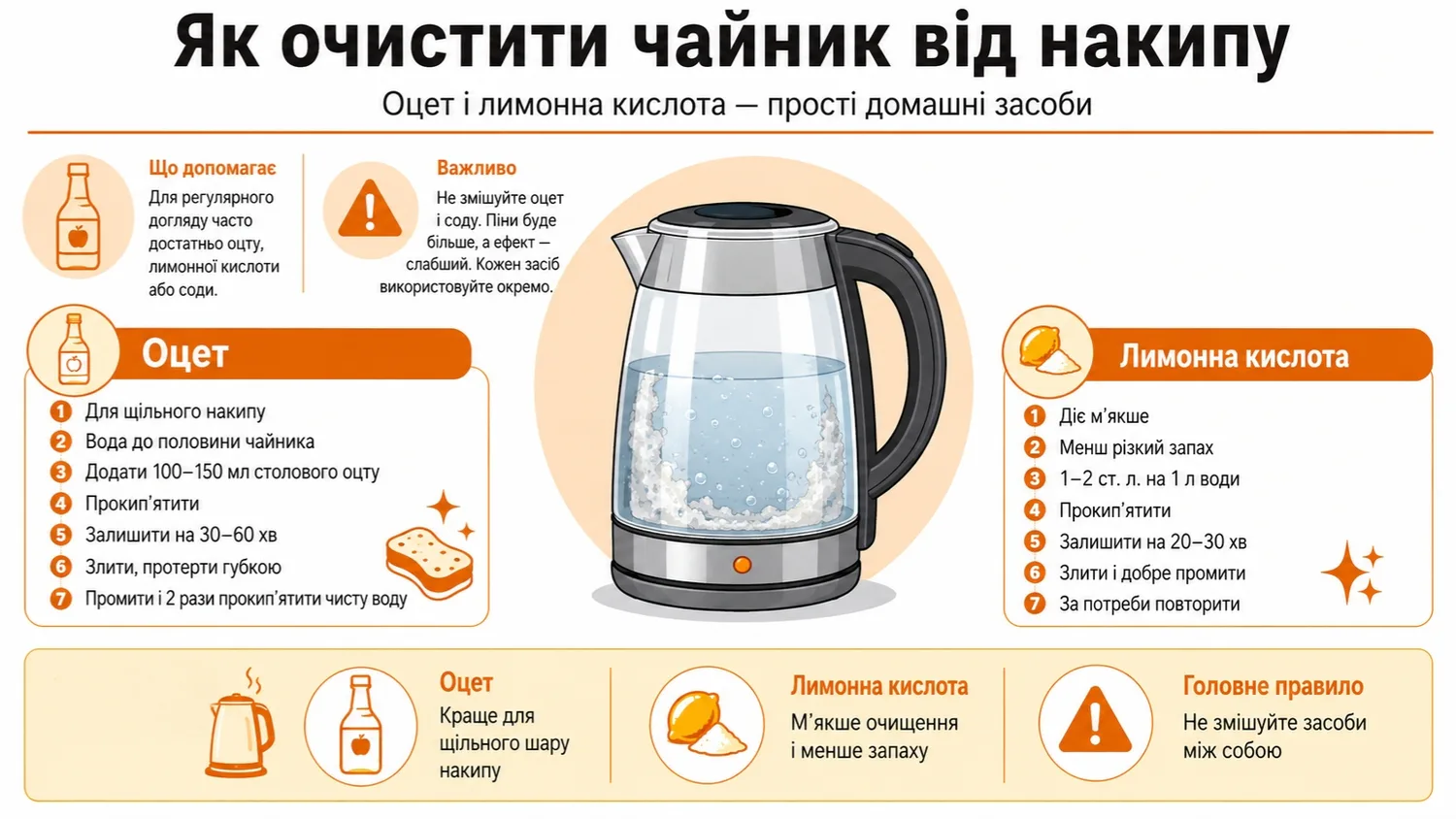
However, you should not mix several agents at once, especially vinegar and soda. The reaction will produce a lot of foam, but the effectiveness will be lower. It is better to use each agent separately.
Vinegar and citric acid
Vinegar is suitable for removing a thick layer of limescale. Pour water into the kettle to about half, add 100–150 ml of table vinegar, boil the solution, and leave it for 30–60 minutes. Then drain the water, remove the remaining deposits with a soft sponge, rinse the kettle several times, and boil clean water twice without further use.
Citric acid works more gently and has a less pungent odor. For a standard kettle, 1–2 tablespoons of citric acid per 1 liter of water is sufficient. Boil the solution, leave it for 20–30 minutes, drain, and rinse the kettle thoroughly. If the deposit is old, the procedure can be repeated.
Baking soda
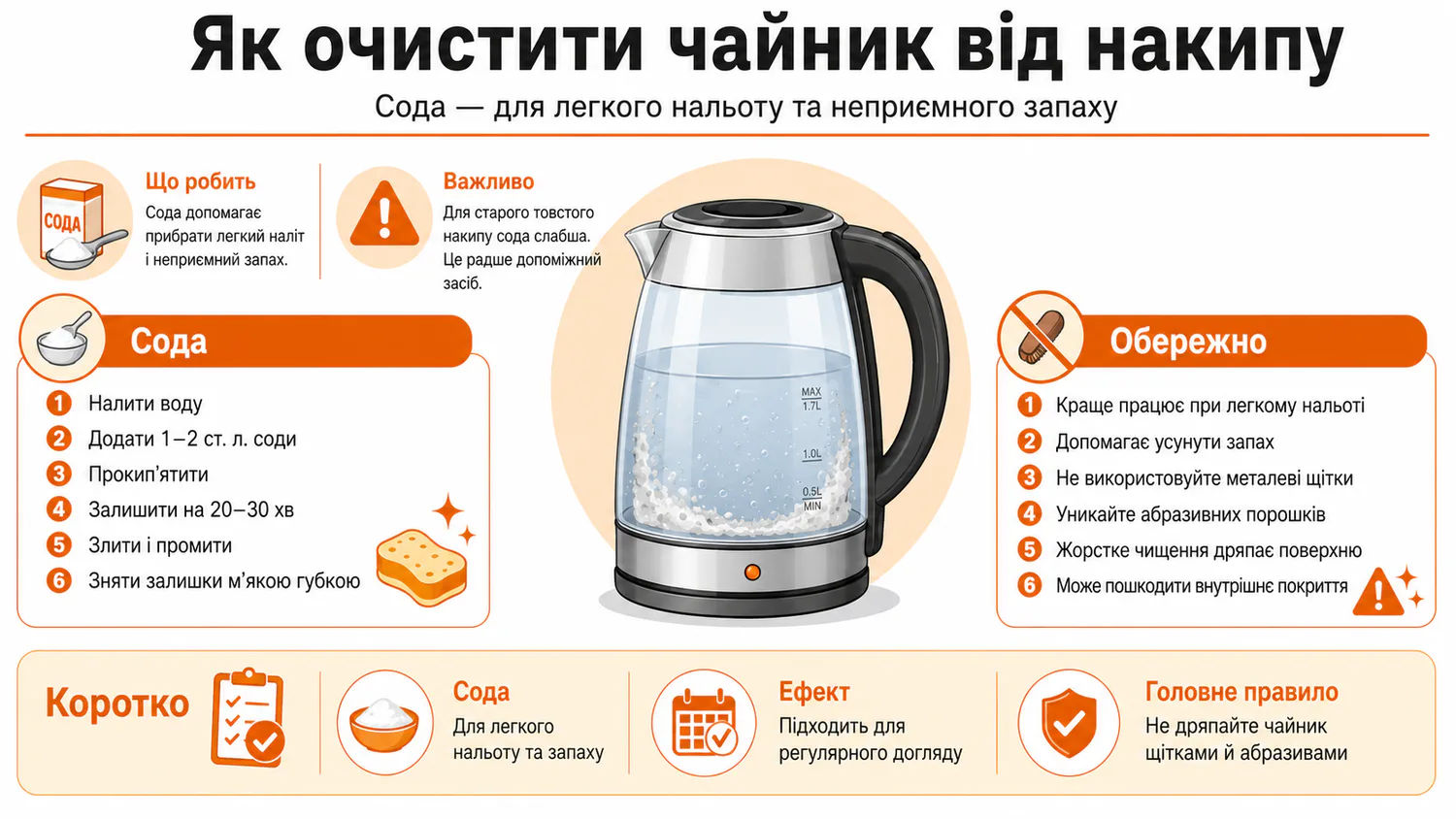
Baking soda works better against light deposits and unpleasant odors. Pour water into the kettle, add 1–2 tablespoons of soda, boil, and leave the solution for 20–30 minutes. Then rinse the kettle and remove any remaining deposits with a soft sponge.
Soda is less effective against a thick layer of deposits, so for removing old limescale, it is better to use it as an auxiliary agent.
In addition, you should not clean the kettle with metal brushes or abrasive powders: they can scratch the surface or damage the inner coating.
Household chemicals against limescale: when to use them
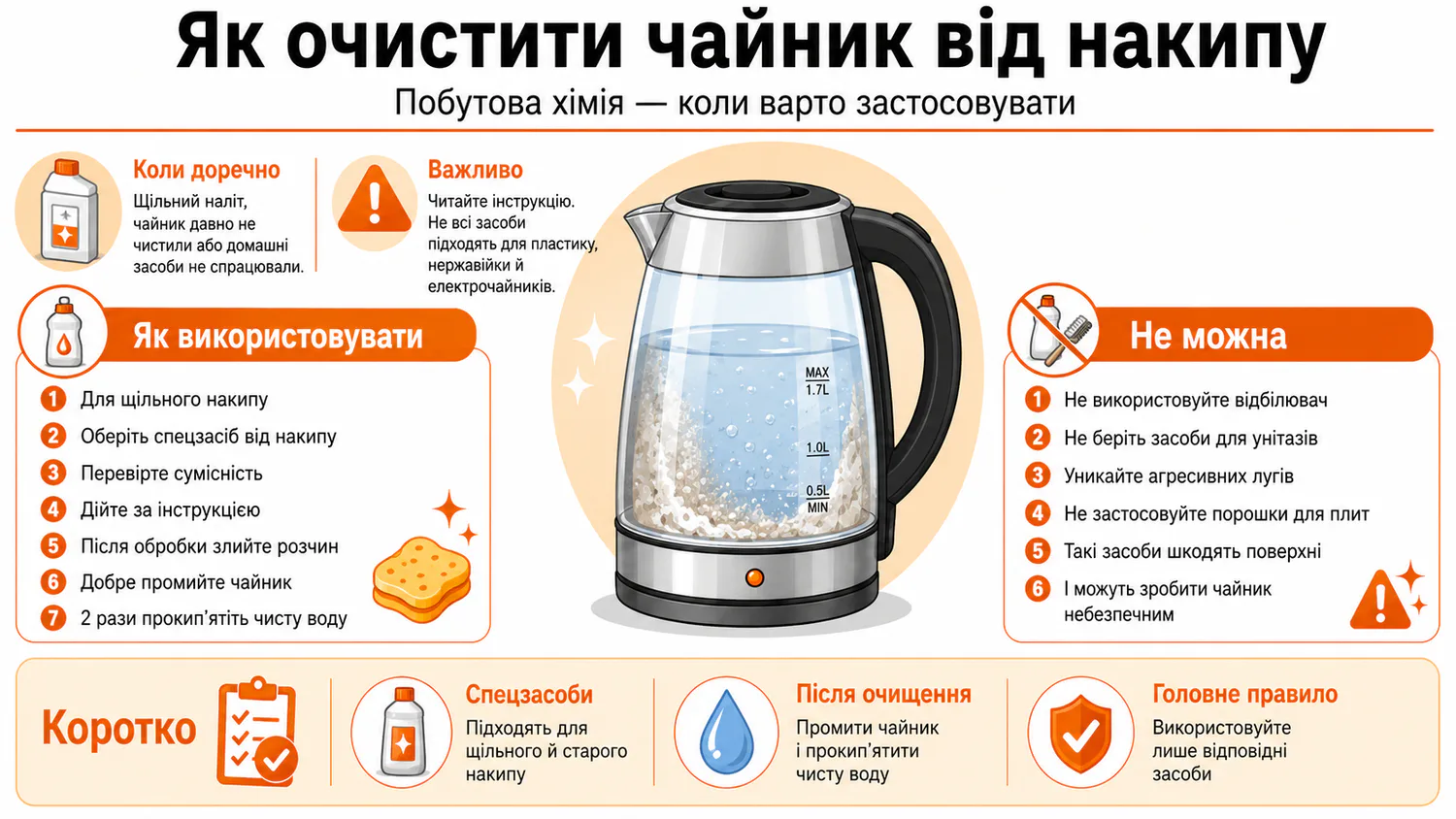
Special anti-limescale products are advisable to use if the deposit is dense, the kettle has not been cleaned for a long time, or home methods have not yielded results. Such products usually contain acids that quickly dissolve deposits.
Before use, you must carefully read the manufacturer's instructions. Not all products are suitable for plastic, stainless steel, or electric kettles with a concealed heating element. After treatment, the kettle should be rinsed several times and clean water boiled in it.
Do not use bleaches, toilet bowl cleaners, aggressive alkaline cleaners, or stove powders. This will not speed up cleaning but can damage the utensil and make it unsafe for use.
How to clean a stainless steel and plastic kettle
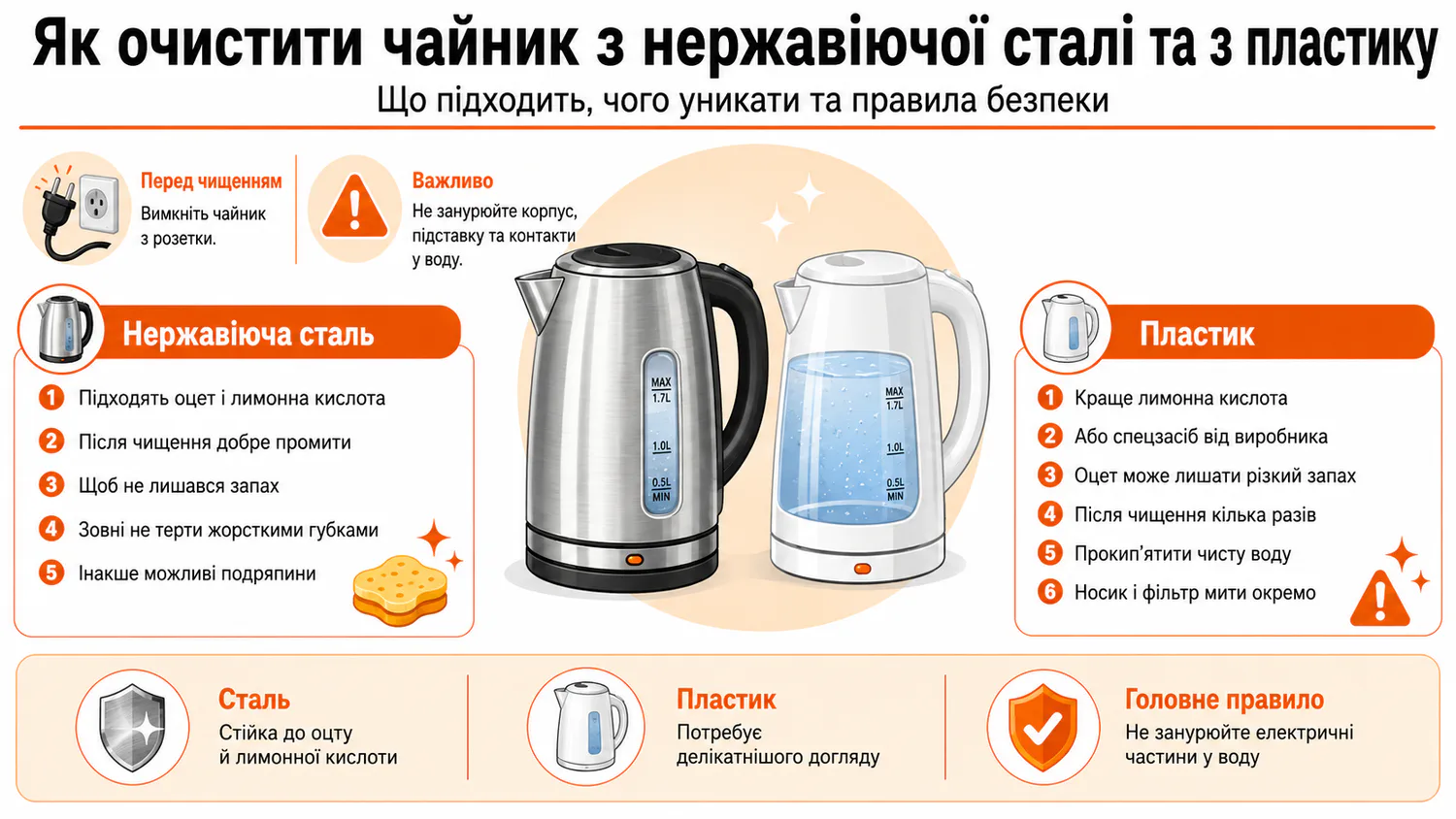
Stainless steel kettles generally tolerate cleaning with citric acid or vinegar well, but after the procedure they must be thoroughly rinsed to avoid lingering odor. The outer surface should not be scrubbed with hard sponges, as scratches may appear on the steel.
Plastic electric kettles require more careful maintenance. For them, it is better to choose citric acid or special products approved by the manufacturer. Vinegar can leave a strong odor that takes longer to dissipate from plastic. After cleaning, it is advisable to boil a plastic kettle several times with clean water.
Before cleaning, the electric kettle must be unplugged from the socket. Do not immerse the body, base, or electrical contacts in water. If there is limescale near the spout or filter, it is better to rinse these parts separately.
Prevention: how to reduce limescale in the kettle
Completely avoiding limescale is difficult if the water is hard. But its appearance can be slowed down. The simplest way is to use filtered or settled water and not boil the same water many times. After boiling, it is advisable to pour out the remaining water rather than leaving it in the kettle overnight.
The kettle should be rinsed regularly, without waiting for a thick layer of limescale. If the water is very hard, a light cleaning with citric acid can be done once every 2–4 weeks. With moderate hardness, it is enough to clean the kettle about once a month or when noticeable sediment appears at the bottom.
A simple rule also helps: do not boil more water than needed for tea or coffee. Less unnecessary heating means fewer deposits. Regular care helps keep the kettle clean, the water more pleasant to taste, and the appliance itself working longer.
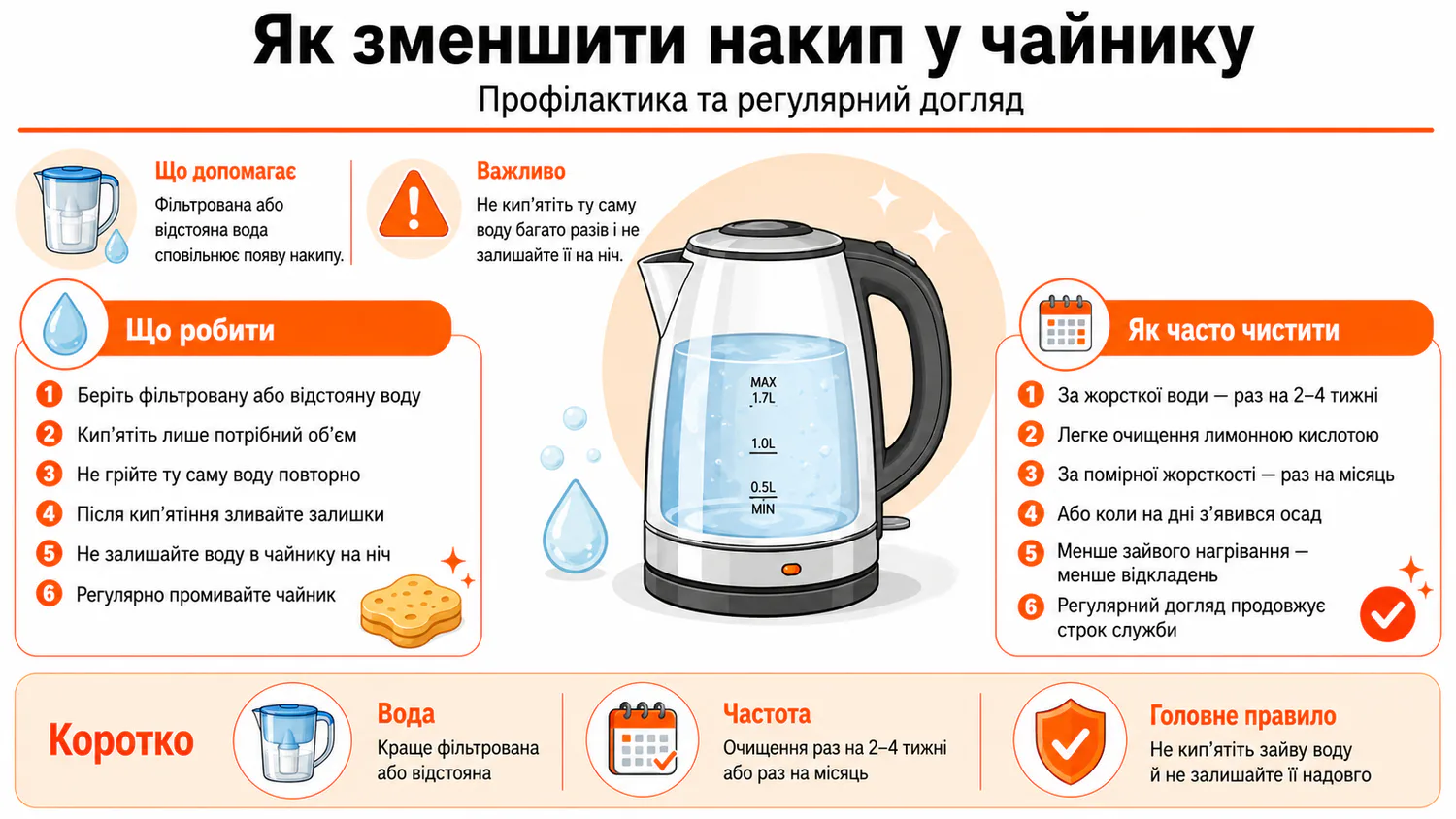
Reminder
Earlier, UNN wrote about how to maintain order at home with minimal effort, thanks to effective micro-habits and thoughtful organization of space.