










How to get land from the state in Ukraine during the war
Kyiv • UNN
In Ukraine, the right to free land acquisition remains, but during martial law, most new transfers are prohibited. Exceptions apply to owners of buildings on plots and destroyed real estate due to Russian aggression.

In Ukraine, the right to receive a land plot free of charge from state or communal ownership formally remains with every citizen of the country. The Land Code determines who can claim a plot and within what limits. However, during wartime, a special ban is in effect on most new free transfers of land into private ownership. Therefore, before starting the procedure, it is necessary to check several important nuances, including the availability of a free plot and the possibility of legally registering it as private property right now.
How to do this, UNN found out.
Who can receive land from the state in 2026
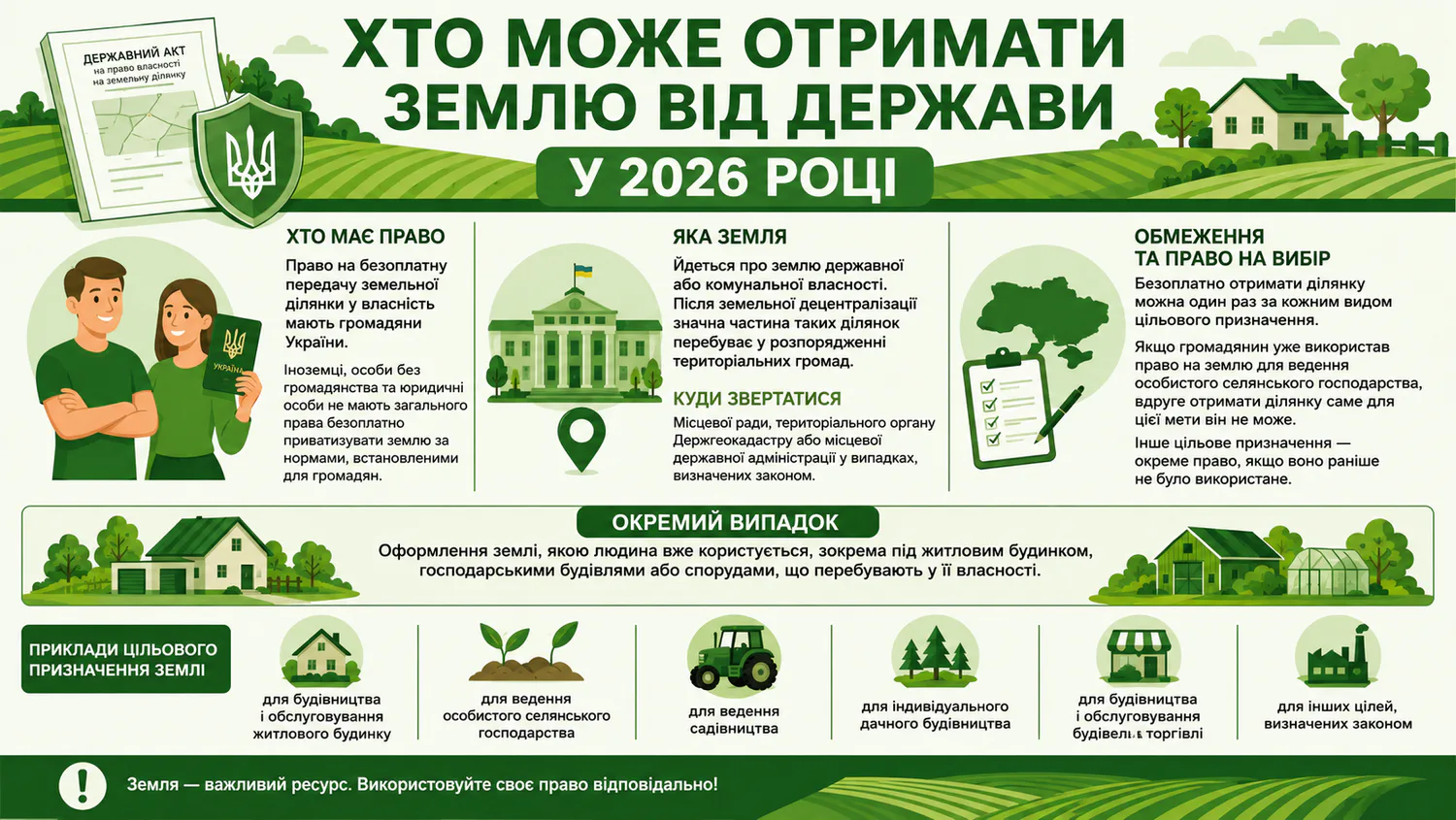
The right to free transfer of a land plot into ownership belongs to citizens of Ukraine. Foreigners, stateless persons, and legal entities do not have the general right to privatize land free of charge under the norms established for citizens.
This refers to land of state or communal ownership. After land decentralization, a significant part of such plots is at the disposal of territorial communities. Therefore, you need to apply to a specific body: the local council, the territorial body of the StateGeoCadastre, or the local state administration in cases determined by law.
You can receive a plot free of charge once for each type of designated purpose. If a citizen has already used the right to land for running a personal peasant farm, they cannot receive a plot for this purpose a second time. A different designated purpose is a separate right, if it has not been used before.
Separate cases include the registration of land that a person is already using, in particular under a residential building, outbuildings, or structures that are in their ownership.
What land plots can be obtained for free
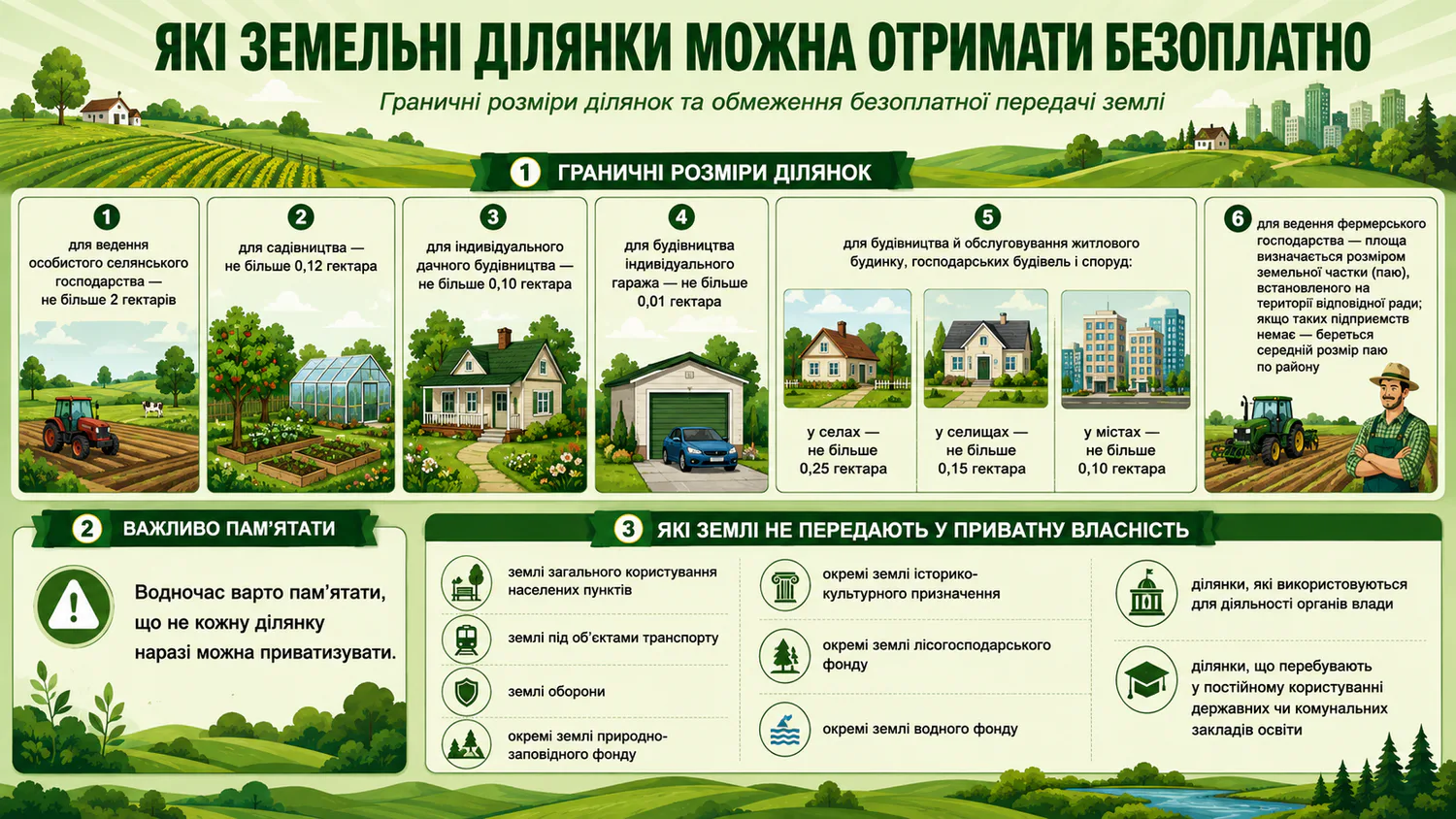
The Land Code determines the maximum sizes of plots that can be transferred to citizens free of charge:
- for running a personal peasant farm — no more than 2 hectares;
- for gardening — no more than 0.12 hectares;
- for individual dacha construction — no more than 0.10 hectares;
- for the construction of an individual garage — no more than 0.01 hectares.
For the construction and maintenance of a residential building, outbuildings, and structures, the size of the plot depends on the type of settlement: in villages it is no more than 0.25 hectares, in settlements — no more than 0.15 hectares, in cities — no more than 0.10 hectares.
For running a farm, the area of the land plot is determined by the size of the land share, i.e., the share established for members of agricultural enterprises on the territory of the relevant council. If there are no such enterprises, the average size of the share in the district is taken for calculation.
At the same time, it is worth remembering that not every plot can currently be privatized.
The following are not transferred into private ownership: public lands of settlements, lands under transport facilities, defense lands, certain lands of the nature reserve, historical-cultural, forestry, and water funds, as well as plots used for the activities of authorities or in permanent use by state or communal educational institutions.
How to submit an application for obtaining a land plot in Ukraine
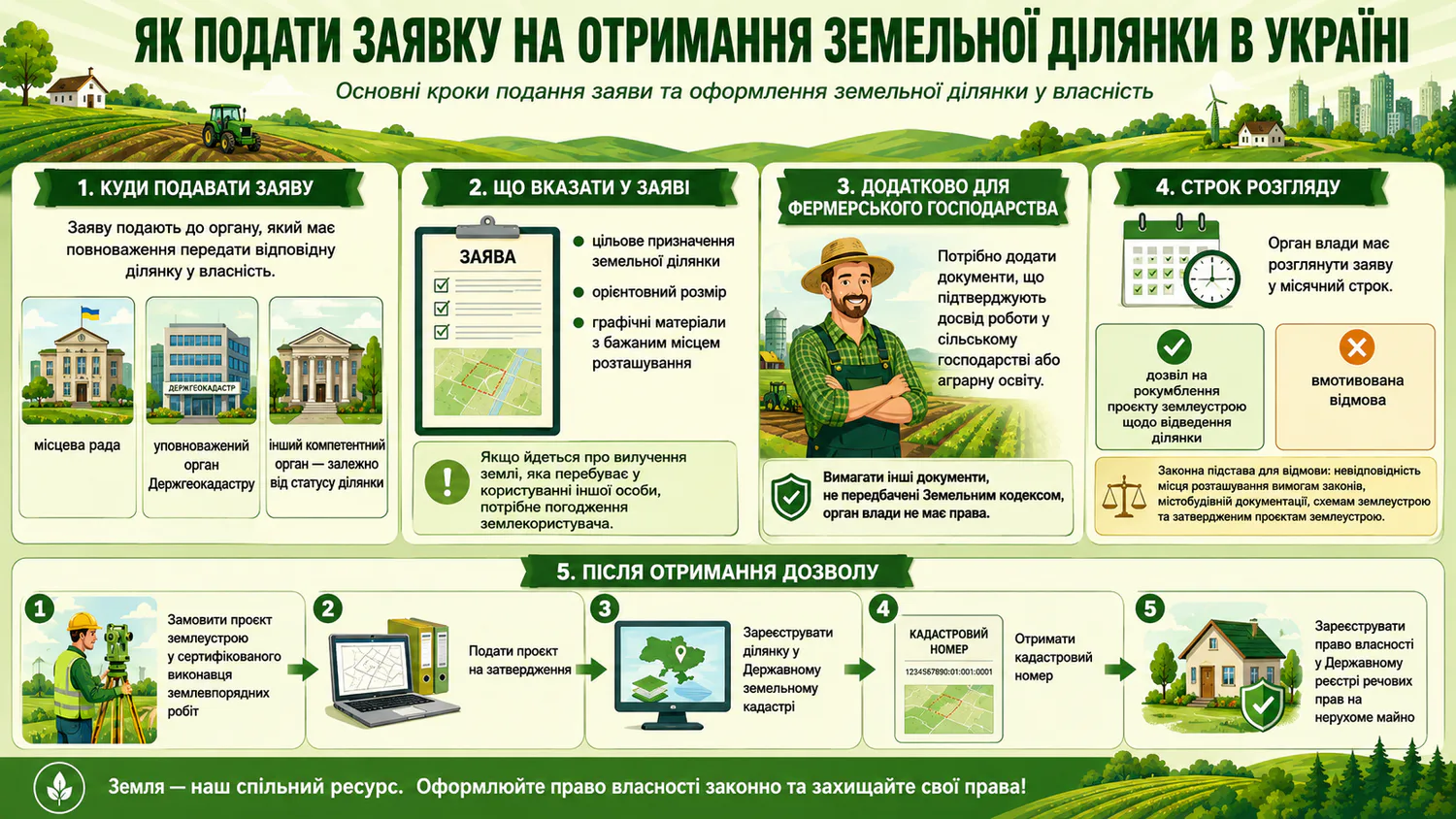
The application is submitted to the body authorized to transfer the relevant plot into ownership. It specifies the designated purpose of the land plot and its approximate size. Graphic materials with the desired location are attached to the application. If it concerns the seizure of land that is in use by another person, the consent of the land user is required.
For land for a farm, documents confirming work experience in agriculture or agricultural education must be attached. The authority has no right to demand other documents not provided for by the Land Code.
The authority must consider the application within a month and grant permission for the development of a land management project for the allocation of the plot or provide a reasoned refusal. A legal basis for refusal at this stage is the non-compliance of the location with the requirements of laws, urban planning documentation, land management schemes, and approved land management projects.
After permission, the citizen orders a land management project from a certified executor of land management works. Then the project is submitted for approval, the plot is registered in the State Land Cadastre, it is assigned a cadastral number, and the ownership right is registered in the State Register of Real Property Rights.
Is it possible to obtain land during martial law
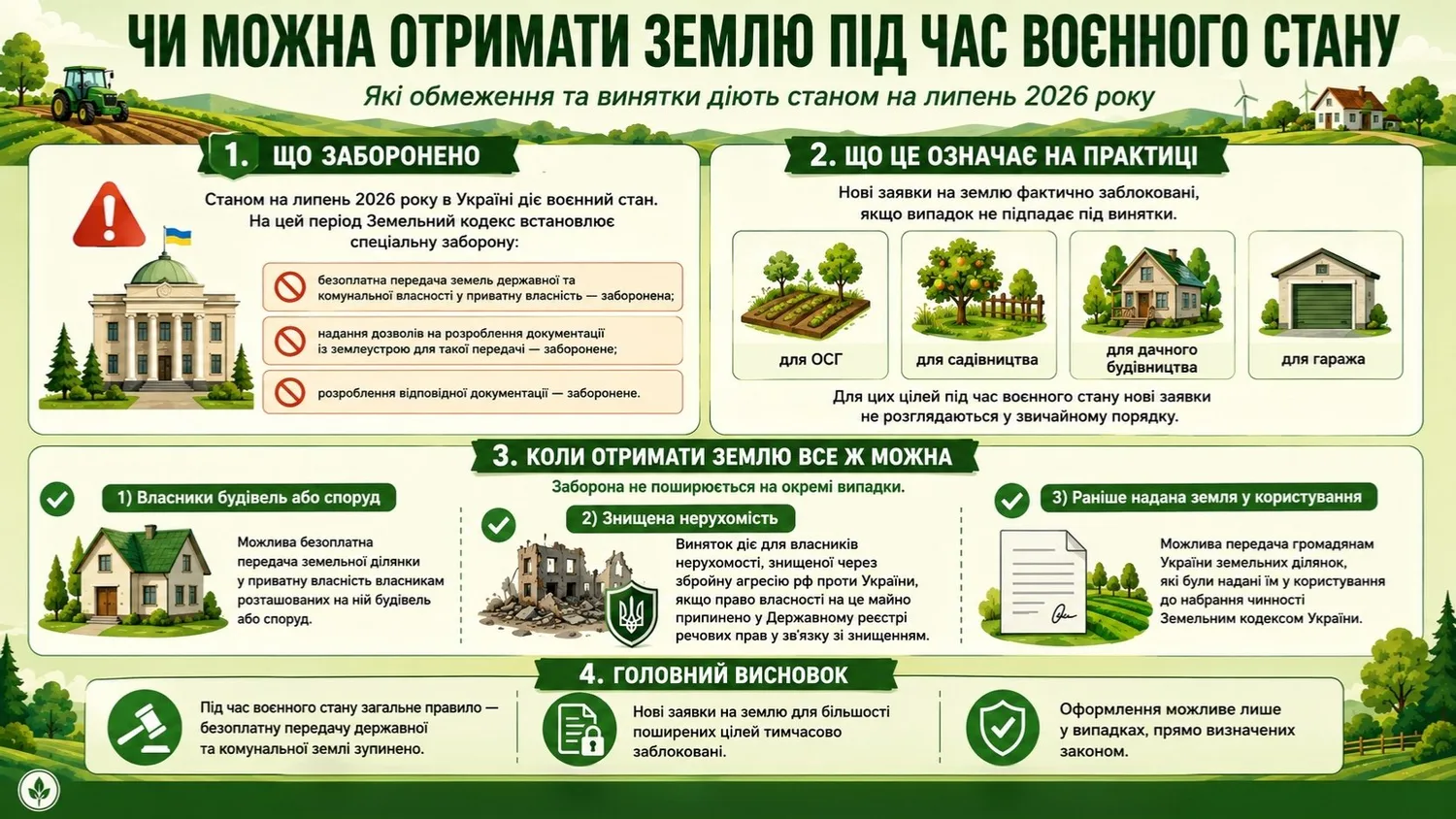
As of July 2026, martial law is in effect in Ukraine. For this period, the Land Code establishes a special ban: the free transfer of state and communal land into private ownership, granting permits for the development of land management documentation for such transfer, and the development of relevant documentation are prohibited.
New applications for land for personal peasant farming, gardening, dacha construction, or a garage are effectively blocked if the case does not fall under exceptions.
However, the ban does not apply to the free transfer of land plots into private ownership to owners of buildings or structures located on them. Also, an exception applies to owners of real estate destroyed due to circumstances caused by the armed aggression of the russian federation against Ukraine, if the ownership right to such property has been terminated in the State Register of Real Property Rights due to its destruction. Another exception is the transfer to citizens of Ukraine of land plots that were provided to them for use before the entry into force of the Land Code of Ukraine.
Stages of registering a land plot into ownership
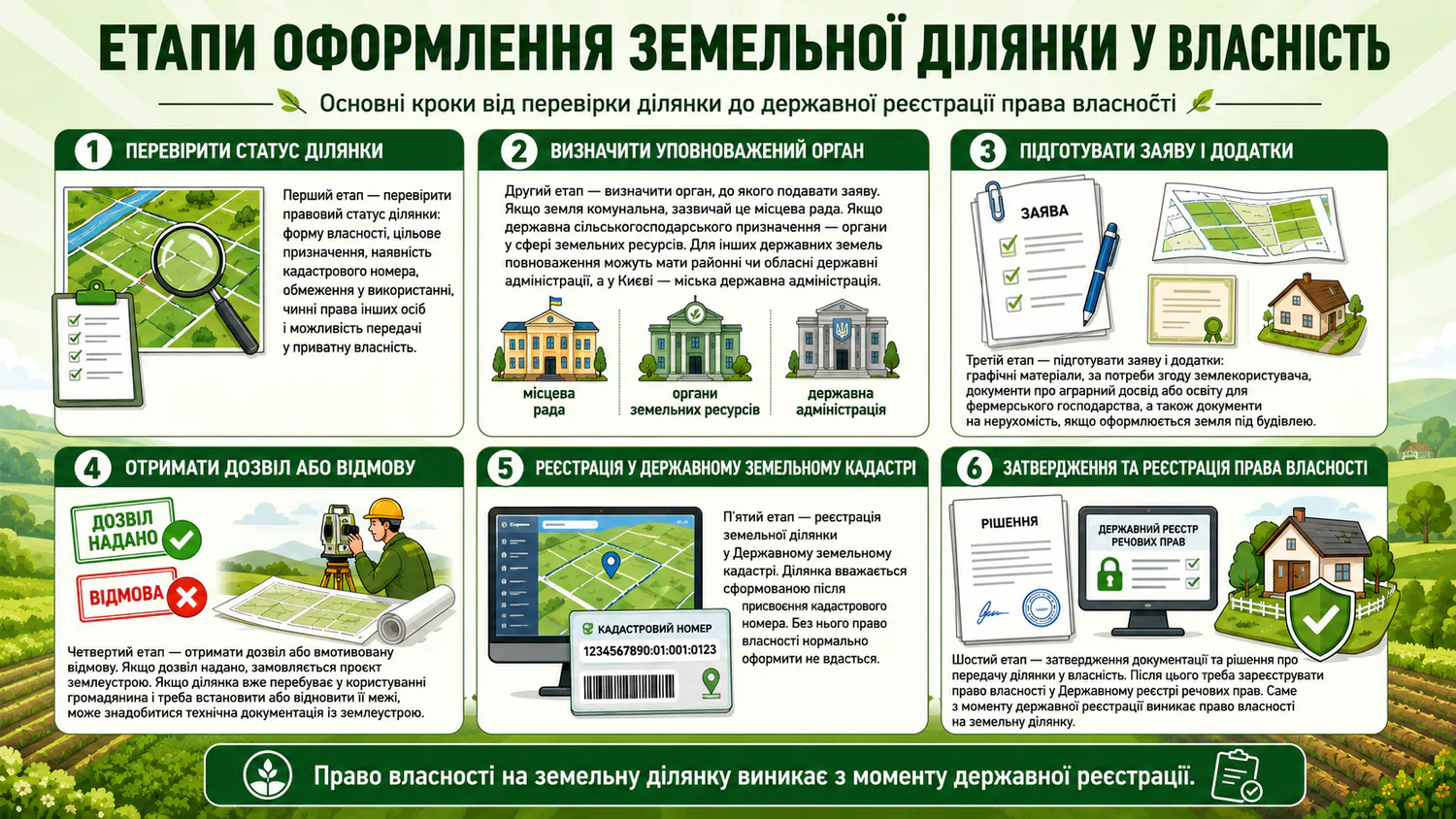
The first stage is to check the legal status of the plot: form of ownership, designated purpose, availability of a cadastral number, restrictions on use, current rights of other persons, and the possibility of transfer into private ownership.
The second stage is to determine the body to which to submit the application. If the land is communal, it is usually the local council. If it is state-owned agricultural land, it is the bodies in the field of land resources. For other state lands, district or regional state administrations may have the authority, and in Kyiv — the city state administration.
The third stage is to prepare the application and attachments: graphic materials, if necessary, the consent of the land user, documents on agricultural experience or education for a farm, as well as documents for real estate if the land under the building is being registered.
The fourth stage is to obtain permission or a reasoned refusal. If permission is granted, a land management project is ordered. If the plot is already in use by the citizen and its boundaries need to be established or restored, technical documentation for land management may be required.
The fifth stage is the registration of the land plot in the State Land Cadastre. The plot is considered formed after the assignment of a cadastral number. Without it, it will not be possible to properly register the ownership right.
The sixth stage is the approval of the documentation and the decision to transfer the plot into ownership. After this, it is necessary to register the ownership right in the State Register of Real Property Rights. The ownership right to the land plot arises from the moment of state registration.
Why and to whom can the provision of a land plot be refused
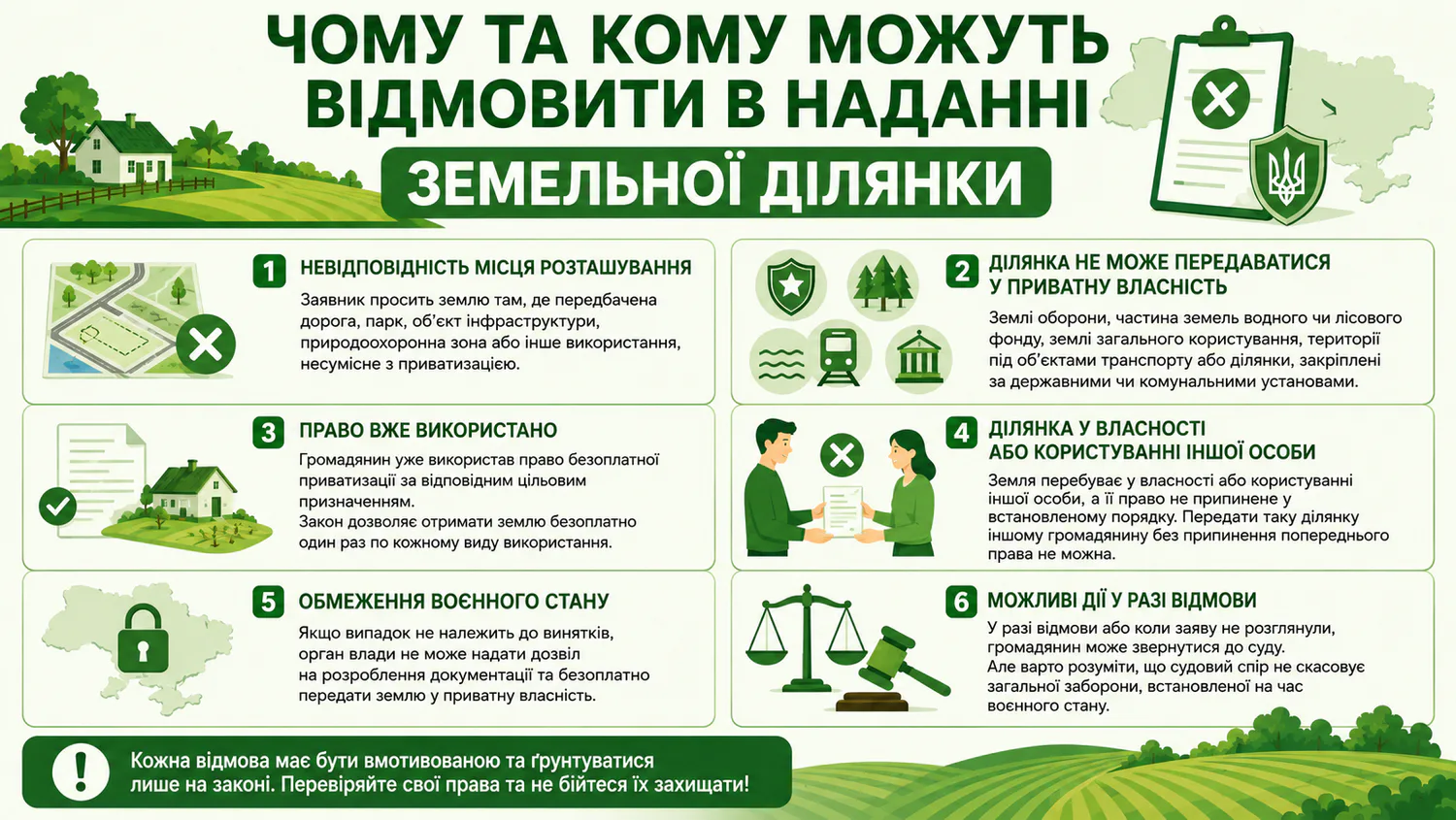
The most common reason is the non-compliance of the plot's location with the requirements of legislation or urban planning documentation. For example, the applicant requests land where a road, park, infrastructure facility, nature protection zone, or other use incompatible with privatization is planned.
The second reason is that the plot belongs to lands that cannot be transferred into private ownership: defense lands, part of water or forest fund lands, public lands, territories under transport facilities, or plots assigned to state or communal institutions.
The third reason is that the citizen has already used the right to free privatization for the corresponding designated purpose. The law allows receiving land free of charge once for each type of use, and not unlimitedly, as some optimistic advisors sometimes hint.
The fourth reason is that the land is owned or used by another person, and their right has not been terminated in the established manner. It is impossible to transfer such a plot to another citizen without terminating the previous right.
The fifth reason is the restrictions of martial law. If the case does not belong to the exceptions, the authority cannot grant permission for the development of documentation and transfer the land free of charge into private ownership.
In case of refusal or if the application was not considered, the citizen can go to court. But it is worth understanding that a court dispute does not cancel the general ban established during martial law.
Reminder
Earlier, UNN wrote about when a zero tax applies during the sale of an apartment, car, or land, and when you will have to pay up to 23%.